Education Access System (EAS): A Low-Latency Learning System for Low-Bandwidth Education Access
Keywords:
Low-Bandwidth Learning, Learning Management System (LMS), Digital Divide, EAS, Low-Latency Education, SDG 4, React-Node-MongoDB StackAbstract
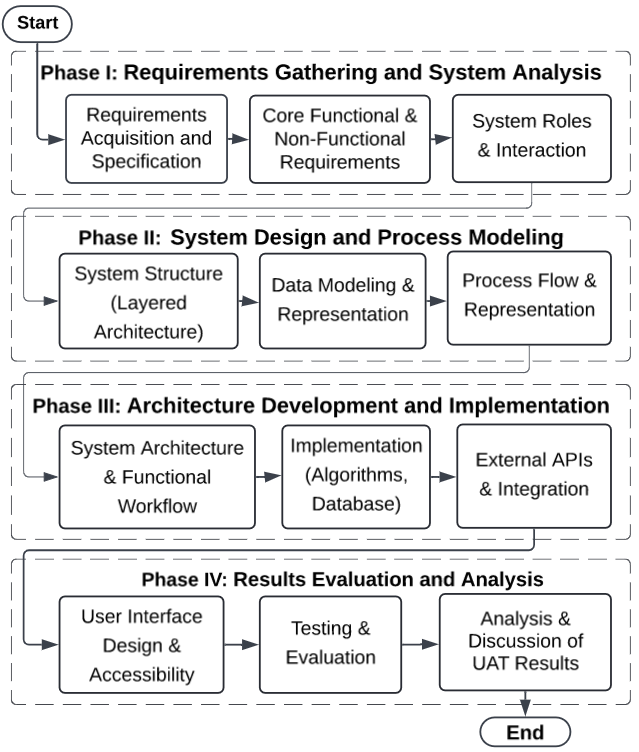
Online learning worldwide requires well-performing Learning Management Systems (LMS); however, most web-based application packages have no opportunities to execute their task in the low-bandwidth areas due to the infrastructure factor, the absence of digital literacy, and the barriers of institutions. It applies this digital divide to the countryside and the developing world and limits access to quality education. Existing LMS systems such as Moodle and Blackboard are designed to support high-bandwidth systems, and they are not applicable in locations where 2G/3G is the predominant network. This gap can be addressed by a low-bandwidth, lightweight, and low-latency LMS named Education Access System (EAS), which is developed, engineered, and tested in this research project. It also worked through four phases of methodology: requirement analysis and stakeholder mapping, data analysis and system architecture built upon a layered architecture, implementation of the application using React, node.js, MongoDB, and optimized APIs, and assessment of the project via manual/automated testing and User Acceptance Testing (UAT) with students. The findings show login and usable databases, 95.8% respondents had improved learning with the platform, but valid performance under the simulated conditions of a 2G/3G (100-500 kbps) was still simulated (low forum interaction 12.5%). EAS explains how LMS optimization solutions can be used to the advantage of equitable digital education, comprising SDG 4, and how the future will center on mobile deployment, offline adaptations, and long-term collaborative capabilities.
References
W. N. Jean Baptiste Mushimiyimana, “ICT Integration in Rwandan Education: A Scoping Review of Opportunities and Challenges,” African J. Empir. Res., vol. 6, no. 1, 2025, [Online]. Available: https://ajernet.net/ojs/index.php/ajernet/article/view/956
H. A. E.-S. & D. M. E. Hosnia M. M. Ahmed, “Effect of Gamified, Mobile, Cloud-Based Learning Management System (GMCLMS) on student engagement and achievement,” Int. J. Educ. Technol. High. Educ., vol. 22, no. 49, 20251, doi: https://doi.org/10.1186/s41239-025-00541-1.
A. A. A. Taha Abuali, “Challenges and Opportunities in Implementing E-Learning in Developing Countries,” Open Eur. J. Soc. Sci. Educ., vol. 1, no. 1, 20251, [Online]. Available: https://easdjournals.com/index.php/oejsse/article/view/2
Y. Assefa, M. M. Gebremeskel, B. T. Moges, S. A. Tilwani, and Y. A. Azmera, “Rethinking the digital divide and associated educational in(equity) in higher education in the context of developing countries: the social justice perspective,” Int. J. Inf. Learn. Technol., vol. 42, no. 1, pp. 15–32, Jan. 2025, doi: 10.1108/IJILT-03-2024-0058.
D. Gh.a., montazer b., “Evaluating E-Learning Readiness In The Iranian Universities,” vol. 4, no. 3, pp. 181–190, Jan. 2010, Accessed: Dec. 24, 2025. [Online]. Available: https://sid.ir/paper/155498/en
“E-Readiness Assessment Model for Low Bandwidth Environment | Download Scientific Diagram.” Accessed: Dec. 24, 2025. [Online]. Available: https://www.researchgate.net/figure/E-Readiness-Assessment-Model-for-Low-Bandwidth-Environment_fig1_280935086
“New technologies for teaching and learning: challenges for higher learning institutions in developing countries. IN: Mukherjee, D. (ed) Information and Communication Technology: Changing Education.” Accessed: Dec. 24, 2025. [Online]. Available: https://www.researchgate.net/publication/225188696_New_technologies_for_teaching_and_learning_challenges_for_higher_learning_institutions_in_developing_countries_IN_Mukherjee_D_ed_Information_and_Communication_Technology_Changing_Education
R. Boateng et al., “Advancing E-Commerce Beyond Readiness in a Developing Country: Experiences of Ghanaian Firms,” https://services.igi-global.com/resolvedoi/resolve.aspx?doi=10.4018/978-1-4666-3622-4.ch001, pp. 1–17, Jan. 1AD, doi: 10.4018/978-1-4666-3622-4.CH001.
M. B. K. Sameer Qazi, “AI-Driven Learning Management Systems: Modern Developments, Challenges and Future Trends during the Age of ChatGPT,” Comput. Mater. Contin., vol. 80, no. 2, pp. 3289–3314, 2024, doi: https://doi.org/10.32604/cmc.2024.048893.
N. K. Sanobar Shadmanova, “Ensuring the Security of an Internet-based E-learning System through the Use of Integrated Encryption Methods,” J. Internet Serv. Inf. Secur., 2024, [Online]. Available: https://jisis.org/wp-content/uploads/2024/12/2024.I4.024.pdf
“Optimizing Interactive Learning Management System (LMS) in Improving Students’ English Language Skills | Zabags International Journal of Education.” Accessed: Dec. 24, 2025. [Online]. Available: https://e.journal.zabagsqupublish.com/zijed/index.php/zijed/article/view/21
T. T. Sulaiman, “A systematic review on factors influencing learning management system usage in Arab gulf countries,” Educ. Inf. Technol. 2023 292, vol. 29, no. 2, pp. 2503–2521, Jun. 2023, doi: 10.1007/S10639-023-11936-W.
S. Dhepe, P. Gebise, D. Lothe, and S. Pawar, “A Real-Time Monitoring System for User Attentivity on e-learning platforms,” Proc. - 2025 5th Int. Conf. Expert Clouds Appl. ICOECA 2025, pp. 843–851, 2025, doi: 10.1109/ICOECA66273.2025.00149.
A. D. Samuel-Okon and O. Abejide, “Bridging the Digital Divide: Exploring the Role of Artificial Intelligence and Automation in Enhancing Connectivity in Developing Nations,” SSRN Electron. J., May 2024, doi: 10.2139/SSRN.4839447.
M. W. R. Anaile Rabelo, “Educational data mining and learning analytics: a review of educational management in e-learning,” Inf. Discov. Deliv., vol. 52, no. 2, pp. 149–163., 2024, doi: https://doi.org/10.1108/IDD-10-2022-0099.
A. R. Liza Husnita, “The Role of Mobile Technology in Improving Accessibility and Quality of Learning,” al-fikrah J. Manaj. Pendidik., vol. 11, no. 2, p. 259, 20231, doi: 10.31958/jaf.v11i2.10548.
K. A. Kadir, N. H. A. Wahab, M. S. Sunar, and S. Z. Harun, “Enhancing Virtual Reality Education with Low-Bandwidth 360-Degree Video,” 2024 20th IEEE Int. Colloq. Signal Process. Its Appl. CSPA 2024 - Conf. Proc., pp. 260–263, 2024, doi: 10.1109/CSPA60979.2024.10525516.
G. M. Sadia Jamil, “The COVID-19 Pandemic and E-Learning: The Digital Divide and Educational Crises in Pakistan’s Universities,” Am. Behav. Sci., vol. 68, no. 9, p. 00027642231156779, 2023, doi: 10.1177/00027642231156779.
N. D. D. Carlos David Barranco González, “Optimizing Education with Data Analytics: A Feature Comparison of LMS and SIS,” Preprints, 2024, [Online]. Available: https://www.preprints.org/manuscript/202405.0459
H. L. Jianfa Guo, “Optimization and Management of Communication Technology in Smart Education Environments,” J. Educ. Humanit. Soc. Res., vol. 2, no. 2, 2025, [Online]. Available: https://www.gbspress.com/index.php/JEHSR/article/view/221
M. F. Sedef Sezgin, “Exploring the Digital Divide in Open Education: A Comparative Analysis of Undergraduate Students,” Int. Rev. Res. Open Distrib. Learn., vol. 25, no. 1, 2024, [Online]. Available: https://www.irrodl.org/index.php/irrodl/article/view/7236
A. Huma, “The Digital Divide: A case of Distance Education in Pakistan,” Int. J. Distance Educ. E-Learning, vol. 9, no. 2, pp. 57–68, Jun. 2024, doi: 10.36261/IJDEEL.V9I2.3347.
H. S. Abayomi Agbeyangi, “Advances and Challenges in Low-Resource-Environment Software Systems: A Survey,” Informatics, vol. 11, no. 4, p. 90, 2024, doi: https://doi.org/10.3390/informatics11040090.
A. Turcotte, S. Gokhale, and F. Tip, “Increasing the Responsiveness of Web Applications by Introducing Lazy Loading,” Proc. - 2023 38th IEEE/ACM Int. Conf. Autom. Softw. Eng. ASE 2023, pp. 459–470, 2023, doi: 10.1109/ASE56229.2023.00192.
M. F. Dedi Kuswandi, “Implementation of personalized approach in video editing learning to improve digital competency of 21st century learners,” Cahaya Pendidik., vol. 11, no. 1, 2025, [Online]. Available: https://www.journal.unrika.ac.id/index.php/journalcahayapendidikan/article/view/7482
W. P. da C. Elaine Santana Silva, “Contribution of Microlearning in Basic Education: A Systematic Review,” Educ. Sci, vol. 15, no. 3, p. 302, 2025, doi: https://doi.org/10.3390/educsci15030302.
N. Adel, “The impact of digital literacy and technology adoption on financial inclusion in Africa, Asia, and Latin America,” Heliyon, vol. 10, no. 24, 2024, [Online]. Available: https://www.cell.com/heliyon/fulltext/S2405-8440(24)16982-4?_returnURL=https%3A%2F%2Flinkinghub.elsevier.com%2Fretrieve%2Fpii%2FS2405844024169824%3Fshowall%3Dtrue
I. O. A. Viktoriia V. Sydorenko, “Improvement of higher education: how to bridge the digital divide during the transformation?,” J. Educ. Learn., vol. 18, no. 3, 2024, [Online]. Available: https://edulearn.intelektual.org/index.php/EduLearn/article/view/21078
B. A. V. Kathiravan Ravichandran, “Moving towards a Blended Tomorrow: The Evolution of EdTech in Education,” Libr. Prog. Int., vol. 44, no. 3, 2024, doi: https://doi.org/10.48165/bapas.2024.44.2.1.
K. M. Siyabonga Mhlongo, “Challenges, opportunities, and prospects of adopting and using smart digital technologies in learning environments: An iterative review,” Heliyon, vol. 9, no. 6, p. e16348, 2023, [Online]. Available: https://www.cell.com/heliyon/fulltext/S2405-8440(23)03555-7?_returnURL=https%3A%2F%2Flinkinghub.elsevier.com%2Fretrieve%2Fpii%2FS2405844023035557%3Fshowall%3Dtrue
S. Z. Raja Bahar Khan Soomro, “Assessing Teacher Training Quality and Student Learning Outcomes in North Sindh Secondary Schools: A Case Study,” Res. Sq., vol. 4, 2025, [Online]. Available: https://www.researchsquare.com/article/rs-6487278/v1
J. S. & R. H. Usama Kalim, Asha Kanwar, “Barriers to AI adoption for women in higher education: a systematic review of the Asian context,” Smart Learn. Environ., vol. 12, no. 38, 2025, doi: https://doi.org/10.1186/s40561-025-00390-5.
A. G. De Siqueira, “Toward New Ecologies of Cyberphysical Representational Forms, Scales, and Interaction Modalities,” TEI 2019 - Proc. 13th Int. Conf. Tangible, Embed. Embodied Interact., 2019, [Online]. Available: https://dl.acm.org/doi/10.1145/3294109.3302960
H. Schwarz, D. Marpe, and T. Wiegand, “Overview of the scalable video coding extension of the H.264/AVC standard,” IEEE Trans. Circuits Syst. Video Technol., vol. 17, no. 9, pp. 1103–1120, Sep. 2007, doi: 10.1109/TCSVT.2007.905532.
I. Sodagar, “The MPEG-dash standard for multimedia streaming over the internet,” IEEE Multimed., vol. 18, no. 4, pp. 62–67, Oct. 2011, doi: 10.1109/MMUL.2011.71.
G. J. Conklin, G. S. Greenbaum, K. O. Lillevold, A. F. Lippman, and Y. A. Reznik, “Video coding for streaming media delivery on the internet,” IEEE Trans. Circuits Syst. Video Technol., vol. 11, no. 3, pp. 269–281, Mar. 2001, doi: 10.1109/76.911155.
Thyagharajan K K, Vadivelan Ramachandran, “Performance Analysis of Media Transmission through Low Bandwidth Networks,” Natl. Conf. Signal Process. Intell. Syst. Netw., 2003, [Online]. Available: https://www.researchgate.net/publication/280383861_Performance_Analysis_of_Media_Transmission_through_Low_Bandwidth_Networks
A. F. Lim, K. B. Ooi, G. W. H. Tan, T. H. Cham, M. A. A. Alryalat, and Y. K. Dwivedi, “Adapt or die: a competitive digital supply chain quality management strategy,” J. Enterp. Inf. Manag., vol. 37, no. 2, pp. 698–720, Apr. 2024, doi: 10.1108/JEIM-09-2022-0345.
Downloads
Published
How to Cite
Issue
Section
License
Copyright (c) 2025 50sea

This work is licensed under a Creative Commons Attribution 4.0 International License.