A Framework for the Prediction of Parkinson’s Disease Using Agentic Artificial Intelligence
Keywords:
Parkinson’s Disease, Agentic Artificial Intelligence, Machine Learning, Voice Biomarkers, Early Detection, Clinical Decision SupportAbstract
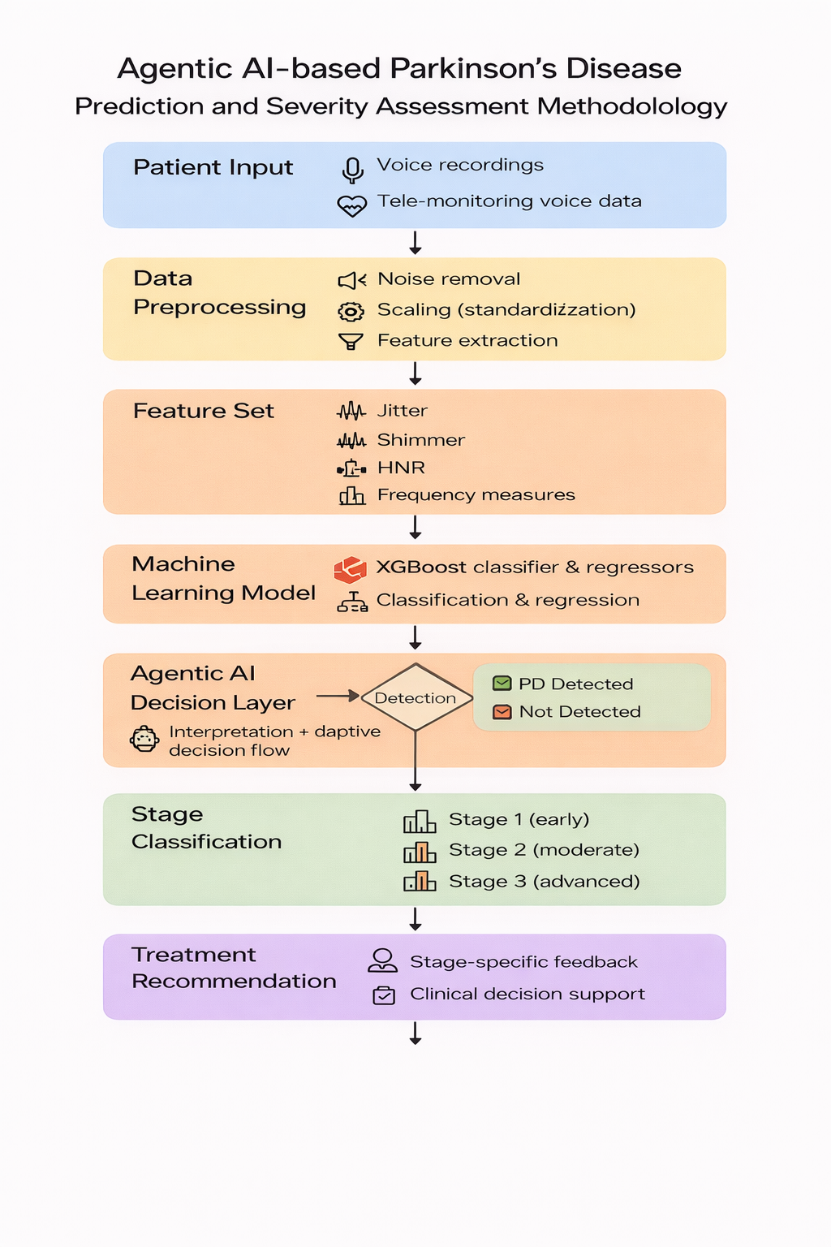
Parkinson’s disease (PD) is a progressive neurodegenerative disorder that is difficult to diagnose, particularly in its early stages. Subtle, slowly evolving symptoms often delay confirmation, reducing opportunities for timely intervention that could improve outcomes and quality of life. Conventional diagnosis relies largely on clinical observation, which can be subjective and insufficiently sensitive for early detection. This thesis proposes an Agentic Artificial Intelligence (AAI) framework for early PD detection and severity assessment using voice-based biomarkers. Biomedical voice parameters are leveraged because vocal changes can reflect early neurological impairment. Two publicly available Kaggle datasets containing voice recordings from individuals with PD and healthy controls are used to train and evaluate the models. For detection, an XGBoost classifier achieves 94.68% accuracy with strong discriminative performance. For severity estimation, XGBoost regression models predict motor and total Unified Parkinson’s Disease Rating Scale (UPDRS) scores with high agreement to clinically reported measurements. A key contribution is an agentic decision-making layer that autonomously interprets model outputs, performs disease staging, and generates stage-dependent monitoring and treatment recommendations. Unlike conventional predictive pipelines that stop at numerical outputs, the proposed system translates predictions into actionable clinical insights to support structured decision-making. Experimental results indicate that the framework can detect PD and estimate severity effectively from non-invasive voice data, highlighting the potential of AAI for earlier diagnosis, personalized monitoring, and intelligent clinical decision support in healthcare. The multi-layer design supports modular updates to models and agent policies, enabling telehealth deployment and longitudinal tracking as additional voice samples become available over time.
References
S. R. Subash Neupane, Sudip Mittal, “Towards a HIPAA Compliant Agentic AI System in Healthcare,” arXiv:2504.17669, 2025, doi: https://doi.org/10.48550/arXiv.2504.17669.
C. C. Jennifer A. Foley, “A Bayesian predictive processing account of Othello syndrome in Parkinson’s disease,” Cogn. Neuropsychiatry, vol. 28, no. 4, 2023, doi: https://doi.org/10.1080/13546805.2023.2229080.
C. D. Jie Mei, “Machine Learning for the Diagnosis of Parkinson’s Disease: A Review of Literature,” Front. Aging Neurosci., vol. 13, 2011, doi: https://doi.org/10.3389/fnagi.2021.633752.
T. Tabashum, R. C. Snyder, M. K. O’Brien, and M. V Albert, “Machine Learning Models for Parkinson Disease: Systematic Review.,” JMIR Med. informatics, vol. 12, no. 1, p. e50117, May 2024, doi: 10.2196/50117.
R. Dawadi, M. Inoue, J. T. Tay, A. Martin-Morales, T. Vu, and M. Araki, “Disease Prediction Using Machine Learning on Smartphone-Based Eye, Skin, and Voice Data: Scoping Review.,” JMIR AI, vol. 4, no. 1, p. e59094, Mar. 2025, doi: 10.2196/59094.
J. D. A.-L. Emiro J. Ibarra, “Towards a Corpus (and Language)-Independent Screening of Parkinson’s Disease from Voice and Speech through Domain Adaptation,” Bioengineering, vol. 10, no. 11, p. 1316, 2023, doi: https://doi.org/10.3390/bioengineering10111316.
M. A. William Tam, “An Exploration of Wearable Device Features Used in UK Hospital Parkinson Disease Care: Scoping Review,” J Med Internet Res, 2023, [Online]. Available: https://www.jmir.org/2023/1/e42950
L. P. Rebecca Ting Jiin Loo, “Interpretable Machine Learning for Cross-Cohort Prediction of Motor Fluctuations in Parkinson’s Disease,” Mov. Disord., 2025, doi: https://doi.org/10.1002/mds.30223.
S. Begum, T. M. Singh, F. A. Khan, and S. Doss, “AI in Personalized Medicine: Redefining Healthcare Through Agentic Intelligence,” pp. 41–57, 2025, doi: 10.1007/978-3-031-89424-4_4.
W. R. Md Saiful Islam, “Using AI to measure Parkinson’s disease severity at home,” npj Digit. Med., vol. 6, no. 1, 2023, doi: https://doi.org/10.1038/s41746-023-00905-9.
K. R. S. Priyadharshini, “A Comprehensive framework for Parkinson’s disease diagnosis using explainable artificial intelligence empowered machine learning techniques,” Alexandria Eng. J., vol. 107, pp. 568–582, 2024, doi: https://doi.org/10.1016/j.aej.2024.07.106.
K. M. Belinda Ndlovu, “Machine Learning and Explainable AI for Parkinson’s Disease Prediction: A Systematic Review,” Indones. J. Comput. Sci., 2025, [Online]. Available: http://ijcs.net/ijcs/index.php/ijcs/article/view/4837
K. R. K. Hirak Mazumdar, “Soft Robotics for Parkinson’s Disease Supported by Functional Materials and Artificial Intelligence,” BME Front., vol. 6, 2025, [Online]. Available: https://spj.science.org/doi/10.34133/bmef.0143
M. D. Gina Wieringa, “Adjusting to living with Parkinson’s disease; a meta-ethnography of qualitative research,” Disabil. Rehabil., 2022, [Online]. Available: https://www.tandfonline.com/doi/full/10.1080/09638288.2021.1981467
A. M. C. Morgan Senter, “Experiences of people living with Parkinson’s disease and key stakeholders in dance-based programs: a systematic review and meta-ethnography,” Disabil. Rehabil., vol. 46, no. 26, 2024, doi: https://doi.org/10.1080/09638288.2024.2327499.
S. S. Mashrur Rashik, “AI-Enabled Conversational Journaling for Advancing Parkinson’s Disease Symptom Tracking,” Conf. Hum. Factors Comput. Syst. - Proc., 2025, [Online]. Available: https://dl.acm.org/doi/10.1145/3706598.3714280
K. R. S. Saravanan, “Explainable Artificial Intelligence (EXAI) Models for Early Prediction of Parkinson’s Disease Based on Spiral and Wave Drawings,” IEEE Access, 2023, [Online]. Available: https://ieeexplore.ieee.org/document/10171347
O. B. Peng Li-Hua, Lamarana Jallow, Yurong Tan, “Precision medicine and music therapy for Parkinson’s Disease,” Clin. Park. Relat. Disord., vol. 13, p. 100382, 2025, [Online]. Available: https://www.sciencedirect.com/science/article/pii/S2590112525000866?via%3Dihub
S. M. R. A. & M. P. Mahboube Sadat Hosseini, “Cross-regional radiomics: a novel framework for relationship-based feature extraction with validation in Parkinson’s disease motor subtyping,” BioData Min., vol. 18, no. 67, 2025, doi: https://doi.org/10.1186/s13040-025-00483-4.
M. F. Kensuke Daida, “Long-Read Sequencing Resolves a Complex Structural Variant in PRKN Parkinson’s Disease,” Mov. Disord., 2023, doi: https://doi.org/10.1002/mds.29610.
Z. L. Elaine G.Y. Chew, “Exome sequencing in Asian populations identifies low-frequency and rare coding variation influencing Parkinson’s disease risk,” Nat. Aging, 2024, [Online]. Available: https://www.nature.com/articles/s43587-024-00760-7
I. P. & Y. I. Meltem Ece Kars, Yiming Wu, Peter D. Stenson, David N. Cooper, Johan Burisch, “The landscape of rare genetic variation associated with inflammatory bowel disease and Parkinson’s disease comorbidity,” Genome Med., vol. 16, no. 66, 2024, doi: https://doi.org/10.1186/s13073-024-01335-2.
D. V. Jennifer G. Goldman, “Delivering Multidisciplinary Rehabilitation Care in Parkinson’s Disease: An International Consensus Statement,” J. Parkinsons. Dis., vol. 4, no. 1, 2024, [Online]. Available: https://journals.sagepub.com/doi/10.3233/JPD-230117
M. B. Cristina Gonzalez-Robles, “Embedding Patient Input in Outcome Measures for Long-Term Disease-Modifying Parkinson Disease Trials,” Mov. Disord., 2024, [Online]. Available: https://movementdisorders.onlinelibrary.wiley.com/doi/10.1002/mds.29691
A. and Neurology, “AI and Neurology,” Neurol. Res. Pract., vol. 7, no. 11, 2025, doi: https://doi.org/10.1186/s42466-025-00367-2.
W. P. Roongroj Bhidayasiri, “Management of dysphagia and gastroparesis in Parkinson’s disease in real-world clinical practice – Balancing pharmacological and non-pharmacological approaches,” Front. Aging Neurosci., 2022, [Online]. Available: https://www.frontiersin.org/journals/aging-neuroscience/articles/10.3389/fnagi.2022.979826/full
F. B. Panying Rong, “Leveraging the Potential of Digital Technology for Better Individualized Treatment of Parkinson’s Disease,” Front. Neurol., 2022, [Online]. Available: https://www.frontiersin.org/journals/neurology/articles/10.3389/fneur.2022.788427/full
“Parkinson’s disease - Symptoms and causes - Mayo Clinic.” Accessed: Dec. 22, 2025. [Online]. Available: https://www.mayoclinic.org/diseases-conditions/parkinsons-disease/symptoms-causes/syc-20376055
“Parkinsons Telemonitoring - UCI Machine Learning Repository.” Accessed: Dec. 22, 2025. [Online]. Available: https://archive.ics.uci.edu/dataset/189/parkinsons+telemonitoring
M. Wilken et al., “Neurophysiological Analysis of the Posterior Subthalamic Area in a Patient with Holmes’ Tremor,” Mov. Disord., vol. 39, no. 3, pp. 623–625, Mar. 2024, doi: 10.1002/MDS.29705;CTYPE:STRING:JOURNAL.
B. L. Jingzhao Chen, “Abnormal behavior detection in industrial control systems based on CNN,” Alexandria Eng. J., vol. 107, pp. 643–651, 2024, doi: https://doi.org/10.1016/j.aej.2024.08.109.
M. T. Elie Matar, “Functional Movement Disorder as a Prodromal Symptom of Parkinson’s Disease—Clinical and Pathophysiological Insights,” Mov. Disord., vol. 39, no. 11, 2024, [Online]. Available: https://movementdisorders.onlinelibrary.wiley.com/doi/10.1002/mds.29958
A. Aljohani, “Late feature fusion using neural network with voting classifier for Parkinson’s disease detection,” BMC Med. Inform. Decis. Mak., vol. 24, 2024, doi: https://doi.org/10.1186/s12911-024-02683-0.
P. A. Moh Afandi, “Diagnosis of Parkinson’s Disease Using Convolutional Neural Network by Hand Drawing Images,” Pre prints, 2023, [Online]. Available: https://www.preprints.org/manuscript/202312.1851
Downloads
Published
How to Cite
Issue
Section
License
Copyright (c) 2025 50sea

This work is licensed under a Creative Commons Attribution 4.0 International License.