Improved Breast Cancer Localization by using Hybrid Approach with Swarm Intelligence and Deep Learning
DOI:
https://doi.org/10.33411/IJIST/1760Keywords:
Breast Cancer, Swarm Intelligence, Bert Pre-Trained, Deep LearningAbstract
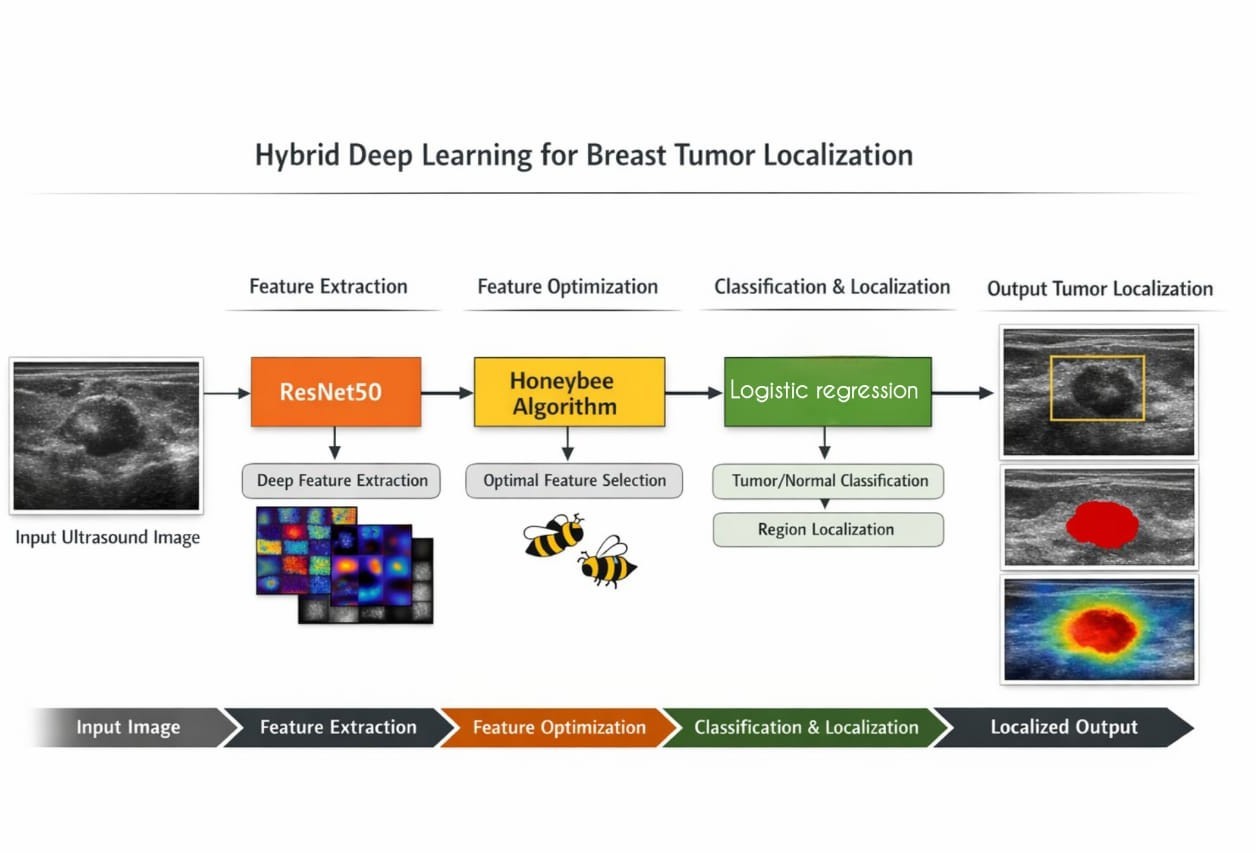
One of the most prevalent illnesses affecting women globally is breast cancer, necessitating enhanced detection approaches for better clinical results. For accurate breast cancer localization, this study suggests a hybrid deep learning architecture that combines massive language models, swarm intelligence, and transfer learning. The suggested method utilizes the ResNet50 network as the feature extractor. In order to further boost model performance, the Honeybee Algorithm was utilized to automatically tune important hyper parameters such as optimization as well as generalization. Performance reached an accuracy of 90% for the Ultrasound dataset, 86.15% for the MRI data, and 95.7% for both datasets combined, showing the advantages of multimodal learning and swarm optimization. Beyond image analysis, a module for interpreting clinical reports was implemented with a BERT based large language model that was able to extract useful diagnostic information such as type of tumor, malignancy level, and treatment recommendations. Testing based on parameters like accuracy, precision, recall, F1-score, sensitivity, specificity, and AUC validated the strength of the suggested approach. The combination of HBA-tuned ResNet50 and LLM based Bert pre-trained model clinical report comprehension creates an integrated and smart diagnostic paradigm that improves not only the accuracy but also the explainability of breast cancer diagnosis systems. This research helps create dependable, explainable, and AI-based healthcare solutions that can assist radiologists in real-time clinical decision-making.
References
Jehad Feras AlSamhori, Abdel Rahman Feras AlSamhori, Leslie Anne Duncan, Ahmad Qalajo, Hamzeh Feras Alshahwan, “Artificial intelligence for breast cancer: Implications for diagnosis and management,” J. Med. Surgery, Public Heal., vol. 3, p. 100120, 2024, doi: https://doi.org/10.1016/j.glmedi.2024.100120.
Arun Kumar Singh, Bireshwar Dass Mazumdar, Rohit Raja, Kamred Udham Singh, Ankit Kumar, “Transforming Early Breast Cancer Detection: A Deep Learning Approach Using Convolutional Neural Networks and Advanced Classification Techniques,” Int. J. Comput. Intell. Syst., vol. 18, no. 134, 2025, [Online]. Available: https://link.springer.com/article/10.1007/s44196-025-00876-7
Jan Witowski, Ken G. Zeng, Joseph Cappadona, Jailan Elayoubi, Khalil Choucair, “Multi-modal AI for comprehensive breast cancer prognostication,” arXiv:2410.21256, 2025, [Online]. Available: https://arxiv.org/abs/2410.21256
“Breast cancer.” Accessed: Sep. 29, 2024. [Online]. Available: https://www.who.int/news-room/fact-sheets/detail/breast-cancer?gad_source=1&gclid=CjwKCAjw9eO3BhBNEiwAoc0-jcug9luWULfTRtCAtYrg57sdbkDDuXgTLH7IgTGaV_5Dg86K1i2U_RoCchsQAvD_BwE
Aakash Tripathi, Asim Waqas, Matthew B. Schabath, Yasin Yilmaz, Ghulam Rasool, “HoneyBee: A Scalable Modular Framework for Creating Multimodal Oncology Datasets with Foundational Embedding Models,” arXiv:2405.07460, 2024, [Online]. Available: https://arxiv.org/abs/2405.07460
Jothi Ganesan, Vaanpriya Krishnan, Thirumalaisamy Rathinavel, K. S. Shalini, Thangaswamy Selvankumar, M. Gomathi, “Enhancing breast cancer detection accuracy through machine learning, deep learning and transfer learning techniques for clinical practice,” Discov. Artif. Intell., vol. 6, no. 29, 2026, [Online]. Available: https://link.springer.com/article/10.1007/s44163-025-00649-3
Shreyas Goyal, Jagath C. Rajapakse, “Self-supervised learning for hotspot detection and isolation from thermal images,” arXiv:2308.13204, 2023, [Online]. Available: https://arxiv.org/abs/2308.13204
Shin’ya Yamaguchi, Sekitoshi Kanai, Atsutoshi Kumagai, Daiki Chijiwa, Hisashi Kashima, “Transfer Learning with Pre-trained Conditional Generative Models,” arXiv:2204.12833, 2022, [Online]. Available: https://arxiv.org/abs/2204.12833
T. Chinglemba, S. Biswas, D. Malakar, V. Meena, D. Sarkar, and A. Biswas, “Introductory Review of Swarm Intelligence Techniques,” Stud. Comput. Intell., vol. 1054, pp. 15–35, 2023, doi: 10.1007/978-3-031-09835-2_2.
L. Luo et al., “Deep Learning in Breast Cancer Imaging: A Decade of Progress and Future Directions,” IEEE Rev. Biomed. Eng., vol. 18, pp. 130–151, 2025, doi: 10.1109/RBME.2024.3357877.
W. Weng and X. Zhu, “U-Net: Convolutional Networks for Biomedical Image Segmentation,” IEEE Access, vol. 9, pp. 16591–16603, May 2015, doi: 10.1109/ACCESS.2021.3053408.
A. I. & E. G. Fatima-Zahrae Nakach, “A comprehensive investigation of multimodal deep learning fusion strategies for breast cancer classification,” Artif. Intell. Rev., vol. 57, 2024, [Online]. Available: https://link.springer.com/article/10.1007/s10462-024-10984-z
F. Zhuang et al., “A Comprehensive Survey on Transfer Learning,” Proc. IEEE, vol. 109, no. 1, pp. 43–76, Jan. 2021, doi: 10.1109/JPROC.2020.3004555.
Mennatallah Mohamed Hanafy, Aya Ahmed Hamed Ahmed, “Mammographically detected asymmetries in the era of artificial intelligence,” Egypt. J. Radiol. Nucl. Med., vol. 54, 2023, [Online]. Available: https://link.springer.com/article/10.1186/s43055-023-00979-1
“Fusing Artificial Intelligence and Optimization with Trustworthy Optimization Proxies | SIAM.” Accessed: Mar. 02, 2026. [Online]. Available: https://www.siam.org/publications/siam-news/articles/fusing-artificial-intelligence-and-optimization-with-trustworthy-optimization-proxies/
“Swarm Intelligence: Foundations, Algorithms, Applications, and Future Directions.” Accessed: Mar. 02, 2026. [Online]. Available: https://atoms.dev/insights/swarm-intelligence-foundations-algorithms-applications-and-future-directions/4af5c16ccd794582a9623355cb09c0cc
Oliver Lester Saldanha, Jiefu Zhu, Gustav Müller-Franzes, “Swarm learning with weak supervision enables automatic breast cancer detection in magnetic resonance imaging,” Commun. Med., vol. 5, 2025, [Online]. Available: https://www.nature.com/articles/s43856-024-00722-5
Julia Amann, Alessandro Blasimme, Effy Vayena, Dietmar Frey, “Explainability for artificial intelligence in healthcare: a multidisciplinary perspective,” BMC Med. Inform. Decis. Mak., vol. 20, 2020, [Online]. Available: https://link.springer.com/article/10.1186/s12911-020-01332-6
Downloads
Published
How to Cite
Issue
Section
License
Copyright (c) 2026 50sea

This work is licensed under a Creative Commons Attribution 4.0 International License.