ELIPSE: Enhanced Live Interview Practice with Sentiment Evaluation, A Zero-Cost Real-Time AI Interview System Achieving Human Level Interaction Fidelity with Sub Two Second Latency and Multi-Dimensional Behavioral Analytics
DOI:
https://doi.org/10.33411/IJIST/1847Keywords:
AI Interviewer, Large Language Models (LLMs), Real-Time Behavioral Analytics, Emotion Recognition, Adaptive Questioning, Neural Text-To-Speech, Simulating A Mock Interview, Zero-Cost AI Systems, Sentiment Analysis, WebSocketAbstract
Background: Interview preparation is among the final significant areas of workforce development that are resistant to automation, and the worldwide coaching sector is greater than $3 billion a year; however, more than 80 percent of job seekers in emerging economies do not have access to formal practice [1]. With innovations in large language models (LLMs), neural text-to-speech (TTS), and transformer-based affective computing, artificially intelligent technology has created an unprecedented opportunity to democratize access to high-quality interview simulation.
Objective: ELIPSE (Enhanced Live Interview Practice with Sentiment Evaluation), to the best of our knowledge, is the first open-source platform to integrate, within a single system, real-time voice-to-voice interaction, adaptive LLM-driven question generation, multi-dimensional behavioral analytics (seven-class emotion detection, continuous sentiment scoring, hesitation quantification, speech-pace monitoring, and composite confidence estimation), and persona.
Methods: ELIPSE is built on a React.js/Node.js WebSocket-driven architecture, integrating Groq-hosted LLaMA 3.3 70B inference, Microsoft Edge neural TTS, and a HuggingFace transformer frontend. Assessment used a within-sub longitudinal design with 15 participants (47 completed sessions, 376 question-answer interactions) addressing three research questions related to latency, behavioral metric validity, and improvement in confidence.
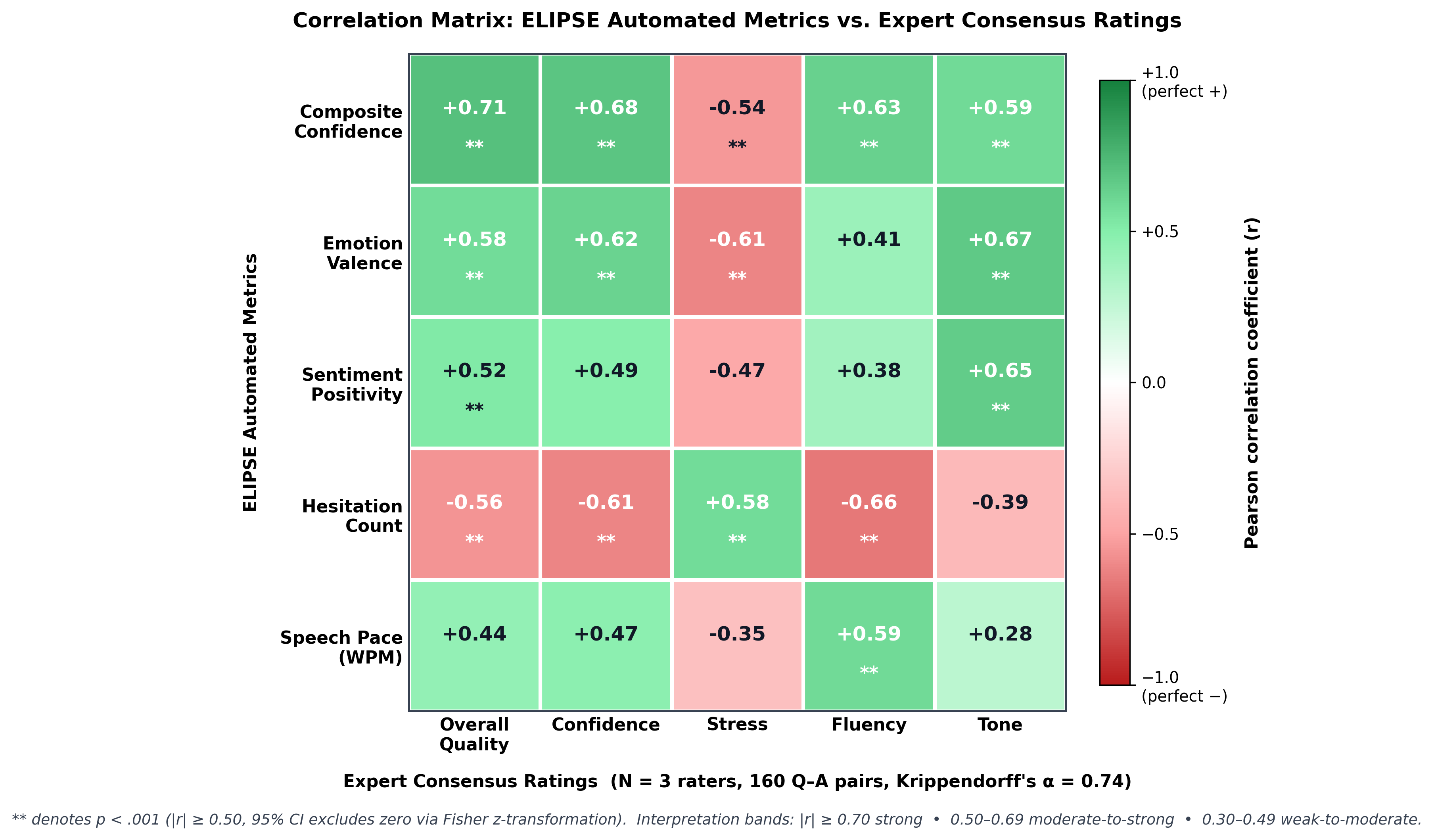
Results: ELIPSE achieves a mean end-to-end response latency of 1.83 s (SD = 0.41, 95% CI [1.79, 1.87]; 95th percentile = 2.61 s), a 26.4% reduction versus [2] (3.8 s) and 42.8% lower than [3] (3.2 s). Automated behavioral analytics correlated moderately to strongly with expert ratings (overall quality r = 0.71, 95% CI [0.62, 0.79], p < .001; confidence r = 0.68, p < .001; fluency r = 0.63, p < .001), with inter-rater reliability Krippendorff's α = 0.74. A significant 1.3-point improvement in interview confidence was observed after three sessions (paired t(11) = 4.72, p < .001, Cohen's d = 1.24 (large effect)), alongside a 38.8% relative increase in overall score (β = 5.4 points/session, R² = 0.38, p < .001), a 38% reduction in hesitation frequency (d = 0.91), and a 22.8% improvement in speech-pace alignment with the 120–160 WPM target (d = 1.04). System Usability Scale score was 76.3 (SD = 8.2, 95% CI [71.8, 80.8]), classified as 'good', exceeding the 68-point threshold. 67% (95% CI [38%, 88%]) of participants preferred ELIPSE to conventional practice methods.
Conclusion: ELIPSE demonstrates that the technical and financial barriers to equitable, evidence-based interview preparation are eliminated by the present-day generation of freely available AI architecture, and that it has direct implications for workforce development programs in resource-limited economies worldwide.
References
“The Future of Jobs Report 2025 | World Economic Forum.” Accessed: Apr. 21, 2026. [Online]. Available: https://www.weforum.org/publications/the-future-of-jobs-report-2025/
“AI-Driven Mock Interview: A New Era In Candidate Preparation | Peer-reviewed Journal.” Accessed: Apr. 21, 2026. [Online]. Available: https://ijarcce.com/papers/ai-driven-mock-interview-a-new-era-in-candidate-preparation/
“(PDF) AI Powered Interview Preperation System.” Accessed: Apr. 21, 2026. [Online]. Available: https://www.researchgate.net/publication/400096562_AI_Powered_Interview_Preperation_System
M. A. CAMPION, E. D. PURSELL, and B. K. BROWN, “Structured Interviewing: Raising The Psychometric Properties Of The Employment Interview,” Pers. Psychol., vol. 41, no. 1, pp. 25–42, Mar. 1988, doi: 10.1111/J.1744-6570.1988.TB00630.X;PAGE:STRING:ARTICLE/CHAPTER.
K. G. Melchers, N. Lienhardt, M. Von Aarburg, and M. Kleinmann, “Is more structure really better? A comparison of frame-of-reference training and descriptively anchored rating scales to improve interviewers’ rating quality,” Pers. Psychol., vol. 64, no. 1, pp. 53–87, Mar. 2011, doi: 10.1111/J.1744-6570.2010.01202.X.
J. Levashina, C. J. Hartwell, F. P. Morgeson, and M. A. Campion, “The Structured Employment Interview: Narrative and Quantitative Review of the Research Literature,” Pers. Psychol., vol. 67, no. 1, pp. 241–293, Mar. 2014, doi: 10.1111/PEPS.12052.
Patrick D. Dunlop, Djurre Holtrop, Serena Wee, “How asynchronous video interviews are used in practice: A study of an Australian-based AVI vendor,” Int. J. Sel. Assess., 2022, [Online]. Available: https://onlinelibrary.wiley.com/doi/10.1111/ijsa.12372
Nicolas Roulin, Le Khoi Anh Pham, “Ready? Camera rolling… action! Examining interviewee training and practice opportunities in asynchronous video interviews,” J. Vocat. Behav., vol. 145, p. 103912, 2023, doi: https://doi.org/10.1016/j.jvb.2023.103912.
N. Roulin, O. Wong, M. Langer, and J. S. Bourdage, “Is more always better? How preparation time and re-recording opportunities impact fairness, anxiety, impression management, and performance in asynchronous video interviews,” Eur. J. Work Organ. Psychol., vol. 32, no. 3, pp. 333–345, 2023, doi: 10.1080/1359432X.2022.2156862.
N. Roulin, E. R. Lukacik, J. S. Bourdage, L. Clow, H. Bakour, and P. Diaz, “Bias in the background? The role of background information in asynchronous video interviews,” J. Organ. Behav., vol. 44, no. 3, pp. 458–475, Mar. 2023, doi: 10.1002/JOB.2680.
J. S. Bourdage, N. Roulin, and R. Tarraf, “‘I (might be) just that good’: Honest and deceptive impression management in employment interviews,” Pers. Psychol., vol. 71, no. 4, pp. 597–632, Dec. 2018, doi: 10.1111/PEPS.12285.
Shreyan Biswas, Ji-Youn Jung, Abhishek Unnam, Kuldeep Yadav, Shreyansh Gupta, Ujwal Gadiraju, “‘Hi. I’m Molly, Your Virtual Interviewer!’ -- Exploring the Impact of Race and Gender in AI-powered Virtual Interview Experiences,” arXiv:2408.14159, 2024, [Online]. Available: https://arxiv.org/abs/2408.14159
“(PDF) When your resume is (not) turning you down: Modelling ethnic bias in resume screening.” Accessed: Apr. 21, 2026. [Online]. Available: https://www.researchgate.net/publication/328833697_When_your_resume_is_not_turning_you_down_Modelling_ethnic_bias_in_resume_screening
Laura J. Kray, Adam D. Galinsky, “Reversing the Gender Gap in Negotiations: An Exploration of Stereotype Regeneration,” Organ. Behav. Hum. Decis. Process., vol. 87, no. 2, pp. 386–409, 2002, doi: https://doi.org/10.1006/obhd.2001.2979.
“Llama 3.3 70b vs GPT-4o.” Accessed: Apr. 21, 2026. [Online]. Available: https://www.vellum.ai/blog/llama-3-3-70b-vs-gpt-4o
“Text-to-Speech Documentation - Tutorials, API Reference - Foundry Tools | Microsoft Learn.” Accessed: Apr. 21, 2026. [Online]. Available: https://learn.microsoft.com/en-us/azure/ai-services/speech-service/index-text-to-speech
Jochen Hartmann, Mark Heitmann, “More than a Feeling: Accuracy and Application of Sentiment Analysis,” Int. J. Res. Mark., vol. 40, no. 1, pp. 75–87, 2023, doi: https://doi.org/10.1016/j.ijresmar.2022.05.005.
“NLP_goats at SemEval-2025 Task 11: Multi-Label Emotion Classification Using Fine-Tuned Roberta-Large Tranformer - ACL Anthology.” Accessed: Apr. 21, 2026. [Online]. Available: https://aclanthology.org/2025.semeval-1.135/
Jingyi Li, Michelle X. Zhou, “Confiding in and Listening to Virtual Agents: The Effect of Personality,” Int. Conf. Intell. User Interfaces, Proc. IUI, 2017, [Online]. Available: https://dl.acm.org/doi/10.1145/3025171.3025206
“(PDF) Improving Asynchronous Interview Interaction with Follow-up Question Generation.” Accessed: Apr. 21, 2026. [Online]. Available: https://www.researchgate.net/publication/368060206_Improving_Asynchronous_Interview_Interaction_with_Follow-up_Question_Generation
“AI Is Replacing Humans In The Interview Process - What You Need To Know To Crush Your Next Video Interview.” Accessed: Apr. 21, 2026. [Online]. Available: https://www.forbes.com/sites/janehanson/2023/09/30/ai-is-replacing-humans-in-the-interview-processwhat-you-need-to-know-to-crush-your-next-video-interview/
“Artificial intelligence in personnel selection and its influence on employer attractiveness | Request PDF.” Accessed: Apr. 21, 2026. [Online]. Available: https://www.researchgate.net/publication/342047560_Artificial_intelligence_in_personnel_selection_and_its_influence_on_employer_attractiveness
M. Langer, C. J. König, and K. Krause, “Examining digital interviews for personnel selection: Applicant reactions and interviewer ratings,” Int. J. Sel. Assess., vol. 25, no. 4, pp. 371–382, Dec. 2017, doi: 10.1111/IJSA.12191;PAGE:STRING:ARTICLE/CHAPTER.
“(PDF) Speech production under uncertainty: how do job applicants experience and communicate with an AI interviewer?” Accessed: Apr. 21, 2026. [Online]. Available: https://www.researchgate.net/publication/371966119_Speech_production_under_uncertainty_how_do_job_applicants_experience_and_communicate_with_an_AI_interviewer
“Where Automated Job Interviews Fall Short.” Accessed: Apr. 21, 2026. [Online]. Available: https://hbr.org/2022/01/where-automated-job-interviews-fall-short
“It Takes More Than a Good Camera: Which Factors Contribute to Differences Between Face-to-Face Interviews and Videoconference Interviews Regarding Performance Ratings and Interviewee Perceptions? - PMC.” Accessed: Apr. 21, 2026. [Online]. Available: https://pmc.ncbi.nlm.nih.gov/articles/PMC7482058/
“Understanding Interviewees’ Perceptions and Behaviour towards Verbally and Non-verbally Expressive Virtual Interviewing Agents | Companion Publication of the 2022 International Conference on Multimodal Interaction.” Accessed: Apr. 21, 2026. [Online]. Available: https://dl.acm.org/doi/10.1145/3536220.3558802
“Does media richness influence job applicants’ experience in asynchronous video interviews? Examining social presence, impression management, anxiety, and performance - Rizi - 2024 - International Journal of Selection and Assessment - Wiley Online Library.” Accessed: Apr. 21, 2026. [Online]. Available: https://onlinelibrary.wiley.com/doi/full/10.1111/ijsa.12448
“‘The interviewer is a machine!’ Investigating the effects of conventional and technology‐mediated interview methods on interviewee reactions and behavior - Kleinlogel - 2023 - International Journal of Selection and Assessment - Wiley Online Library.” Accessed: Apr. 21, 2026. [Online]. Available: https://onlinelibrary.wiley.com/doi/full/10.1111/ijsa.12433
“Frontiers | Asynchronous Video Interviewing as a New Technology in Personnel Selection: The Applicant’s Point of View.” Accessed: Apr. 21, 2026. [Online]. Available: https://www.frontiersin.org/journals/psychology/articles/10.3389/fpsyg.2016.00863/full
J. P. Hausknecht, D. V. Day, and S. C. Thomas, “Applicant reactions to selection procedures: An updated model and meta-analysis,” Pers. Psychol., vol. 57, no. 3, pp. 639–683, Sep. 2004, doi: 10.1111/J.1744-6570.2004.00003.X.
“(PDF) Once an Impression Manager, Always an Impression Manager? Antecedents of Honest and Deceptive Impression Management Use and Variability across Multiple Job Interviews.” Accessed: Apr. 21, 2026. [Online]. Available: https://www.researchgate.net/publication/312083871_Once_an_Impression_Manager_Always_an_Impression_Manager_Antecedents_of_Honest_and_Deceptive_Impression_Management_Use_and_Variability_across_Multiple_Job_Interviews
D. George, K. S. Keerthi, K. Gayathri, and G. N. Harshini, “AI powered learning management system with mock interview platform,” Artif. Intell. Sustain. Innov., pp. 433–438, Jan. 2026, doi: 10.1201/9781003654049-63.
Iftekhar Naim, M. Iftekhar Tanveer, Daniel Gildea, Mohammed (Ehsan)Hoque, “Automated Analysis and Prediction of Job Interview Performance,” IEEE Trans. Affect. Comput., vol. 9, no. 2, 2015, [Online]. Available: https://arxiv.org/abs/1504.03425
J. R. Lewis, “The System Usability Scale: Past, Present, and Future,” Int. J. Hum. Comput. Interact., vol. 34, no. 7, pp. 577–590, Jul. 2018, doi: 10.1080/10447318.2018.1455307.
A. F. Hayes, “Introduction to Mediation, Moderation, and Conditional Process Analysis: A Regression-Based Approach,” Guilford Press, 2018.
G. G. K. J R Landis, “The measurement of observer agreement for categorical data,” Biometrics, vol. 33, no. 1, pp. 159–74, 1977, [Online]. Available: https://pubmed.ncbi.nlm.nih.gov/843571/
“(PDF) Introducing a Multi-Stakeholder Perspective on Opacity, Transparency and Strategies to Reduce Opacity in Algorithm-Based Human Resource Management.” Accessed: Apr. 21, 2026. [Online]. Available: https://www.researchgate.net/publication/356287777_Introducing_a_Multi-Stakeholder_Perspective_on_Opacity_Transparency_and_Strategies_to_Reduce_Opacity_in_Algorithm-Based_Human_Resource_Management
Downloads
Published
How to Cite
Issue
Section
License
Copyright (c) 2026 50sea

This work is licensed under a Creative Commons Attribution 4.0 International License.