Neuro Alert: Efficient Deep Learning-Based Detection of Intracranial Hemorrhage from CT Images
DOI:
https://doi.org/10.33411/IJIST/1863Keywords:
Intracranial Hemorrhage, Convolutional Neural Network (CNN), Computed Tomography (CT), Deep Learning, Machine LearningAbstract
Importance of Study: Quick and accurate detection of intracranial hemorrhage (ICH) is crucial, as delays can lead to higher risks of death, disability, and more complex treatment. While non-contrast CT scans are the main tool for diagnosing ICH, fast interpretation relies on radiologists, who may not always be available in emergencies or in places with limited resources.
Novelty Statement: This study introduces NeuroAlert, a lightweight convolutional neural network (CNN) that can detect different types of intracranial hemorrhage from non-contrast CT images. Unlike more complex deep learning systems, NeuroAlert maintains high accuracy while running efficiently with TensorFlow Lite.
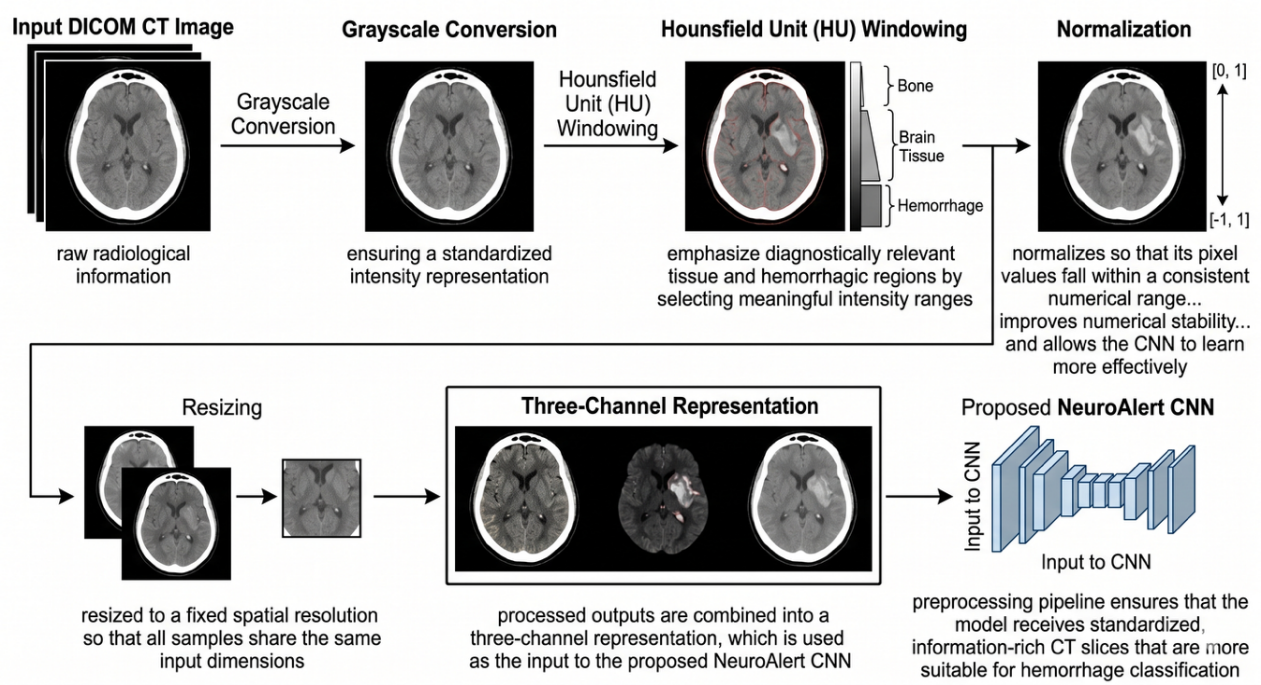
Methodology: A framework named NeuroAlert is presented using the RSNA Intracranial Hemorrhage dataset, which includes about 750,000 CT images labeled for five types of hemorrhage and an extra category for any hemorrhage. The images were preprocessed with Hounsfield Unit windowing, normalization, resizing, and data augmentation to highlight important features. NeuroAlert uses a compact CNN with four convolutional blocks, a fully connected layer, and a softmax output layer. To handle class imbalance, weighted categorical cross-entropy was used during training. The final model was optimized with TensorFlow Lite for faster, lightweight use.
Results and Discussion: NeuroAlert achieved a macro-averaged accuracy of 93.7%, an F1-score of 0.926, and an AUC of 0.985, demonstrating strong overall discrimination across all hemorrhage categories. Class-wise analysis showed the highest performance for the any hemorrhage class, with an F1-score of 0.95 and an AUC of 0.992, while Intraparenchymal Hemorrhage (IPH) also showed strong recognition with an F1-score of 0.94 and an AUC of 0.990. After TensorFlow Lite optimization, the model size was reduced by 61%, and inference time remained below 1 second per image, indicating near real-time performance with efficient computational requirements.
Conclusion: NeuroAlert demonstrates that a carefully designed lightweight CNN can provide reliable multi-class intracranial hemorrhage detection while maintaining deployment-oriented efficiency. The proposed framework offers a promising solution for AI-assisted CT interpretation in time-sensitive and resource-limited healthcare settings.
References
Luis Cortés-Ferre, Miguel Angel Gutiérrez-Naranjo, “Deep Learning Applied to Intracranial Hemorrhage Detection,” J. Imaging, vol. 9, no. 2, p. 37, 2023, doi: https://doi.org/10.3390/jimaging9020037.
Muhannad Seyam, Thomas Weikert, “Utilization of Artificial Intelligence-based Intracranial Hemorrhage Detection on Emergent Noncontrast CT Images in Clinical Workflow,” Radiol. Artif. Intell., vol. 4, no. 2, p. e210168, 2022, [Online]. Available: https://pubmed.ncbi.nlm.nih.gov/35391777/
So Yeon Choi, Ji Hoon Kim, Hyun Soo Chung, Sona Lim, Eun Hwa Kim & Arom Choi, “Impact of a deep learning-based brain CT interpretation algorithm on clinical decision-making for intracranial hemorrhage in the emergency department,” Sci. Rep., 2024, [Online]. Available: https://www.nature.com/articles/s41598-024-73589-0
Jialiang Fan, Xinhui Fan, Chengyan Song, Xiaofan Wang, Bingdong Feng, Lucan Li & Guoyu Lu, “Dual-task vision transformer for rapid and accurate intracerebral hemorrhage CT image classification,” Sci. Rep., 2024, [Online]. Available: https://www.nature.com/articles/s41598-024-79090-y
Bargava Subramanian, Naveen Kumarasami, Praveen Shastry, “3D Convolutional Neural Networks for Improved Detection of Intracranial bleeding in CT Imaging,” arXiv:2503.20306, 2025, [Online]. Available: https://arxiv.org/abs/2503.20306
A. Phaphuangwittayakul, Y. Guo, F. Ying, A. Y. Dawod, S. Angkurawaranon, and C. Angkurawaranon, “An optimal deep learning framework for multi-type hemorrhagic lesions detection and quantification in head CT images for traumatic brain injury,” Appl. Intell. (Dordrecht, Netherlands), vol. 52, no. 7, pp. 7320–7338, May 2022, doi: 10.1007/S10489-021-02782-9.
Jayesh Soni, “Toward the detection of intracranial hemorrhage: a transfer learning approach,” Art Int Surg, 2025, doi: 10.20517/ais.2024.46.
S. Kaur and A. Singh, “A New Deep Learning Framework for Accurate Intracranial Brain Hemorrhage Detection and Classification Using Real-Time Collected NCCT Images,” Appl. Magn. Reson. 2024 556, vol. 55, no. 6, pp. 629–661, Jun. 2024, doi: 10.1007/S00723-024-01661-Z.
Dong Wan Kang, Museong Kim, “Deep learning-assisted detection of intracranial hemorrhage: validation and impact on reader performance,” Neuroradiology, vol. 67, no. 6, pp. 1511–1519, 2025, [Online]. Available: https://pubmed.ncbi.nlm.nih.gov/40116947/
Ronald Antulov, Martin Weber Kusk, “Real-World Integration of an Automated Tool for Intracranial Hemorrhage Detection in an Unselected Cohort of Emergency Department Patients-An External Validation Study,” Diagnostics (Basel, Switzerland), vol. 16, no. 2, p. 282, 2026, [Online]. Available: https://pubmed.ncbi.nlm.nih.gov/41594258/
Armin Karamian, Ali Seifi, “Diagnostic Accuracy of Deep Learning for Intracranial Hemorrhage Detection in Non-Contrast Brain CT Scans: A Systematic Review and Meta-Analysis,” J. Clin. Med., vol. 14, no. 7, p. 2377, 2025, doi: https://doi.org/10.3390/jcm14072377.
L. Goelz et al., “Machine‐learning algorithms for detecting intracranial hemorrhage on head computed tomography,” Cochrane Database Syst. Rev., vol. 2026, no. 2, p. CD016266, Feb. 2026, doi: 10.1002/14651858.CD016266.
P. Hu et al., “Deep learning-assisted detection and segmentation of intracranial hemorrhage in noncontrast computed tomography scans of acute stroke patients: a systematic review and meta-analysis,” Int. J. Surg., vol. 110, no. 6, p. 3839, Jun. 2024, doi: 10.1097/JS9.0000000000001266.
Gul Cihan Habek, Fatih Basciftci, “Slice-level and scan-level performance of deep learning models for intracranial hemorrhage detection and subtype classification: a systematic review and meta-analysis,” Eng. Sci. Technol. an Int. J., vol. 77, p. 102368, 2026, doi: https://doi.org/10.1016/j.jestch.2026.102368.
Alireza Golkarieh, Mohammad Sassani, “Intracranial Hemorrhage Diagnosis Using Deep Learning: A Survey of Techniques, Frameworks, and Challenges,” Comput. Decis. Mak. An Int. J., vol. 3, pp. 780–804, 2026, doi: 10.59543/comdem.v3i.15543.
Omid Mirzaei, Sedra Alialsagher Mohammed, “Comparison of Intracranial Hemorrhages Detection Performances of Deep Learning Models on CT Images,” Procedia Comput. Sci., vol. 258, pp. 3194–3202, 2025, doi: https://doi.org/10.1016/j.procs.2025.04.577.
Franziska Tombach, Kristina Krompaß, “Diagnostic performance and confidence of an optimized deep-learning algorithm for the detection of intracranial hemorrhages,” Insights Imaging, vol. 17, no. 1, p. 73, 2026, [Online]. Available: https://pubmed.ncbi.nlm.nih.gov/41843310/
P. Fusco, G. P. Rimoli, and M. Ficco, “TinyML and Federated Learning for Resource-Constrained Medical Devices,” pp. 113–126, 2025, doi: 10.1007/978-3-031-70775-9_7.
Md Wahidur Rahman, Mais Nijim, “Privacy-Preserving Federated IoT Architecture for Early Stroke Risk Prediction,” Electronics, vol. 15, no. 1, p. 32, 2026, doi: https://doi.org/10.3390/electronics15010032.
Kai Cheng Yang, Yunzhi Xu, “Explainable deep learning algorithm for identifying cerebral venous sinus thrombosis-related hemorrhage (CVST-ICH) from spontaneous intracerebral hemorrhage using computed tomography,” eClinicalMedicine, vol. 81, p. 103128, 2025, [Online]. Available: https://pubmed.ncbi.nlm.nih.gov/40093990/
A. Nada et al., “External validation and performance analysis of a deep learning-based model for the detection of intracranial hemorrhage,” Neuroradiol. J., vol. 38, no. 3, pp. 312–321, Jun. 2025, doi: 10.1177/19714009241303078.
Mohammadreza Chavoshi, Aawez Mansuri, Wasif Bala, “Real-world performance evaluation of a commercial deep learning model for intracranial hemorrhage detection,” npj Digit. Med., 2026, [Online]. Available: https://www.nature.com/articles/s41746-025-02244-3
H. Kavandi, K. Costenbader, S. Yazbek, P. Kamel, N. Yahyavi-Firouz-Abadi, and J. Jeudy, “Performance Evaluation of a Commercial Deep Learning Software for Detecting Intracranial Hemorrhage in a Pediatric Population,” J. imaging informatics Med., 2026, doi: 10.1007/S10278-026-01857-8.
Tommaso D’Angelo, Giuseppe M. Bucolo, “Accuracy and time efficiency of a novel deep learning algorithm for Intracranial Hemorrhage detection in CT Scans,” Radiol. Med., vol. 129, no. 10, pp. 1499–1506, 2024, [Online]. Available: https://pubmed.ncbi.nlm.nih.gov/39123064/
S. Ahmed, “Exploring Deep Learning and Machine Learning Approaches for Brain Hemorrhage Detection,” IEEE Access, vol. 12, pp. 45060–45093, 2024, doi: 10.1109/ACCESS.2024.3376438.
Kasra Davoodi, Mohammad Hoseyni, Javad Khoramdel, Reza Barati, Reihaneh Mortazavi, “Hemorica: A Comprehensive CT Scan Dataset for Automated Brain Hemorrhage Classification, Segmentation, and Detection,” arXiv:2509.22993, 2025, [Online]. Available: https://arxiv.org/abs/2509.22993
D. W. Kang et al., “Strengthening deep-learning models for intracranial hemorrhage detection: strongly annotated computed tomography images and model ensembles,” Front. Neurol., vol. 14, 2023, doi: 10.3389/FNEUR.2023.1321964/PDF.
Jingjing Liu, Weijie Fan, “Deep learning-based identification and localization of intracranial hemorrhage in patients using a large annotated head computed tomography dataset: A retrospective multicenter study,” Intell. Med., vol. 5, no. 1, pp. 14–22, 2025, doi: https://doi.org/10.1016/j.imed.2024.11.002.
P. Raguraman, M. Kumaresan, and S. Ramesh, “A Comprehensive Survey of AI-Driven Biomedical Image Processing for Intracerebral Hemorrhage Detection and Classification: Current Trends, Challenges, and Future Directions,” 8th Int. Conf. Electron. Commun. Aerosp. Technol. ICECA 2024 - Proc., pp. 1649–1653, 2024, doi: 10.1109/ICECA63461.2024.10801000.
Qian Gao, Yujia Jin, “Transforming Intracerebral Hemorrhage Care with Artificial Intelligence: Opportunities, Challenges, and Future Directions,” Diagnostics, vol. 16, no. 5, p. 752, 2026, doi: https://doi.org/10.3390/diagnostics16050752.
Downloads
Published
How to Cite
Issue
Section
License
Copyright (c) 2026 50sea

This work is licensed under a Creative Commons Attribution 4.0 International License.