A Multi-Domain Feature Fusion Framework Integrating DCT, DWT, and Deep CNN for Brain Tumor Classification
DOI:
https://doi.org/10.33411/IJIST/1879Keywords:
deep learning, brain tumor classification, Attention-Based Feature Fusion, discrete wavelet transformation, discrete Cosine Transform (DCT), MRIAbstract
Background: The study investigates brain tumor diagnosis using MRI, a fundamental task in neuro-oncology, as accurate tumor type identification determines diagnostic outcomes and treatment strategies. Deep learning techniques have achieved substantial success with Convolutional Neural Networks (CNNs), which primarily extract spatial features while often overlooking other essential information, such as frequency and multi-scale information.
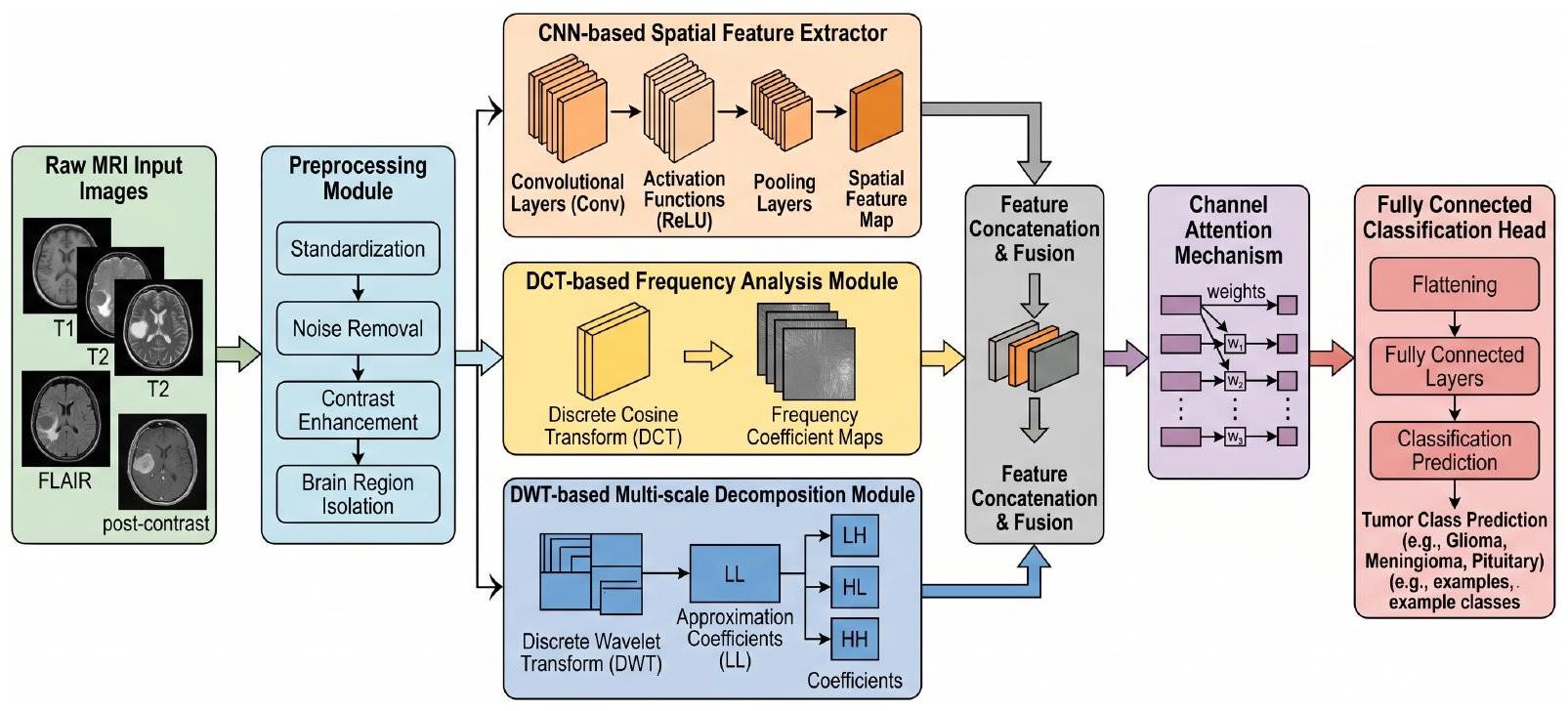
Method: The study proposes a hybrid multi-domain framework that combines spatial features from a Pretrained ResNet-50 model with frequency-domain data obtained via the Discrete Cosine Transform (DCT) and multi-scale data from the Discrete Wavelet Transform (DWT). A channel attention mechanism fuses the extracted features by dynamically selecting the most discriminative ones. The model uses 5-fold stratified cross-validation to assess its performance on the TCIA MU-Glioma-Post dataset.
Results: The proposed hybrid model reached an overall classification accuracy of 97%, with weighted precision, recall, and F1-score all at about 0.97. It also showed strong performance across tumor types, with AUC-ROC values close to 0.99. Compared to baseline models, this framework improved accuracy by 3-5%, supporting the value of integrating features from multiple domains.
Discussion: The combination of spatial, frequency, and multi-scale representations emerges as a superior approach for MRI data classification, as it captures complementary information from the data. The attention mechanism enhances the model's ability to adaptively weight each feature during processing. The findings suggest that medical image analysis benefits from multi-domain feature fusion, and the developed framework demonstrates high-precision classification of brain tumors.
References
Felix J. Dorfner, Jay B. Patel, Jayashree Kalpathy-Cramer, Elizabeth R. Gerstner & Christopher P. Bridge, “A review of deep learning for brain tumor analysis in MRI,” npj Precis. Oncol., vol. 9, 2025, [Online]. Available: https://www.nature.com/articles/s41698-024-00789-2
Tarek Berghout, “The Neural Frontier of Future Medical Imaging: A Review of Deep Learning for Brain Tumor Detection,” J. Imaging, vol. 11, no. 1, p. 2, 2025, doi: https://doi.org/10.3390/jimaging11010002.
M. A. Abid and K. Munir, “A systematic review on deep learning implementation in brain tumor segmentation, classification and prediction,” Multimed. Tools Appl. 2025 8431, vol. 84, no. 31, pp. 38203–38242, Feb. 2025, doi: 10.1007/S11042-025-20706-4.
Zain Ul Abidin, Rizwan Ali Naqvi, “Recent deep learning-based brain tumor segmentation models using multi-modality magnetic resonance imaging: a prospective survey,” Front. Bioeng. Biotechnol., vol. 12, 2024, [Online]. Available: http://frontiersin.org/journals/bioengineering-and-biotechnology/articles/10.3389/fbioe.2024.1392807/full
S. Das and R. S. Goswami, “Advancements in brain tumor analysis: a comprehensive review of machine learning, hybrid deep learning, and transfer learning approaches for MRI-based classification and segmentation,” Multimed. Tools Appl. 2024 8423, vol. 84, no. 23, pp. 26645–26682, Sep. 2024, doi: 10.1007/S11042-024-20203-0.
Rim Missaoui, Wided Hechkel, “Advanced Deep Learning and Machine Learning Techniques for MRI Brain Tumor Analysis: A Review,” Sensors, vol. 25, no. 9, p. 2746, 2025, doi: https://doi.org/10.3390/s25092746.
Shenbagarajan Anantharajan, Shenbagalakshmi Gunasekaran, “MRI brain tumor detection using deep learning and machine learning approaches,” Meas. Sensors, vol. 31, p. 101026, 2024, doi: https://doi.org/10.1016/j.measen.2024.101026.
Chandrakant M. Umarani, S. G. Gollagi, “Advancements in deep learning techniques for brain tumor segmentation: A survey,” Informatics Med. Unlocked, vol. 50, p. 101576, 2024, doi: https://doi.org/10.1016/j.imu.2024.101576.
“Developments in Brain Tumor Segmentation Using MRI: Deep Learning Insights and Future Perspectives | IEEE Journals & Magazine | IEEE Xplore.” Accessed: May 11, 2026. [Online]. Available: https://ieeexplore.ieee.org/document/10431786
“A hybrid explainable model based on advanced machine learning and deep learning models for classifying brain tumors using MRI images | Scientific Reports.” Accessed: May 11, 2026. [Online]. Available: https://www.nature.com/articles/s41598-025-85874-7
“Sparse Dynamic Volume TransUNet with multi-level edge fusion for brain tumor segmentation - ScienceDirect.” Accessed: May 11, 2026. [Online]. Available: https://www.sciencedirect.com/science/article/abs/pii/S0010482524003688
Monika Agarwal, Geeta Rani, “Deep learning for enhanced brain Tumor Detection and classification,” Results Eng., vol. 22, p. 102117, 2024, doi: https://doi.org/10.1016/j.rineng.2024.102117.
Alain Marcel Dikande Simo, Aurelle Tchagna Kouanou, “Introducing a deep learning method for brain tumor classification using MRI data towards better performance,” Informatics Med. Unlocked, vol. 44, p. 101423, 2024, doi: https://doi.org/10.1016/j.imu.2023.101423.
Hossein Sadr, Mojdeh Nazari, “Enhancing brain tumor classification in MRI images: A deep learning-based approach for accurate diagnosis,” Image Vis. Comput., vol. 159, p. 105555, 2025, doi: https://doi.org/10.1016/j.imavis.2025.105555.
“An automated deep learning framework for brain tumor classification using MRI imagery | Scientific Reports.” Accessed: May 11, 2026. [Online]. Available: https://www.nature.com/articles/s41598-025-02209-2
“Employing deep learning and transfer learning for accurate brain tumor detection | Scientific Reports.” Accessed: May 11, 2026. [Online]. Available: https://www.nature.com/articles/s41598-024-57970-7
Mohsen Asghari Ilani, Dingjing Shi & Yaser Mike Banad, “T1-weighted MRI-based brain tumor classification using hybrid deep learning models,” Sci. Rep., 2025, [Online]. Available: https://www.nature.com/articles/s41598-025-92020-w
B. C. Mohanty, P. K. Subudhi, R. Dash, and B. Mohanty, “Feature-enhanced deep learning technique with soft attention for MRI-based brain tumor classification,” Int. J. Inf. Technol. 2024 163, vol. 16, no. 3, pp. 1617–1626, Jan. 2024, doi: 10.1007/S41870-023-01701-0.
A. A. Joshi and R. M. Aziz, “Deep learning approach for brain tumor classification using metaheuristic optimization with gene expression data,” Int. J. Imaging Syst. Technol., vol. 34, no. 2, p. e23007, Mar. 2024, doi: 10.1002/IMA.23007;WGROUP:STRING:PUBLICATION.
Zhiqin Zhu, Ziyu Wang, “Brain tumor segmentation in MRI with multi-modality spatial information enhancement and boundary shape correction,” Pattern Recognit., vol. 153, 2024, [Online]. Available: https://www.sciencedirect.com/science/article/abs/pii/S0031320324003042
“Deep Learning-Based MRI Brain Tumor Segmentation With EfficientNet-Enhanced UNet | IEEE Journals & Magazine | IEEE Xplore.” Accessed: May 11, 2026. [Online]. Available: https://ieeexplore.ieee.org/document/10938151
“Improved Brain Tumor Segmentation and Classification in Brain MRI With FCM-SVM: A Diagnostic Approach | IEEE Journals & Magazine | IEEE Xplore.” Accessed: May 11, 2026. [Online]. Available: https://ieeexplore.ieee.org/document/10509694
Muhammed Celik, Ozkan Inik, “Development of hybrid models based on deep learning and optimized machine learning algorithms for brain tumor Multi-Classification,” Expert Syst. Appl., vol. 238, 2024, [Online]. Available: https://www.sciencedirect.com/science/article/abs/pii/S0957417423026611
Md Naim Islam, Md Shafiul Azam, “An improved deep learning-based hybrid model with ensemble techniques for brain tumor detection from MRI image,” Informatics Med. Unlocked, vol. 47, p. 101483, 2024, doi: https://doi.org/10.1016/j.imu.2024.101483.
Sandeep Kumar Mathivanan, Saravanan Srinivasan, Manjula Sanjay Koti, Virendra Singh Kushwah, Rose Bindu Joseph & Mohd Asif Shah, “A secure hybrid deep learning framework for brain tumor detection and classification,” J. Big Data, vol. 12, no. 72, 2025, [Online]. Available: https://link.springer.com/article/10.1186/s40537-025-01117-6
Aditya Jayesh Aiya, Nishant Wani, Mayur Ramani, Anuj Kumar, Sangeeta Pant, Ketan Kotecha & Ambarish Kulkarni, “Optimized deep learning for brain tumor detection: a hybrid approach with attention mechanisms and clinical explainability,” Sci. Rep., 2025, [Online]. Available: https://www.nature.com/articles/s41598-025-04591-3
Dianlong An, Panpan Liu, “Dynamic weighted knowledge distillation for brain tumor segmentation,” Pattern Recognit., vol. 155, 2024, [Online]. Available: https://www.sciencedirect.com/science/article/abs/pii/S0031320324004825
R. Ahsan, I. Shahzadi, F. Najeeb, and H. Omer, “Brain tumor detection and segmentation using deep learning,” MAGMA, vol. 38, no. 1, pp. 13–22, Feb. 2025, doi: 10.1007/S10334-024-01203-5.
R. Sajjanar, U. D. Dixit, and V. K. Vagga, “Advancements in hybrid approaches for brain tumor segmentation in MRI: a comprehensive review of machine learning and deep learning techniques,” Multimed. Tools Appl. 2023 8310, vol. 83, no. 10, pp. 30505–30539, Sep. 2023, doi: 10.1007/S11042-023-16654-6.
Novsheena Rasool, Niyaz Ahmad Wani, “CNN-TumorNet: leveraging explainability in deep learning for precise brain tumor diagnosis on MRI images,” Front. Oncol., vol. 15, 2025, doi: https://doi.org/10.3389/fonc.2025.1554559.
B. Sandhiya, S. Kanaga Suba Raja, “Deep Learning and Optimized Learning Machine for Brain Tumor Classification,” Biomed. Signal Process. Control, vol. 89, p. 105778, 2024, doi: https://doi.org/10.1016/j.bspc.2023.105778.
Muhammad Faheem Khan, Arslan Iftikhar, Huzaifa Anwar, & Sadaqat Ali Ramay, “Brain Tumor Segmentation and Classification using Optimized Deep Learning,” J. Comput. Biomed. Informatics, vol. 7, no. 1, pp. 632–640, 2024, [Online]. Available: https://www.jcbi.org/index.php/Main/article/view/528
Mohamed S. Elhadidy, Abdelrahman T. Elgohr, “Comparative analysis for accurate multi-classification of brain tumor based on significant deep learning models,” Comput. Biol. Med., vol. 188, p. 109872, 2025, doi: https://doi.org/10.1016/j.compbiomed.2025.109872.
Downloads
Published
How to Cite
Issue
Section
License
Copyright (c) 2026 50sea

This work is licensed under a Creative Commons Attribution 4.0 International License.