The Hierarchical Feature Learning for Accurate Pixel-Wise Segmentation of Cardiac Structures in CT Images: A Comprehensive Evaluation of U-Net Variants
DOI:
https://doi.org/10.33411/IJIST/1868Keywords:
Segmentation, Hierarchical Deep Features, Data-Efficient Learning, Structure-Preserving Segmentation, Medical Image Analysis, U-Net VariantsAbstract
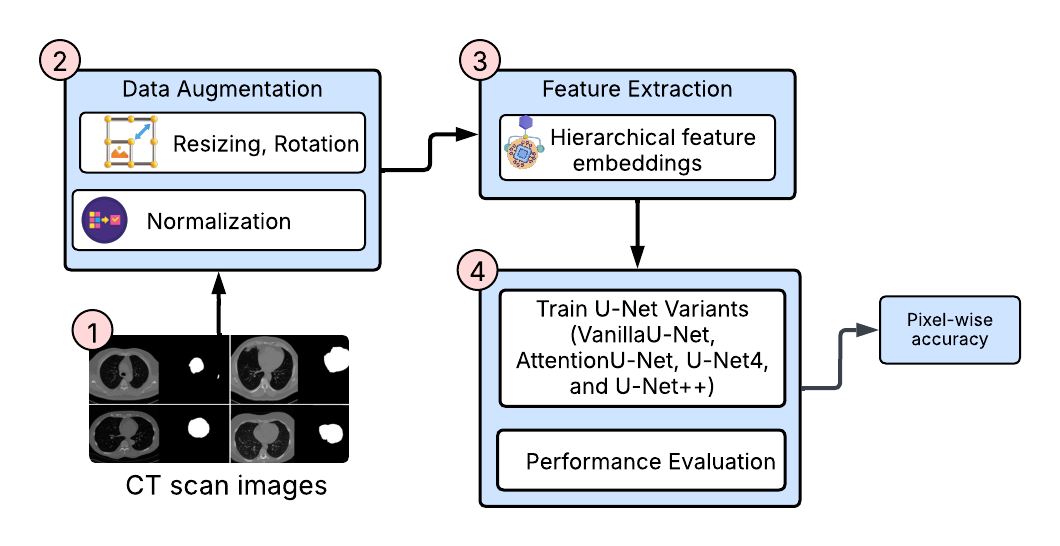
Precise segmentation of cardiac structures from computed tomography angiography (CTA) images is essential for the early analysis of cardiovascular conditions. This study presents a robust deep learning model for precise segmentation of cardiac structures from CTA images, with particular emphasis on pixel-level accuracy and hierarchical convolutional feature learning to delineate thin and low-contrast vessels. Four different variants of the U-Net architecture such as Vanilla U-Net, U-Net4, Attention U-Net, and U-Net++ were evaluated on a publicly available CTA image dataset. The Vanilla U-Net had the best overall accuracy of 99% and precision of 98%, indicating excellent feature learning with very few false positives. However, its recall of 91% was slightly lower, indicating some under-segmentation of the distal vessels. Attention U-Net and U-Net4 had the same accuracy of 98% and F1-score of 95%. Attention U-Net improved precision to 98% with attention-driven feature refinement, while U-Net4 improved recall to 93% with multi-scale feature aggregation. U-Net++ had a slightly lower accuracy of 97% but the best recall of 94%, indicating its dense skip connections that enable the refinement of fine details of the vessels. For all models, the Dice score varied from 92-94% and IoU from 88-89%, while AUC scores were all above 0.99, indicating excellent segmentation performance. Without performing any statistical test or confidence interval calculation, the results show a consistent pattern across all evaluation metrics considered in the study, which suggests that the comparisons between models are reliable. These results demonstrate that by leveraging deep learning-based feature learning accurate and continuous coronary artery segmentations can be obtained. The proposed method has promising potential in improving the non-invasive diagnosis of CAD and reducing the dependence on invasive procedures.
References
“Cardiovascular diseases (CVDs).” Accessed: May 09, 2026. [Online]. Available: https://www.who.int/news-room/fact-sheets/detail/cardiovascular-diseases-(cvds)
“High Blood Pressure and Cardiovascular Disease - PubMed.” Accessed: May 09, 2026. [Online]. Available: https://pubmed.ncbi.nlm.nih.gov/31865786/
“Deep learning-based automatic segmentation of images in cardiac radiography: A promising challenge - PubMed.” Accessed: May 09, 2026. [Online]. Available: https://pubmed.ncbi.nlm.nih.gov/35487181/
R. Birjais, “Challenges and Future Directions for Segmentation of Medical Images Using Deep Learning Models,” Deep Learn. Appl. Med. Image Segmentation Overview, Approaches, Challenges, pp. 243–264, Jan. 2024, doi: 10.1002/9781394245369.CH10.
“Frontiers | Advancements in cardiac structures segmentation: a comprehensive systematic review of deep learning in CT imaging.” Accessed: May 09, 2026. [Online]. Available: https://www.frontiersin.org/journals/cardiovascular-medicine/articles/10.3389/fcvm.2024.1323461/full
“Deep learning-based automatic segmentation of cardiac substructures for lung cancers - PubMed.” Accessed: May 09, 2026. [Online]. Available: https://pubmed.ncbi.nlm.nih.gov/38122850/
“Advances in Medical Image Segmentation: A Comprehensive Review of Traditional, Deep Learning and Hybrid Approaches.” Accessed: May 09, 2026. [Online]. Available: https://www.mdpi.com/2306-5354/11/10/1034
“Multiscale attention guided U-Net architecture for cardiac segmentation in short-axis MRI images - ScienceDirect.” Accessed: May 09, 2026. [Online]. Available: https://www.sciencedirect.com/science/article/pii/S0169260721002170
“Coronary artery segmentation under class imbalance using a U-Net based architecture on computed tomography angiography images | Scientific Reports.” Accessed: May 09, 2026. [Online]. Available: https://www.nature.com/articles/s41598-021-93889-z
“Coronary Artery Segmentation Based on Transfer Learning and UNet Architecture on Computed Tomography Coronary Angiography Images | IEEE Journals & Magazine | IEEE Xplore.” Accessed: May 09, 2026. [Online]. Available: https://ieeexplore.ieee.org/document/10175517
“An analytics-driven review of U-Net for medical image segmentation | Request PDF.” Accessed: May 09, 2026. [Online]. Available: https://www.researchgate.net/publication/395766139_An_analytics-driven_review_of_U-Net_for_medical_image_segmentation
R. Azad et al., “Medical Image Segmentation Review: The Success of U-Net,” IEEE Trans. Pattern Anal. Mach. Intell., vol. 46, no. 12, pp. 10076–10095, 2024, doi: 10.1109/TPAMI.2024.3435571.
“A Comprehensive Review of U‐Net and Its Variants: Advances and Applications in Medical Image Segmentation - Jiangtao - 2025 - IET Image Processing - Wiley Online Library.” Accessed: May 09, 2026. [Online]. Available: https://ietresearch.onlinelibrary.wiley.com/doi/10.1049/ipr2.70019
“U-Net-Based Medical Image Segmentation - PMC.” Accessed: May 09, 2026. [Online]. Available: https://pmc.ncbi.nlm.nih.gov/articles/PMC9033381/
“An automatic approach for heart segmentation in CT scans through image processing techniques and Concat-U-Net | Request PDF.” Accessed: May 09, 2026. [Online]. Available: https://www.researchgate.net/publication/358567283_An_automatic_approach_for_heart_segmentation_in_CT_scans_through_image_processing_techniques_and_Concat-U-Net
“Automated heart segmentation using U-Net in pediatric cardiac CT | Request PDF.” Accessed: May 09, 2026. [Online]. Available: https://www.researchgate.net/publication/355081653_Automated_heart_segmentation_using_U-Net_in_pediatric_cardiac_CT
V. Subha, G. Gomathi, and A. Manivanna Boopathi, “An exploration of ventricle regions segmentation and multiclass disease detection using cardiac MRI,” Int. J. Imaging Syst. Technol., vol. 34, no. 1, Jan. 2024, doi: 10.1002/IMA.22938.
“Frontiers | Adaptive Feature Medical Segmentation Network: an adaptable deep learning paradigm for high-performance 3D brain lesion segmentation in medical imaging.” Accessed: May 09, 2026. [Online]. Available: https://www.frontiersin.org/journals/neuroscience/articles/10.3389/fnins.2024.1363930/full
“Frontiers | Deep Learning for Cardiac Image Segmentation: A Review.” Accessed: May 09, 2026. [Online]. Available: https://www.frontiersin.org/journals/cardiovascular-medicine/articles/10.3389/fcvm.2020.00025/full
M. Ashok and A. Gupta, “A Systematic Review of the Techniques for the Automatic Segmentation of Organs-at-Risk in Thoracic Computed Tomography Images,” Arch. Comput. Methods Eng. 2020 284, vol. 28, no. 4, pp. 3245–3267, Sep. 2020, doi: 10.1007/S11831-020-09497-Z.
“Deep learning-based whole-heart segmentation in 4D contrast-enhanced cardiac CT - PubMed.” Accessed: May 09, 2026. [Online]. Available: https://pubmed.ncbi.nlm.nih.gov/35026571/
“Heart CT & MRI Dataset.” Accessed: May 09, 2026. [Online]. Available: https://www.kaggle.com/datasets/ziya07/heart-ct-and-mri-dataset
“A Comprehensive Survey of Deep Learning Approaches in Image Processing.” Accessed: May 09, 2026. [Online]. Available: https://www.mdpi.com/1424-8220/25/2/531
“Feature extraction and feature selection in medical images - ScienceDirect.” Accessed: May 09, 2026. [Online]. Available: https://www.sciencedirect.com/science/chapter/edited-volume/abs/pii/B9780443159992000086
X. Guo, J. Hu, T. Lu, G. Li, and R. Xiao, “A novel vessel enhancement method based on Hessian matrix eigenvalues using multilayer perceptron,” Biomed. Mater. Eng., vol. 36, no. 2, pp. 83–97, Mar. 2025, doi: 10.1177/09592989241296431.
O. O. Sule, S. Viriri, and A. Abayomi, “Effects of image enhancement techniques on cNns based algorithms for segmentation of blood vessels: A review,” 2020 Int. Conf. Artif. Intell. Big Data, Comput. Data Commun. Syst. icABCD 2020 - Proc., Aug. 2020, doi: 10.1109/ICABCD49160.2020.9183896.
“Lemon-Flavored Gummy Candies: Sourness, Flavor and Overall Acceptance Optimization Using Lattice-Simplex Mixture Design Implemented with Python Programming Language.” Accessed: May 09, 2026. [Online]. Available: https://www.mdpi.com/2673-9976/40/1/41
“A novel sub-differentiable hausdorff loss combined with BCE for MRI brain tumor segmentation using UNet variants | Scientific Reports.” Accessed: May 09, 2026. [Online]. Available: https://www.nature.com/articles/s41598-025-33136-x
“A lightweight segmentation model based on dilated multi-scale residual attention U-Net for brain tumor segmentation - ScienceDirect.” Accessed: May 09, 2026. [Online]. Available: https://www.sciencedirect.com/science/article/pii/S095219762501927X
“Lightweight U-Net for Blood Vessels Segmentation in X-Ray Coronary Angiography - PubMed.” Accessed: May 09, 2026. [Online]. Available: https://pubmed.ncbi.nlm.nih.gov/40278022/
“(PDF) CAS-Net: A Novel Coronary Artery Segmentation Neural Network.” Accessed: May 09, 2026. [Online]. Available: https://www.researchgate.net/publication/355252457_CAS-Net_A_Novel_Coronary_Artery_Segmentation_Neural_Network
Downloads
Published
How to Cite
Issue
Section
License
Copyright (c) 2026 50sea

This work is licensed under a Creative Commons Attribution 4.0 International License.