AI Vision for Health Care: AI-Powered Smart Glasses for Visually Impaired Individual
Keywords:
Machine Learning; Assistive Technology; YOLOv8; Object Detection; Computer Vision; Visually Impaired; Smart Glasses; Text-to-SpeechAbstract
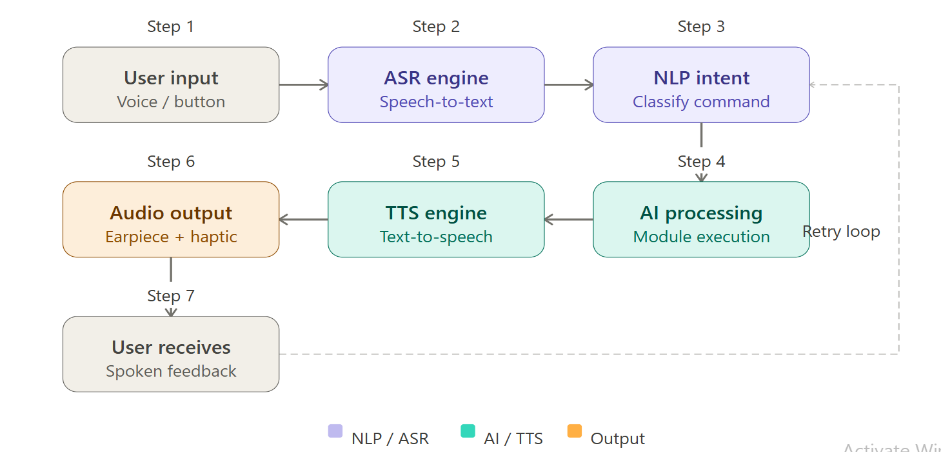
Visual Impairment can be counted among the sensory deficiencies that severely debilitate affected individuals and restrict their capabilities at performing basic everyday tasks like recognizing currency notes, managing their medicines and navigating spatially independent of any aid. In this context, there is still no effective solution available that covers all these requirements under the same umbrella. Thus, this study proposes an innovative concept of an AI-assisted vision help system with unique features. These features incorporate currency recognition, assistance in medicine consumption, and navigation. The system is based on a modular approach where YOLOv8, an advanced object detection technique, has been used for developing different assistive modules with custom annotations for training and optimization through Google Colab using GPUs. Each module was tested with 76% data in the training phase, 15% for validation, and 9% for testing purposes. Acquisition of frames was achieved by OpenCV, which is then processed by the YOLO algorithm, and detected objects are converted into relevant speech using TTS technique. The output speech is transmitted through earphones or bone conduction headphones. Currency recognition module has produced Macro precision scores of 96-98% and mAP@50 of 98.2% after 65 training epochs. Currency detection achieved a performance score of F1-score of 0.96 at confidence level 0.333, Precision of 1.00, and Recall of 1.00. The Medical prescription assistance module has shown Macro precision score of 99.2%, Macro recall of 98.0% and mAP@50 of 99.3% after 50 training epochs. Medical Prescription Detection Module achieved a performance score of F1-score of 0.99 at confidence 0.657, Precision of 1.00, and Recall of 1.00 while navigation assistance module recorded Macro precision of 99.0% and mAP@50 of 75.9% after training 50 epochs. Navigation Module showed an F1-score of 0.73 at confidence level 0.504 Confusion matrixes and Precision Recall Curve results have validated robustness in detecting objects in various lighting conditions along with occluded environments. The total number of images analyzed were 13087, which included all the above modules. It was observed that the inference time required for each frame was 28 ms. comparatively, it was found that YOLOv8 had performed 3.7% better than YOLOv5. All the modules can be run independently by sharing a common backbone detection algorithm. This will save computing power for processing other tasks with ease without any noticeable delay. The suggested technique is scalable and cost-effective enough to offer a practical solution for improving the lives of visually impaired individuals.
References
Saleem Khan, Muhammad Mohsin Khan, “Intelligent Assistive Device for Visually Impaired People - A Computer Vision Based Approach,” Spectr. Eng. Sci., 2025, [Online]. Available: https://thesesjournal.com/index.php/1/article/view/782
Erwin Syahrudin, Ema Utami, “Augmentation for Accuracy Improvement of YOLOv8 in Blind Navigation System,” J. RESTI (Rekayasa Sist. dan Teknol. Informasi), vol. 8, no. 4, pp. 579–588, 2024, doi: 10.29207/resti.v8i4.5931.
G R Venkatkrishnan, R Jeya, “Real-Time Object Detection For The Visually Impaired Using Yolov8 And NLP On Iot Devices,” Int. J. Environ. Sci., vol. 11, no. 8, 2025, [Online]. Available: https://theaspd.com/index.php/ijes/article/view/2142
Incheol Jeong, Kapyol Kim, “YOLOv8-Based XR Smart Glasses Mobility Assistive System for Aiding Outdoor Walking of Visually Impaired Individuals in South Korea,” Electronics, vol. 14, no. 3, p. 425, 2025, doi: https://doi.org/10.3390/electronics14030425.
F. Jiang et al., “Artificial intelligence in healthcare: Past, present and future,” Stroke Vasc. Neurol., vol. 2, no. 4, pp. 230–243, 2017, doi: 10.1136/svn-2017-000101.
G. K. Walia, M. Kumar, and S. S. Gill, “AI-Empowered Fog/Edge Resource Management for IoT Applications: A Comprehensive Review, Research Challenges, and Future Perspectives,” IEEE Commun. Surv. Tutorials, vol. 26, no. 1, pp. 619–669, 2024, doi: 10.1109/COMST.2023.3338015.
E. A. Hassan and T. B. Tang, “Smart glasses for the visually impaired people,” Lect. Notes Comput. Sci. (including Subser. Lect. Notes Artif. Intell. Lect. Notes Bioinformatics), vol. 9759, pp. 579–582, 2016, doi: 10.1007/978-3-319-41267-2_82.
Mingxing Tan, Ruoming Pang, Quoc V. Le, “EfficientDet: Scalable and Efficient Object Detection,” arXiv:1911.09070, 2020, [Online]. Available: https://arxiv.org/abs/1911.09070
“AI Voice‑Activated Assistants Empower Visually Impaired Users | Battle for Blindness.” Accessed: Jun. 02, 2026. [Online]. Available: https://battleforblindness.org/voice-activated-assistants-how-ai-is-empowering-the-visually-impaired
Nilesh Deotale, Shubham Raut, “Smart Assistive Stick for Visually Impaired People using YOLOv8 Algorithm,” Res. Sq., 2024, doi: 10.21203/rs.3.rs-4334164/v1.
Omar Kanaan Taha Alsultan, Mohammad Tarik Mohammad, “A Deep Learning-Based Assistive System for the Visually Impaired Using YOLO-V7,” IIETA J., 2023, [Online]. Available: https://www.iieta.org/journals/ria/paper/10.18280/ria.370409
Wei Wang, Bin Jing, “YOLO-OD: Obstacle Detection for Visually Impaired Navigation Assistance,” Sensors, vol. 24, no. 23, p. 7621, 2024, doi: 10.3390/s24237621.
A. Tavakoli Yaraki, “Seeing with Sound : Object detection, localization with YOLOv8 and audio feedback for blind individuals”, doi: 10.5281/ZENODO.17340214.
Maria Bestarina Laili, Kartika Kartika, “Integrating YOLOv8, EasyOCR, and GTTS for Text Detection in Assistive Technology for the Visually Impaired,” BIS Inf. Technol. Comput. Sci., vol. 2, 2025, [Online]. Available: https://unimma.press/conference/index.php/bistyc/article/view/185
Hoysala Y Devanga, “AI-Driven Vision Assistance for Visually Impaired,” Int. J. Res. Appl. Sci. Eng. Technol., vol. 13, no. 8, pp. 909–915, 2025, doi: 10.22214/ijraset.2025.73684.
G Krishna Reddy, “A Review on Object Detection with Voice Support for the Visually Impaired People,” Ijraset J. Res. Appl. Sci. Eng. Technol., 2024, [Online]. Available: https://www.ijraset.com/research-paper/object-detection-with-voice-support-for-the-visually-impaired-people
Alexey Bochkovskiy, Chien-Yao Wang, Hong-Yuan Mark Liao, “YOLOv4: Optimal Speed and Accuracy of Object Detection,” arXiv:2004.10934, 2020, [Online]. Available: https://arxiv.org/abs/2004.10934
J. Redmon and A. Farhadi, “YOLOv3: An Incremental Improvement,” Apr. 2018, Accessed: Nov. 15, 2023. [Online]. Available: https://arxiv.org/abs/1804.02767v1
T. Y. Lin, P. Goyal, R. Girshick, K. He, and P. Dollar, “Focal Loss for Dense Object Detection,” Proc. IEEE Int. Conf. Comput. Vis., vol. 2017-October, pp. 2999–3007, Dec. 2017, doi: 10.1109/ICCV.2017.324.
A. G. Howard et al., “MobileNets: Efficient Convolutional Neural Networks for Mobile Vision Applications,” arXiv.org, 2017.
Gao Huang, Zhuang Liu, Laurens van der Maaten, Kilian Q. Weinberger, “Densely Connected Convolutional Networks,” arXiv:1608.06993, 2018, [Online]. Available: https://arxiv.org/abs/1608.06993
Alex Krizhevsky, Ilya Sutskever, “ImageNet classification with deep convolutional neural networks,” Commun. ACM, vol. 60, no. 6, 2017, [Online]. Available: https://dl.acm.org/doi/10.1145/3065386
M. Everingham, L. Van Gool, C. K. I. Williams, J. Winn, and A. Zisserman, “The Pascal Visual Object Classes (VOC) Challenge,” Int. J. Comput. Vis. 2009 882, vol. 88, no. 2, pp. 303–338, Sep. 2009, doi: 10.1007/s11263-009-0275-4.
S. Ren, K. He, R. Girshick, and J. Sun, “Faster R-CNN: Towards Real-Time Object Detection with Region Proposal Networks,” IEEE Trans. Pattern Anal. Mach. Intell., vol. 39, no. 6, pp. 1137–1149, Jun. 2017, doi: 10.1109/TPAMI.2016.2577031.
W. Liu et al., “SSD: Single shot multibox detector,” Lect. Notes Comput. Sci. (including Subser. Lect. Notes Artif. Intell. Lect. Notes Bioinformatics), vol. 9905 LNCS, pp. 21–37, 2016, doi: 10.1007/978-3-319-46448-0_2/FIGURES/5.
“Ultralytics/YOLOv5 · Hugging Face.” Accessed: Jun. 02, 2026. [Online]. Available: https://huggingface.co/Ultralytics/YOLOv5
C. Y. Wang, A. Bochkovskiy, and H. Y. M. Liao, “YOLOv7: Trainable Bag-of-Freebies Sets New State-of-the-Art for Real-Time Object Detectors,” Proc. IEEE Comput. Soc. Conf. Comput. Vis. Pattern Recognit., vol. 2023-June, pp. 7464–7475, 2023, doi: 10.1109/CVPR52729.2023.00721.
World Health Organization, “World Health Organisation, ‘World report on vision,’ 2019.,” World Heal. Organ., vol. 214, no. 14, p. 180, 2019, Accessed: Jun. 02, 2026. [Online]. Available: https://iris.who.int/bitstream/handle/10665/328717/9789241516570-eng.pdf?sequence=18
Downloads
Published
How to Cite
Issue
Section
License
Copyright (c) 2026 50sea

This work is licensed under a Creative Commons Attribution 4.0 International License.