A Density-Sensitive IoT System for Detection of Vehicle Submersion and Auto-Buoyancy
DOI:
https://doi.org/10.33411/IJIST/1899Keywords:
Keywords: IoT; vehicle water submersion; density sensor; inflatable platform; CO2 inflation; false alarm reduction; GPS; GSM; Arduino UNO; buoyancy; multi- sensor fusion.Abstract
Water-related vehicle submersion accidents, such as those in rivers, canals and flooded roads, are becoming a rapidly growing cause of traffic fatalities in the world. An estimated 300,000 people drowned in the world in 2021 and drowning is the third leading cause of unintentional injury-related death in the world, accounting for 7% of all unintentional injury-related deaths. Many of these deaths have been attributed to being people trapped in vehicles who were unable to evacuate in time, a substantial proportion of these incidents.
Introduction/Importance of Study: Vehicular water submersion is a fatal emergency situation which causes loss of thousands of lives every year, and the existing vehicular IoT-based safety systems do not have a physical buoyancy response system to prevent the vehicle sinking.
Novelty Statement: A unique density-sensitive multi-sensor fusion algorithm and a flat inflatable TPU platform (shoes, arms, legs etc. under the vehicle chassis in 3 to 5 seconds using CO2 to create stable level buoyancy which eliminates false alarms due to rain <5 kg/m³ versus genuine submersion >800 kg/m³).
Material and Method: The proposed SIPSAS will use an MS5837 water density sensor, water level sensor, ADXL345 accelerometer, and MPU-6050 tilt sensor along with an Arduino UNO microcontroller. The sensor data are processed is processed by a Kalman filter and a three-stage false alarm reduction process. The TPU inflatable platform (4m x 2m x 0.3m) deploys beneath the chassis and inflates with CO2 cartridge. In the event of confirmed submersion, GPS/GSM modules send out Emergency SMS notifications to the rescue services.
Result and Discussion: Using Python-based sensor simulation in Google Colab, the proposed SIPSAS attained the accuracy of 97%, precision of 91%, and recall of 88% and specificity of 86%. The seven test scenarios—heavy rain, car wash, shallow puddle, and the three real submersion environments—were all properly classified without any false alarms. The average time to inflate the platforms was 3.8 seconds, resulting in a horizontal floating period of more than 10 minutes.
Concluding Remarks: The SIPSAS offers a physics-based, automatic, and dependable submersion safety system for vehicles that is superior to current IoT-based approaches and addresses key limitations in current buoyancy response systems and suppression of false alarms.
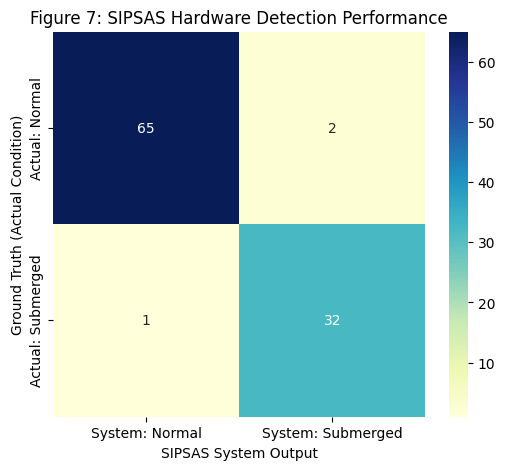
The proposed system was tested with 118 synthetic sensor samples from 7 real-world scenarios (heavy rain, car wash, shallow puddle, flooded road, river, lake, sea water), created in Python with simulation done in Google Colab (Python 3.10). A confusion matrix analysis was used for validation, with an accuracy of 97%, precision of 91%, and recall of 88% and specificity of 86%. This represents a 36% improvement in accuracy from single water-contact sensor baselines. All 4 non-submersion test scenarios had zero false alarms.
References
“National Disaster Management Authority (NDMA).” Accessed: Sep. 06, 2025. [Online]. Available: https://www.ndma.gov.pk/
“Advancing Road Safety Through Intelligent Vehicle Accident Detection and Reporting Enabled by IoT Innovation.” Accessed: May 21, 2026. [Online]. Available: https://www.researchgate.net/publication/384918058_Advancing_Road_Safety_Through_Intelligent_Vehicle_Accident_Detection_and_Reporting_Enabled_by_IoT_Innovation
“(PDF) Real-time Monitoring IoT-based System for Early Flash Flood Notification in Melaka.” Accessed: May 21, 2026. [Online]. Available: https://www.researchgate.net/publication/368291392_Real-time_Monitoring_IoT-based_System_for_Early_Flash_Flood_Notification_in_Melaka
N K Kaphungkui, “Smart Flood Monitoring and Alert System using IoT with GSM Communication,” J. Electr. Syst., vol. 20, no. 11, 2024, doi: 10.52783/jes.8830.
“Global report on drowning prevention.” Accessed: May 21, 2026. [Online]. Available: https://www.who.int/teams/social-determinants-of-health/safety-and-mobility/global-report-on-drowning-prevention
S. A. Mohammed Balfaqih, Soltan Abed Alharbi, Moutaz Alzain, Faisal Alqurashi, “An Accident Detection and Classification System Using Internet of Things and Machine Learning towards Smart City,” Sustainability, vol. 14, no. 1, p. 10, 2022, doi: https://doi.org/10.3390/su14010210.
M. B. Nikhlesh Pathik, Rajeev Kumar Gupta, Yatendra Sahu, Ashutosh Sharma, Mehedi Masud, “AI Enabled Accident Detection and Alert System Using IoT and Deep Learning for Smart Cities,” Sustainability, vol. 14, no. 13, p. 7701, 2022, doi: https://doi.org/10.3390/su14137701.
B. V. P. Josephinshermila, S. Sharon priya, K. Malarvizhi, Ramakrishna hegde, S. Gokul Pran, “Accident detection using Automotive Smart Black-Box based Monitoring system,” Meas. Sensors, vol. 27, p. 100721, 2023, doi: https://doi.org/10.1016/j.measen.2023.100721.
Amal Hussain Alkhaiwani, Badr Soliman Alsamani, “A Framework and IoT-Based Accident Detection System to Securely Report an Accident and the Driver’s Private Information,” Sustainability, vol. 15, no. 10, 2023, doi: 10.3390/su15108314.
X. Zeng, B. Wang, C. Wu, S. D. Regani, and K. J. Ray Liu, “WiCPD: Wireless Child Presence Detection System for Smart Cars,” IEEE Internet Things J., vol. 9, no. 24, pp. 24866–24881, Dec. 2022, doi: 10.1109/JIOT.2022.3194873.
S. S. Jayaweera, B. Wang, X. Zeng, W. H. Wang, and K. J. Ray Liu, “WIFI-Based Robust Child Presence Detection for Smart Cars,” ICASSP, IEEE Int. Conf. Acoust. Speech Signal Process. - Proc., vol. 2023-June, 2023, doi: 10.1109/ICASSP49357.2023.10096908.
Leona Dennis, Preetha S L, “Anti-Drowning Inflatable System,” Int. J. Res. Appl. Sci. Eng. Technol., vol. 13, no. 3, pp. 2334–2339, 2025, doi: 10.22214/ijraset.2025.67806.
“Vehicle Recovery System - iSubC.” Accessed: May 21, 2026. [Online]. Available: https://isubc.com/product/vehicle-recovery-system/
Mingyu Ouyang, Bowei Zeng, “A deep learning method for identifying waterlogging depth on urban roadways from surveillance camera images,” Remote Sens. Appl. Soc. Environ., vol. 41, p. 101827, 2026, doi: https://doi.org/10.1016/j.rsase.2025.101827.
Dong Zou, Xuejian Jiao, “Design and Multi-Objective Optimization of an Electric Inflatable Pontoon Amphibious Vehicle,” World Electr. Veh. J., vol. 16, no. 2, p. 58, 2025, doi: https://doi.org/10.3390/wevj16020058.
“IoT Based Smart Vehicle Safety System,” Int. J. Eng. Res. Technol., doi: 10.5281/ZENODO.18596501.
“(PDF) Automatic prevention of drowning by inflatable wrist band system.” Accessed: May 21, 2026. [Online]. Available: https://www.researchgate.net/publication/393024184_Automatic_prevention_of_drowning_by_inflatable_wrist_band_system
Jungme Park, Wenchang Yu, “A Sensor Fused Rear Cross Traffic Detection System Using Transfer Learning,” Sensors, vol. 21, no. 18, 2021, doi: 10.3390/s21186055.
K. Sudhakar et al., “Deep Learning-Based MultiSensor Fusion for Safe and Efficient Autonomous Vehicle Operations in IoT-Enabled Smart Cities,” AI’s role Enhanc. Automot. Saf., pp. 109–126, Jan. 2025, doi: 10.4018/979-8-3373-0442-7.CH008.
“(PDF) Design and Construction of Microcontroller based Vehicle Accident detection and reporting System.” Accessed: May 21, 2026. [Online]. Available: https://www.researchgate.net/publication/356378428_Design_and_Construction_of_Microcontroller_based_Vehicle_Accident_detection_and_reporting_System
Para Keerti, Kandela Ruchitha, “IOT Based GPS Vehicle Tracking and Monitoring System,” Int. Res. J. Adv. Eng. Manag., vol. 3, no. 5, pp. 2164–2169, 2025, doi: 10.47392/IRJAEM.2025.0342.
“Underwater gas release modeling and verification analysis | Request PDF.” Accessed: May 21, 2026. [Online]. Available: https://www.researchgate.net/publication/339132821_Underwater_gas_release_modeling_and_verification_analysis
Zhou Yang, Shuibo Hu, “A Low-Cost Variable Buoyancy System for Hybrid Aerial Underwater Vehicle,” Appl. Sci., vol. 15, no. 17, p. 9499, 2025, doi: https://doi.org/10.3390/app15179499.
Eun Yeop Choi, Chang Keun Kim, “Degradation and lifetime prediction of thermoplastic polyurethane encapsulants in seawater for underwater acoustic sensor applications,” Polym. Degrad. Stab., vol. 209, p. 110281, 2023, doi: https://doi.org/10.1016/j.polymdegradstab.2023.110281.
Maha Bouaziz, Houda Jmila, Skander Mhadhbi, Darine Rammal, “Connected vehicles in the 5G era: a position paper,” Ann. Telecommun., 2026, [Online]. Available: https://link.springer.com/article/10.1007/s12243-026-01171-y
Mohammad Ali Sahraei, Said Ramadhan, “A Review of Internet of Things Approaches for Vehicle Accident Detection and Emergency Notification,” Sust, vol. 17, no. 14, 2025, [Online]. Available: https://ui.adsabs.harvard.edu/abs/2025Sust...17.6510S/abstract
Y. Yao and E. Atkins, “The Smart Black Box: A Value-Driven High-Bandwidth Automotive Event Data Recorder,” IEEE Trans. Intell. Transp. Syst., vol. 22, no. 3, pp. 1484–1496, Mar. 2021, doi: 10.1109/TITS.2020.2971385.
B. K. Tiwari, R. Sharma, “Study on System Design and Integration of Variable Buoyancy Systems for Underwater Operation,” Def. Sci. J., vol. 71, no. 1, pp. 124–133, 2021, doi: 10.14429/dsj.71.15557.
K. I. Sadek et al., “A Review of Various Buoyancy Control Mechanisms for Underwater Vehicles,” Adv. Sci. Eng. Technol. Int. Conf. ASET, no. 2025, 2025, doi: 10.1109/ASET66891.2025.11427867.
J Aparicio-Navarro, Ali Safaa Sadiq Al Shakarchi, “Sensors in Self-Driving Vehicles: A Detailed Literature Review and New Trends,” Sensors, vol. 26, no. 7, p. 2153, 2026, doi: https://doi.org/10.3390/s26072153.
Downloads
Published
How to Cite
Issue
Section
License
Copyright (c) 2026 50sea

This work is licensed under a Creative Commons Attribution 4.0 International License.