Federated Learning-Based Intrusion Detection and Energy Optimization for IoT Networks Using Whale Optimization Algorithm
Keywords:
Internet of Things (IoT), Intrusion Detection Systems (IDS), Federated Learning (FL). Whale Optimization Algorithm (WOA).Abstract
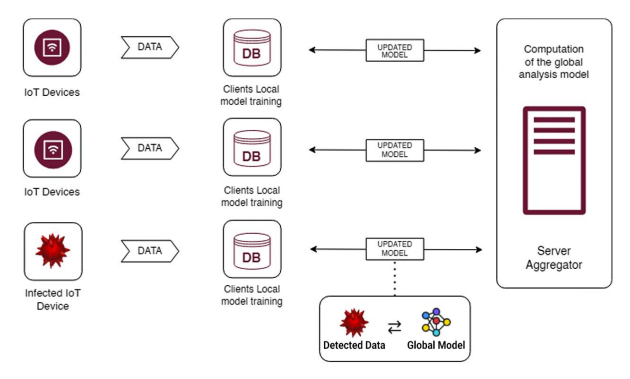
The IoT devices plays an important role in today’s technology. However, with rapid growth of IoT based technology, security of these devices and high power consumption are significant challenges. To mitigate these challenges, this research work proposed novel federated learning-based intrusion detection system to mitigate security issues. Moreover, to minimize energy consumption, a whale colony-based algorithm is proposed. The results are simulated and compared with other studied algorithms. The proposed algorithms outperformed the other understudied algorithms. Experimental results on the CIC-IoT-2023 dataset demonstrate that the proposed FL-WOA framework achieved 99.17% intrusion detection accuracy, outperforming existing federated learning approaches by up to 5.56%, while significantly reducing network energy consumption through optimized resource allocation.
References
S. Sicari, A. Rizzardi, L. A. Grieco, and A. Coen-Porisini, “Security, privacy and trust in Internet of things: The road ahead,” Comput. Networks, vol. 76, pp. 146–164, Jan. 2015, doi: 10.1016/J.COMNET.2014.11.008.
H. Ren, D. Anicic, and T. A. Runkler, “The synergy of complex event processing and tiny machine learning in industrial IoT,” DEBS 2021 - Proc. 15th ACM Int. Conf. Distrib. Event-Based Syst., pp. 126–135, Jun. 2021, doi: 10.1145/3465480.3466928; Topic:Conference collections>Debs;Page:String:Article/Chapter.
M. Sayad Haghighi, F. Farivar, A. Jolfaei, A. B. Asl, and W. Zhou, “Cyber Attacks via Consumer Electronics: Studying the Threat of Covert Malware in Smart and Autonomous Vehicles,” IEEE Trans. Consum. Electron., vol. 69, no. 4, pp. 825–832, Nov. 2023, doi: 10.1109/TCE.2023.3297965.
A. A. S. & J. A. Adeel Abbas, Muazzam A. Khan, Shahid Latif, Maria Ajaz, “A New Ensemble-Based Intrusion Detection System for Internet of Things,” Arab. J. Sci. Eng., vol. 47, pp. 1805–1819, 2022, doi: https://doi.org/10.1007/s13369-021-06086-5.
Rayeesa Malik, Yashwant Singh, “[Retracted] An Improved Deep Belief Network IDS on IoT-Based Network for Traffic Systems,” J. Adv. Transp., 2022, [Online]. Available: https://onlinelibrary.wiley.com/doi/10.1155/2022/7892130
V. S. and I. K. S. U. Jan, S. Ahmed, “Toward a Lightweight Intrusion Detection System for the Internet of Things,” IEEE Access, vol. 7, pp. 42450–42471, 2019, doi: 10.1109/ACCESS.2019.2907965.
B. Gopalakrishnan and P. Purusothaman, “A new design of intrusion detection in IoT sector using optimal feature selection and high ranking-based ensemble learning model,” Peer-to-Peer Netw. Appl. 2022 155, vol. 15, no. 5, pp. 2199–2226, Jun. 2022, doi: 10.1007/S12083-022-01336-1.
T. K. Das Manikant Panthi, “Intelligent Intrusion Detection Scheme for Smart Power-Grid Using Optimized Ensemble Learning on Selected Features,” Int. J. Crit. Infrastruct. Prot., vol. 39, p. 100567, 2022, doi: https://doi.org/10.1016/j.ijcip.2022.100567.
Cristiano Antonio de Souza, Carlos Becker Westphall, “Two-step ensemble approach for intrusion detection and identification in IoT and fog computing environments,” Comput. Electr. Eng., vol. 98, p. 107694, 2022, doi: https://doi.org/10.1016/j.compeleceng.2022.107694.
K. Cao, Y. Liu, G. Meng and Q. Sun, “An Overview on Edge Computing Research,” IEEE Access, vol. 8, pp. 85714–85728, 2020, doi: 10.1109/ACCESS.2020.2991734.
A. A. G. Euclides Carlos Pinto Neto, Sajjad Dadkhah, Raphael Ferreira, Alireza Zohourian, Rongxing Lu, “CICIoT2023: A Real-Time Dataset and Benchmark for Large-Scale Attacks in IoT Environment,” Sensors, vol. 23, no. 13, p. 5941, 2023, doi: https://doi.org/10.3390/s23135941.
Dr Lachit Dutta, Swapna Bharali, “TinyML Meets IoT: A Comprehensive Survey,” Internet of Things, vol. 16, no. 9, p. 100461, 2021, doi: 10.1016/j.iot.2021.100461.
Souradip Roy, Juan Li, “A Two-layer Fog-Cloud Intrusion Detection Model for IoT Networks,” Internet of Things, vol. 19, p. 100557, 2022, doi: https://doi.org/10.1016/j.iot.2022.100557.
Xiaoxuan Wang, Feiyu Zhao, “Evaluating computing performance of deep neural network models with different backbones on IoT-based edge and cloud platforms,” Internet of Things, vol. 20, p. 100609, 2022, doi: https://doi.org/10.1016/j.iot.2022.100609.
Bayi Xu, Lei Sun, “IoT Intrusion Detection System Based on Machine Learning,” Electronics, vol. 12, no. 20, p. 4289, 2023, doi: https://doi.org/10.3390/electronics12204289.
P. García-Teodoro, J. Díaz-Verdejo, “Anomaly-based network intrusion detection: Techniques, systems and challenges,” Comput. Secur., vol. 28, no. 1–2, pp. 18–28, 2009, doi: https://doi.org/10.1016/j.cose.2008.08.003.
S. Guan, J. Wang, C. Jiang, J. Tong, and Y. Ren, “Intrusion detection for wireless sensor networks: A multi-criteria game approach,” IEEE Wirel. Commun. Netw. Conf. WCNC, vol. 2018-April, pp. 1–6, Jun. 2018, doi: 10.1109/WCNC.2018.8377427.
K. D. & B. H. FatimaEzzahra Laghrissi, Samira Douzi, “IDS-attention: an efficient algorithm for intrusion detection systems using attention mechanism,” J. Big Data, vol. 8, no. 149, 2021, doi: https://doi.org/10.1186/s40537-021-00544-5.
Zeeshan Ahmad, Adnan Shahid Khan, Cheah Wai Shiang, Johari Abdullah, Farhan Ahmad, “Network intrusion detection system: A systematic study of machine learning and deep learning approaches,” Trans. Emerg. Telecommun. Technol., vol. 32, no. 1, 2020.
T. S. Wooyeon Jo, Sungjin Kim, Changhoon Lee, “Packet Preprocessing in CNN-Based Network Intrusion Detection System,” Electronics, vol. 9, no. 7, p. 1151, 2020, doi: https://doi.org/10.3390/electronics9071151.
H. Rajadurai and U. D. Gandhi, “A stacked ensemble learning model for intrusion detection in wireless network,” Neural Comput. Appl., vol. 34, no. 18, pp. 15387–15395, Sep. 2022, doi: 10.1007/S00521-020-04986-5/METRICS.
S. Z. Owais Bukhari, Parul Agarwal, Deepika Koundal, “Anomaly detection using ensemble techniques for boosting the security of intrusion detection system,” Procedia Comput. Sci., vol. 218, pp. 1003–1013, 2023, doi: https://doi.org/10.1016/j.procs.2023.01.080.
H. Yao, P. Gao, P. Zhang, J. Wang, C. Jiang, and L. Lu, “Hybrid intrusion detection system for edge-based IIoT relying on machine-learning-aided detection,” IEEE Netw., vol. 33, no. 5, pp. 75–81, Sep. 2019, doi: 10.1109/MNET.001.1800479.
Sauptik Dhar, Junyao Guo, “A Survey of On-Device Machine Learning: An Algorithms and Learning Theory Perspective,” ACM Trans. Internet Things, vol. 2, no. 3, 2021, [Online]. Available: https://dl.acm.org/doi/10.1145/3450494
Xiaokang Zhou, Qiuyue Yang, Xuzhe Zheng, Wei Liang, Kevin I-Kai Wang, Jianhua Ma, Yi Pan, Qun Jin, “Personalized Federated Learning With Model-Contrastive Learning for Multi-Modal User Modeling in Human-Centric Metaverse,” IEEE J. Sel. Areas Commun., vol. 42, no. 4, 2024, [Online]. Available: https://ieeexplore.ieee.org/stamp/stamp.jsp?arnumber=10384325
T. R. G. Shaashwat Agrawal, Sagnik Sarkar, Ons Aouedi, Gokul Yenduri, Kandaraj Piamrat, Sweta Bhattacharya, Praveen Kumar Reddy Maddikunta, “Federated Learning for Intrusion Detection System: Concepts, Challenges and Future Directions,” arXiv:2106.09527, 2021, doi: https://doi.org/10.48550/arXiv.2106.09527.
V. C. Riccardo Lazzarini, Huaglory Tianfield, “Federated Learning for IoT Intrusion Detection,” AI, vol. 4, no. 3, pp. 509–530, 2023, doi: https://doi.org/10.3390/ai4030028.
M. E. Md Mamunur Rashid, Shahriar Usman Khan, Fariha Eusufzai, Md. Azharuddin Redwan, Saifur Rahman Sabuj, “A Federated Learning-Based Approach for Improving Intrusion Detection in Industrial Internet of Things Networks,” Network, vol. 3, no. 1, pp. 158–179, 2023, doi: https://doi.org/10.3390/network3010008.
R. S. Aashmi, T. Jaya, “Intrusion Detection Using Federated Learning for Computing,” Comput. Syst. Sci. Eng., vol. 45, no. 2, pp. 1295–1308, 2023, doi: 10.32604/csse.2023.027216.
P. Ruzafa-Alcázar et al, “Intrusion Detection Based on Privacy-Preserving Federated Learning for the Industrial IoT,” IEEE Trans. Ind. Informatics, vol. 19, no. 2, pp. 1145–1154, 2023, doi: 10.1109/TII.2021.3126728.
D. C. Nguyen, M. Ding, P. N. Pathirana, A. Seneviratne, J. Li and H. Vincent Poor, “Federated Learning for Internet of Things: A Comprehensive Survey,” IEEE Commun. Surv. Tutorials, vol. 23, no. 3, pp. 1622–1658, 2021, doi: 10.1109/COMST.2021.3075439.
Mir Shahnawaz Ahmad, Shahid Mehraj Shah, “A lightweight mini-batch federated learning approach for attack detection in IoT,” Internet of Things, vol. 25, p. 101088, 2024, doi: https://doi.org/10.1016/j.iot.2024.101088.
S. Chatterjee and M. K. Hanawal, “Federated learning for intrusion detection in IoT security: a hybrid ensemble approach,” Int. J. Internet Things Cyber-Assurance, vol. 2, no. 1, p. 62, 2022, doi: 10.1504/IJITCA.2022.124372.
F. Wang, G. Xu and M. Wang, “An Improved Genetic Algorithm for Constrained Optimization Problems,” IEEE Access, vol. 11, pp. 10032–10044, 2023, doi: 10.1109/ACCESS.2023.3240467.
M. L. and M. L. J. Liu, D. Yang, “Research on Intrusion Detection Based on Particle Swarm Optimization in IoT,” IEEE Access, vol. 9, pp. 38254–38268, 2021, doi: 10.1109/ACCESS.2021.3063671.
M. Dorigo, V. Maniezzo, and A. Colorni, “Ant system: Optimization by a colony of cooperating agents,” IEEE Trans. Syst. Man, Cybern. Part B Cybern., vol. 26, no. 1, pp. 29–41, 1996, doi: 10.1109/3477.484436.
J. Zhang, C. Luo, M. Carpenter, and G. Min, “Federated Learning for Distributed IIoT Intrusion Detection Using Transfer Approaches,” IEEE Trans. Ind. Informatics, vol. 19, no. 7, pp. 8159–8169, Jul. 2023, doi: 10.1109/TII.2022.3216575.
J. Zhang, C. Luo, M. Carpenter, and G. Min, “Federated Learning for Distributed IIoT Intrusion Detection Using Transfer Approaches,” IEEE Trans. Ind. Informatics, vol. 19, no. 7, pp. 8159–8169, Jul. 2023, doi: 10.1109/TII.2022.3216575.
J. Li, X. Tong, J. Liu, and L. Cheng, “An Efficient Federated Learning System for Network Intrusion Detection,” IEEE Syst. J., vol. 17, no. 2, pp. 2455–2464, Jun. 2023, doi: 10.1109/JSYST.2023.3236995.
D. C. Attota, V. Mothukuri, R. M. Parizi and S. Pouriyeh, “An Ensemble Multi-View Federated Learning Intrusion Detection for IoT,” IEEE Access, vol. 9, pp. 117734–117745, 2021, doi: 10.1109/ACCESS.2021.3107337.
Bingqin Su, Yuting Lin, “Sewage treatment system for improving energy efficiency based on particle swarm optimization algorithm,” Energy Reports, vol. 8, pp. 8701–8708, 2022, doi: https://doi.org/10.1016/j.egyr.2022.06.053.
C. Iwendi, P. K. R. Maddikunta, T. R. Gadekallu, K. Lakshmanna, A. K. Bashir, and M. J. Piran, “A metaheuristic optimization approach for energy efficiency in the IoT networks,” Softw. - Pract. Exp., vol. 51, no. 12, pp. 2558–2571, Dec. 2021, doi: 10.1002/SPE.2797;REQUESTEDJOURNAL:JOURNAL:1097024X.
K. V. Prachi Maheshwari, Ajay K. Sharma, “Energy efficient cluster based routing protocol for WSN using butterfly optimization algorithm and ant colony optimization,” Ad Hoc Networks, vol. 110, p. 102317, 2021, doi: https://doi.org/10.1016/j.adhoc.2020.102317.
Jayavardhana Gubbi, Rajkumar Buyya, “Internet of Things (IoT): A vision, architectural elements, and future directions,” Futur. Gener. Comput. Syst., vol. 29, no. 7, pp. 1645–1660, 2013, doi: https://doi.org/10.1016/j.future.2013.01.010.
M. F. Alam, P. Singla, and R. N. Phursule, “Design of Detection System using Deep Learning Algorithm for Attack on Network,” 2022 IEEE 7th Int. Conf. Converg. Technol. I2CT 2022, 2022, doi: 10.1109/I2CT54291.2022.9824150.
M. Spirito et al., “Internet of Things applications - From research and innovation to market deployment,” Internet Things Appl. From Res. Innov. to Mark. Deploy., pp. 243–286, Jun. 2014, doi: 10.1201/9781003338628/Internet-Things-Applications-Research-Innovation-Market-Deployment-Peter-Friess-Ovidiu-Vermesan/Rights-And-Permissions.
I. Stojmenovic and S. Wen, “The Fog computing paradigm: Scenarios and security issues,” 2014 Fed. Conf. Comput. Sci. Inf. Syst. FedCSIS 2014, pp. 1–8, Oct. 2014, doi: 10.15439/2014F503.
Valerian Rey, Pedro Miguel Sánchez Sánchez, “Federated learning for malware detection in IoT devices,” Comput. Networks, vol. 204, 2022, [Online]. Available: https://www.sciencedirect.com/science/article/pii/S1389128621005582
Kelton A.P. da Costa, João P. Papa, “Internet of Things: A survey on machine learning-based intrusion detection approaches,” Comput. Networks, vol. 151, 2019, [Online]. Available: https://www.sciencedirect.com/science/article/pii/S1389128618308739
G. Kambourakis, C. Kolias, and A. Stavrou, “The Mirai botnet and the IoT Zombie Armies,” Proc. - IEEE Mil. Commun. Conf. MILCOM, vol. 2017-October, pp. 267–272, Dec. 2017, doi: 10.1109/MILCOM.2017.8170867.
Q. V. Pham, S. Mirjalili, N. Kumar, M. Alazab, and W. J. Hwang, “Whale Optimization Algorithm with Applications to Resource Allocation in Wireless Networks,” IEEE Trans. Veh. Technol., vol. 69, no. 4, pp. 4285–4297, Apr. 2020, doi: 10.1109/TVT.2020.2973294.
Akash Dogra, “CIC IoT dataset 2023,” Kaggle, 2023, [Online]. Available: https://www.kaggle.com/datasets/akashdogra/cic-iot-2023
Fatima Asiri, “Explainable federated learning through causal reasoning for intrusion detection in IoT,” Discov. Internet Things, vol. 6, no. 23, 2026, [Online]. Available: https://link.springer.com/article/10.1007/s43926-026-00292-z
Luo, Yiqiong Liang & Mingwan, “Optimization of distributed network intrusion detection system based on internet of things and federated learning,” Discov. Internet Things, vol. 6, no. 3, 2026, [Online]. Available: https://link.springer.com/article/10.1007/s43926-025-00260-z
M. Kamran et al., “A blockchain-assisted secure federated learning architecture for intrusion detection in internet of things networks,” Sci. Reports 2026, May 2026, doi: 10.1038/S41598-026-53053-X.
J. Du, “A novel intrusion detection system for IIoT in 5G networks using attention-augmented federated learning and lightweight transformer architectures,” Sci. Reports 2026, May 2026, doi: 10.1038/S41598-026-54748-X.
Thien D. Nguyen, Ammar Alazab, Ansam Khraisat & Tony Jan, “Feature reduction in federated learning for intrusion detection in IoT networks,” Cybersecurity, vol. 9, no. 102, 2026, [Online]. Available: https://link.springer.com/article/10.1186/s42400-025-00509-8
Ali Alqazzaz, “SecuFL-IoT: an adaptive privacy-preserving federated learning framework for anomaly detection in smart industrial networks,” Sci. Rep., vol. 16, 2026, [Online]. Available: https://www.nature.com/articles/s41598-025-11883-1
Muhammad Ahmad Bilal, Ihtesham Ul Islam, Sarmad Idrees, “Dataset-centric evaluation of federated intrusion detection models in IoT networks,” Sci. Rep., vol. 16, 2026, [Online]. Available: http://nature.com/articles/s41598-025-32567-w
Chao Feng, Alberto Huertas Celdrán, Jing Han, “A crowdsensing intrusion detection dataset for decentralized federated learning models,” Sci. Data, 2026, [Online]. Available: https://www.nature.com/articles/s41597-026-07155-w
Q.-V. P. Minh Ngoc Luu, Minh-Duong Nguyen, Ebrahim Bedeer, Van Duc Nguyen, Dinh Thai Hoang, Diep N. Nguyen, “Sample-Driven Federated Learning for Energy-Efficient and Real-Time IoT Sensing,” arXiv:2310.07497, 2023, doi: https://doi.org/10.48550/arXiv.2310.07497.
“GitHub - iZRJ/Federated-Learning-Based-Intrusion-Detection-System: FL-based intrusion detection system development using model averaging. · GitHub.” Accessed: May 31, 2026. [Online]. Available: https://github.com/iZRJ/Federated-Learning-Based-Intrusion-Detection-System
Peter Kairouz, H. Brendan McMahan, Brendan Avent, Peter Kairouz, H. Brendan McMahan, Brendan Avent, “Advances and Open Problems in Federated Learning,” arXiv:1912.04977, 2019, [Online]. Available: https://arxiv.org/abs/1912.04977
Keith Bonawitz, Hubert Eichner, Wolfgang Grieskamp, Dzmitry Huba, Alex Ingerman, “Towards Federated Learning at Scale: System Design,” arXiv:1902.01046, 2019, [Online]. Available: https://arxiv.org/abs/1902.01046
Aditya Durgadas Naik, Raj Mani Shukla, “Beyond data sharing: enhancing IoT intrusion detection with blockchain-enabled federated learning,” Front. Comput. Sci., vol. 8, 2026, doi: https://doi.org/10.3389/fcomp.2026.1770179.
Hafiz Bilal Ahmad, Haichang Gao, “FedMamba: Robust multimodal federated intrusion detection for heterogeneous IoT systems,” Internet of Things, vol. 6, p. 101877, 2026, doi: https://doi.org/10.1016/j.iot.2026.101877.
N. Hamdi, “Federated learning-based intrusion detection system for Internet of Things,” Int. J. Inf. Secur., vol. 22, no. 6, pp. 1937–1948, Dec. 2023, doi: 10.1007/S10207-023-00727-6/METRICS.
Downloads
Published
How to Cite
Issue
Section
License
Copyright (c) 2026 50sea

This work is licensed under a Creative Commons Attribution 4.0 International License.