Exploring Climate Variability in Lahore, Pakistan: Investigating the Interplay of Precipitation, Relative Humidity, and Temperature
Keywords:
Climate, Temperature, Precipitation, Relative Humidity, Linear Regression Coefficient, Correlation CoefficientAbstract
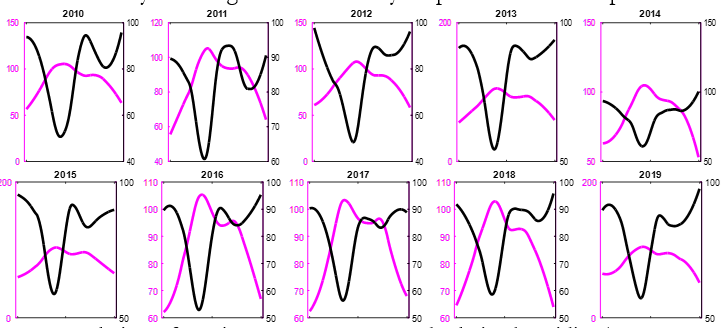
In recent years, the rapid changes in climate parameters such as temperature, precipitation, and relative humidity have become increasingly evident. To address this, the study investigates the intricate fluctuations within distinct climatic parameters precipitation, relative humidity, and maximum temperature—for ten years that capture pronounced pre-2020 climatic variability and provides a critical baseline for interpreting more recent and ongoing climatic shifts in Lahore. Understanding these dynamics is important due to Lahore’s vulnerability to climate variation and its implications for agriculture and urban sustainability. Monthly climatic data was investigated to identify trends, while linear regression and correlation analyses were employed to quantify relationships among the variables. Findings revealed that precipitation shows a consistent pattern of minor fluctuations across the years. Of particular note, 2015 emerges as the driest year among the dataset, while 2013 and 2017 stand out as the wettest years. The years 2010 and 2014 observed the highest levels of precipitation. Relative humidity, uncovers a remarkable uniformity in its yearly evolution from 2010 to 2019 having lowest values during the summer months, primarily in May and peak values during the winter months, specifically in January and February. The analysis of maximum temperature patterns, except for 2014, showcases a consistent pattern of uniformity from 2010 to 2019. May consistently records the highest maximum temperatures, while January consistently registers the lowest minimum temperatures. Quantitative analysis demonstrated a strong inverse relationship between maximum temperature and relative humidity, with correlation coefficients ranging from −0.43 to −0.71 and regression coefficients varying from −0.40 to −0.84. Similarly, temperature and precipitation exhibited weak to moderate negative correlations (CRC = −0.14 to −0.32), indicating reduced precipitation under warmer conditions. In contrast, precipitation and relative humidity showed positive associations with correlation coefficients ranging from 0.10 to 0.26 and regression coefficients reaching 0.70, suggesting that increased precipitation contributes to elevated humidity levels. These findings highlight the strong relation among climatic variables and underscore their relevance for agricultural planning, water resource management, and urban climate adaptation strategies particularly in light of intensifying climate variability observed in the post-2019 period.
References
Tofan Agung Eka Prasetya, Rafika Minati Devi, “Systematic assessment of the warming trend in Madagascar’s mainland daytime land surface temperature from 2000 to 2019,” J. African Earth Sci., vol. 189, p. 104502, 2022, doi: https://doi.org/10.1016/j.jafrearsci.2022.104502.
Adeel Tahir, Muhammad Ashraf, “Temperature data of Hyderabad from the temperature of three neighboring cities using the ANN and the multiple regression methods,” Kuwait J. Sci., vol. 50, pp. 147–161, 2023, doi: 10.48129/kjs.20585.
Young-Min Yang, Jae-Heung Park, Soon-Il An, “Mean sea surface temperature changes influence ENSO-related precipitation changes in the mid-latitudes,” Nat. Commun., vol. 12, 2021, [Online]. Available: https://www.nature.com/articles/s41467-021-21787-z
Bruska S. Mamand, Dana K. Mawlood, “Identifying sources of groundwater and recharge zone using stable environmental isotopes in the Erbil basin-northern Iraq,” Kuwait J. Sci., vol. 51, no. 1, p. 100128, 2024, [Online]. Available: https://www.sciencedirect.com/science/article/pii/S2307410823001530
Fiona Bassy William, Prasanna Mohan Viswanathan, “Spatial and temporal distribution of geochemical elements and their processes in different size fractions–Miri River (NW Borneo),” Kuwait J. Sci., vol. 51, no. 1, p. 100136, 2024, [Online]. Available: https://www.sciencedirect.com/science/article/pii/S2307410823001773
R. Izhar, S. Afsar, S. Bano, and S. Hasnain, “The Role of Industries in Accelerating Climate Change: A Case Study of Karachi (SITE Industrial Area),” Int. J. Innov. Sci. Technol., vol. 7, no. 9, pp. 57–65, 2025, Accessed: Feb. 04, 2026. [Online]. Available: https://ideas.repec.org/a/abq/ijist1/v7y2025i9p57-65.html
B. Jalil, A., Syed, T., Ibrar, M., & Bahadar, “Resilience Assessment of Urban Areas in Peshawar, Pakistan, in Response to Climate Change Impacts,” Int. J. Innov. Sci. Technol., vol. 6, no. 6, pp. 333–340, 2024, [Online]. Available: https://www.researchgate.net/publication/382447164_Resilience_Assessment_of_Urban_Areas_in_Peshawar_Pakistan_in_Response_to_Climate_Change_Impacts
M. M. Rahman, N. Ferdousi, S. M. A. Abdullah, S. Kusunoki, and A. Islam, “Recent Climate Simulation over SAARC Region Including Bangladesh Using High Resolution AGCM,” Asia-Pacific J. Atmos. Sci. 2019 552, vol. 55, no. 2, pp. 115–134, Feb. 2019, doi: 10.1007/s13143-018-0077-0.
Kuo Li, Gyilbag Amatus, “Spatiotemporal changes of heat waves and extreme temperatures in the main cities of China from 1955 to 2014,” Nat. Hazards Earth Syst. Sci., vol. 20, no. 7, pp. 1889–1901, 2020, [Online]. Available: https://nhess.copernicus.org/articles/20/1889/2020/
Maria Latif, Syed Imran Hussain Shah, “Assessing Climate Change Vulnerability and Identifying Adaptation Strategies for Sustainable Agriculture in Pakistan,” Int. J. Adv. Sustain. Dev., vol. 1, no. 1, pp. 42–50, 2024, [Online]. Available: https://journals.uol.edu.pk/IJASD/article/view/3036
Muhammad Rizwanullah, Anhua Yang, “Resilience in maize production for food security: Evaluating the role of climate-related abiotic stress in Pakistan,” Heliyon, vol. 9, no. 11, p. e22140, 2023, [Online]. Available: https://www.sciencedirect.com/science/article/pii/S2405844023093489
M. B. Safeera Zaineb, “Assessing Eight Years of Monsoon Rainfall Patterns in Karachi, Pakistan: Study of the Intense Rainfall Events,” Int. J. Innov. Sci. Technol., vol. 6, no. 2, pp. 621–631, 2024, [Online]. Available: https://journal.50sea.com/index.php/IJIST/article/view/767#:~:text=The yearly (2016-2023),in August 2020 and 2022.
S. Zaineb, M. Jamal, and M. Bashir*, “Trend Analysis and Prediction for Extreme Temperature of Lahore, Pakistan,” Int. J. Innov. Sci. Technol., vol. 7, no. 3, pp. 1779–1796, 2025, Accessed: Jun. 06, 2026. [Online]. Available: https://ideas.repec.org/a/abq/ijist1/v7y2025i3p1779-1796.html
Yeon Hee Kim, Seung Ki Min, “Evaluation of the CMIP6 multi-model ensemble for climate extreme indices,” Weather Clim. Extrem., vol. 29, p. 100269, 2020, doi: https://doi.org/10.1016/j.wace.2020.100269.
Tanuja, Rajesh Kumar, “Climatic shifts in the Beas Basin: A spatio-temporal analysis of time series of temperature and precipitation of TerraClimate dataset,” Sci. Total Environ., vol. 984, p. 179712, 2025, doi: https://doi.org/10.1016/j.scitotenv.2025.179712.
S. H. B. Ali, M. N. Shafqat, S. A. M. A. S. Eqani, and S. T. A. Shah, “Trends of climate change in the upper Indus basin region, Pakistan: implications for cryosphere,” Environ. Monit. Assess. 2019 1912, vol. 191, no. 2, pp. 51-, Jan. 2019, doi: 10.1007/S10661-018-7184-3.
Mehmet Bilgili, Sergen Tumse, Sude Nar, “Comprehensive Overview on the Present State and Evolution of Global Warming, Climate Change, Greenhouse Gasses and Renewable Energy,” Arab. J. Sci. Eng., vol. 49, pp. 14503–14531, 2024, [Online]. Available: https://link.springer.com/article/10.1007/s13369-024-09390-y
T. P. Singh, V. Kumbhar, S. Das, M. M. Deshpande, and K. Dhoka, “Comparison of TRMM multi-satellite precipitation analysis (TMPA) estimation with ground-based precipitation data over Maharashtra, India,” Environ. Dev. Sustain. 2019 226, vol. 22, no. 6, pp. 5539–5552, Aug. 2019, doi: 10.1007/s10668-019-00437-x.
M. Adnan et al., “Variability and Predictability of Summer Monsoon Rainfall over Pakistan,” Asia-Pacific J. Atmos. Sci. 2020 571, vol. 57, no. 1, pp. 89–97, Jan. 2020, doi: 10.1007/S13143-020-00178-2.
Muhammad Imran Ghafoor, Mehmood Baryalai, “Climate Variability And Rainfall Patterns In Pakistan: Implications For Agriculture And Water Resources,” Spectr. Eng. Sci., vol. 3, no. 10, pp. 1485–1498, 2025, [Online]. Available: https://thesesjournal.com/index.php/1/article/view/1382
O. Hakam, A. Baali, T. El Kamel, Y. Ahouach, and K. Azennoud, “Comparative evaluation of precipitation-temperature based drought indices (DIs): A case study of Moroccan Lower Sebou basin,” Maǧallaẗ Al-Kuwayt li-l-ʿulūm, vol. 49, no. 3, Jul. 2021, doi: 10.48129/KJS.13911.
Sachin Kumar, Arun Kumar, Ranbir Singh Rana, Shilpa Manhas, Banti Kumar, Ali Salem, “Rainfall variability for crop water management under changing climate in Himachal Pradesh,” Appl. Water Sci., vol. 15, 20251, [Online]. Available: https://link.springer.com/article/10.1007/s13201-025-02653-5
F. S. & H. N. G. Ghaffar Ali, Muhammad Sajjad, Shamsa Kanwal, Tingyin Xiao, Shoaib Khalid, “Spatial–temporal characterization of rainfall in Pakistan during the past half-century (1961–2020),” Sci. Rep., vol. 11, 2021, doi: https://doi.org/10.1038/s41598-021-86412-x.
A. Yasin, S. Qamar, S. Satti, N. Ahmad, Z. Ali, and A. Nazeer, “Spatially integrated standardized relative humidity index: A principal component analysis-based approach for regional drought assessment,” Theor. Appl. Climatol. 2025 15612, vol. 156, no. 12, pp. 651-, Nov. 2025, doi: 10.1007/S00704-025-05885-2.
Mandeep Bhardwaj, Pushp Kumar, Balraj Verma, “Dynamic assessment of precipitation and temperature shifts in Punjab using a VAR model,” Discov. Appl. Sci., vol. 7, 2025, [Online]. Available: https://link.springer.com/article/10.1007/s42452-025-07731-6
Q.-U.-A. A. Nuzba Shaheen, “CMIP6-Based Climate Projections and Trends for Exploring Adaptations and Policies in Pakistan,” Pakistan J. Eng. Appl. Sci., vol. 33, pp. 50–69, 2025, [Online]. Available: https://journal.uet.edu.pk/ojs_old/index.php/pjeas/article/view/3700
Awais Ali, Bilal Hussain, “Geospatial Analysis of Surface Urban Heat Island Dynamics and Land Use Changes in Pakistan Using Multi-Spectral Indices,” Adv. Sp. Res., vol. 77, no. 12, pp. 11688–11707, 2026, [Online]. Available: https://www.sciencedirect.com/science/article/pii/S0273117726004473
Mohib Ullah, Chenghai Wang, “Summer monsoon precipitation patterns and their relationship to flood probabilities across Pakistan,” J. Hydrol. Reg. Stud., vol. 65, 2026, doi: https://doi.org/10.1016/j.ejrh.2026.103485.
Downloads
Published
How to Cite
Issue
Section
License
Copyright (c) 2026 50sea

This work is licensed under a Creative Commons Attribution 4.0 International License.