Design and Evaluation of a Multilingual Voice-Based E-Governance ICT Solution to Empower Non-Literate Citizens for Public Service Access
Keywords:
E-Governance, Voice User Interface, Non-Literate Users, Digital Inclusion, Artificial Intelligence, Usability Evaluation, ICT4D, PakistanAbstract
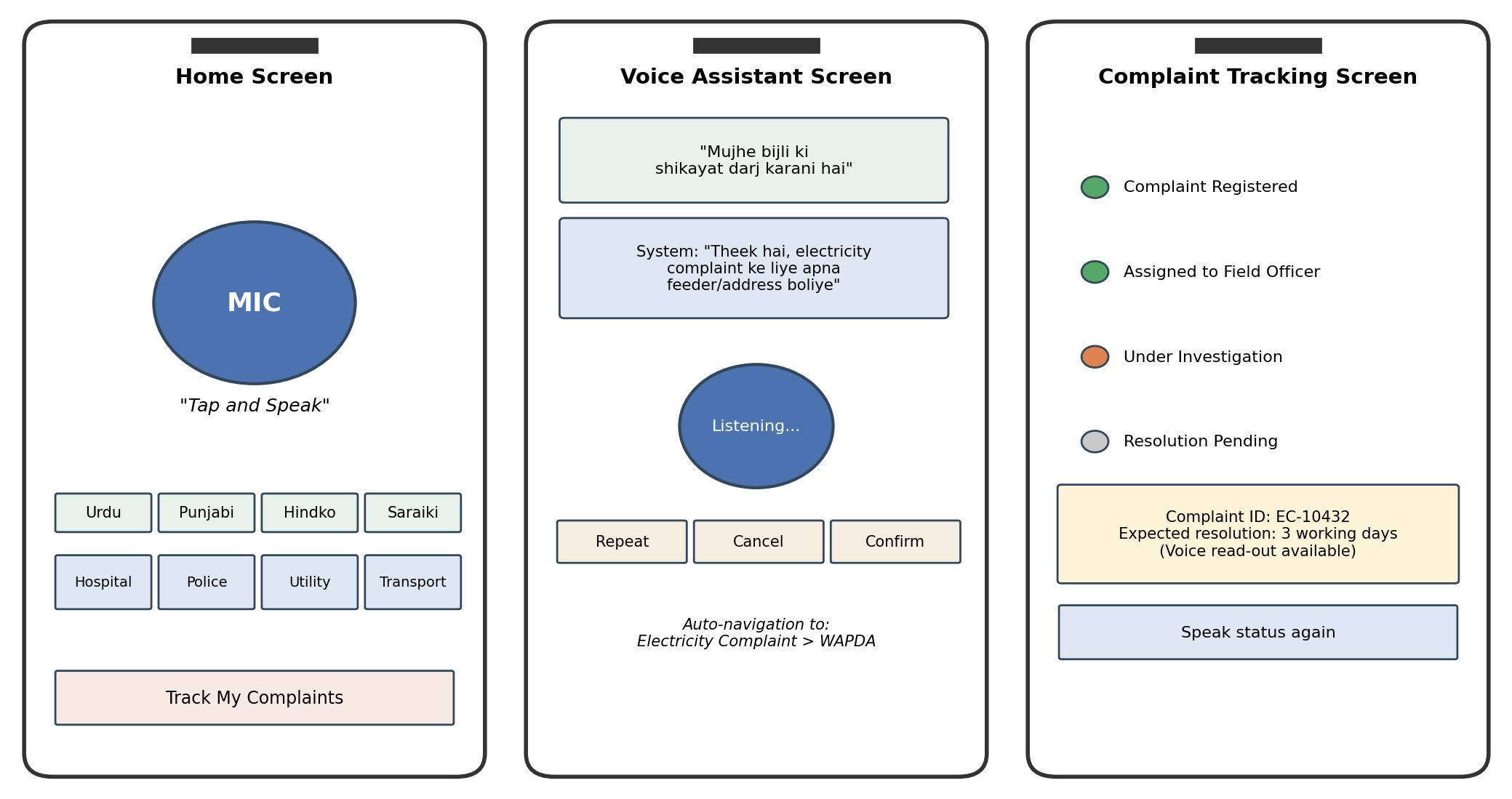
Pakistan's rapid growth in mobile-phone and smartphone penetration has not been matched by a corresponding rise in the use of digital public services, largely because a substantial share of citizens, particularly in rural areas, remain non-literate or low-literate and cannot navigate text-heavy e-governance portals. This paper presents the design, development, and field evaluation of a multilingual, voice-based mobile ICT solution that lets non-literate and semi-literate citizens access core government services, including hospital information, police assistance, utility-complaint registration, subsidy inquiries, commodity price checking, and public transport information, through natural spoken interaction in Urdu, Punjabi, Hindko and Saraiki. Unlike prior text-free or fixed-menu voice interfaces, the proposed system embeds an artificial-intelligence-based intent-recognition and dialogue-management layer that allows a citizen to state a need using free-form conversational speech (for example, “I want to complain about electricity”) and be routed automatically to the correct service and complaint workflow, without navigating nested menus. The system was designed using a six-phase User-Centered Design methodology comprising requirements gathering, an observational study, icon and voice-prompt assessment, prototype design, application development using Flutter, Firebase and Python-based AI services, and usability evaluation. A field study involving 45 rural participants aged 20–65 was conducted using ISO 9241-11 effectiveness, efficiency and satisfaction measures, comparing the proposed voice-based prototype against an existing text/menu-based e-government application. Results show substantially higher task-completion rates, shorter completion times and lower error rates for the voice-based system, together with a mean System Usability Scale score of 78.4, indicating good-to-excellent perceived usability. The findings support voice-first, AI-assisted design as a viable pathway toward digital and civic inclusion for non-literate populations in Pakistan and comparable developing-country contexts.
References
“Gallup Pakistan - Pakistan’s Foremost Research Lab.” Accessed: Jul. 13, 2026. [Online]. Available: https://gallup.com.pk/post/39428
Sadia Jamil, “From digital divide to digital inclusion: Challenges for wide-ranging digitalization in Pakistan,” Telecomm. Policy, vol. 45, no. 8, 2021, [Online]. Available: https://www.sciencedirect.com/science/article/pii/S0308596121001105
“Bridging the Digital Divide: Infrastructure Deficits, Policy Frameworks, and Socio-Economic Imperatives in Pakistan’s Pathway to Global Digital Competitiveness - Criterion Quarterly.” Accessed: Jul. 13, 2026. [Online]. Available: https://criterion-quarterly.com/bridging-the-digital-divide/
Muhammad Atique, Su Su Htay, “An analysis of E-governance in Pakistan from the lens of the Chinese governance model,” Heliyon, vol. 10, no. 5, p. e27003, 2024, doi: https://doi.org/10.1016/j.heliyon.2024.e27003.
I. Medhi, A. Sagar, and K. Toyama, “Text-free user interfaces for illiterate and semi-literate users,” 2006 Int. Conf. Inf. Commun. Technol. Dev. ICTD2006, pp. 72–82, 2006, doi: 10.1109/ICTD.2006.301841.
J. Sherwani, S. Palijo, S. Mirza, T. Ahmed, N. Ali, and R. Rosenfeld, “Speech vs. touch-tone: Telephony interfaces for information access by low literate users,” Int. Conf. Inf. Commun. Technol. Dev., pp. 447–457, 2009, doi: 10.1109/ICTD.2009.5426682.
D. Kettani and A. El Mahdi, “Implementing e-government accessible to illiterate citizens,” 2009 Int. Conf. Inf. Commun. Technol. Dev. ICTD 2009 - Proc., p. 486, 2009, doi: 10.1109/ICTD.2009.5426723.
Indrani Medhi, Somani Patnaik, “Designing mobile interfaces for novice and low-literacy users,” ACM Trans. Comput. Interact., vol. 18, no. 1, 2011, [Online]. Available: https://dl.acm.org/doi/10.1145/1959022.1959024
Beenish M. Chaudry, Kay H. Connelly, “Mobile interface design for low-literacy populations,” IHI’12 - Proc. 2nd ACM SIGHIT Int. Heal. Informatics Symp., 2012, [Online]. Available: https://dl.acm.org/doi/10.1145/2110363.2110377
I. Maqood, S. Jan, S. Ahmad, A. S. Alluhaidan, M. S. Anwar, and Q. M. ul Haq, “A multimodal AI-based decision support framework for precision agriculture: Enhancing accessibility for low literate farmers,” CABI Agric. Biosci., Apr. 2026, doi: 10.1079/AB.2026.0015.
S. J. Imran Maqsood, “Design And Usability Evaluation Of A Bilingual (Urdu/English) Child Monitoring App For Low-Literacy Parents,” Kashf J. Multidiscip. Res., vol. 3, no. 1, pp. 139–153, 2026, doi: 10.71146/kjmr798.
Á. L. L. Eduardo C. Garrido-Merchán, “An Automated Survey of Generative Artificial Intelligence: Large Language Models, Architectures, Protocols, and Applications,” arXiv:2306.02781, 2026, [Online]. Available: https://arxiv.org/abs/2306.02781
Imran Maqsood, Mareena Karim, “A Content Independent Digital Image Forensics Framework for PRNU-Based Image Forgery Detection and Localization,” Annu. Methodol. Arch. Res. Rev., vol. 4, no. 3, 2026, [Online]. Available: https://amresearchjournal.com/index.php/Journal/article/view/2196?articlesBySimilarityPage=8
“ISO 9241-210:2019 - Ergonomics of human-system interaction — Part 210: Human-centred design for interactive systems.” Accessed: Jul. 13, 2026. [Online]. Available: https://www.iso.org/standard/77520.html
Sadeeq Jan, Imran Maqsood, “Investigating the Use of Email Application in Illiterate and Semi-Illiterate Population,” Comput. Mater. Contin., vol. 61, no. 3, pp. 1473–1486, 2019, doi: 10.32604/cmc.2020.08917.
S. J. Imran Maqsood, “Design And Usability Evaluation Of A Voice-Assisted Text-Free Customer Management System For Low-Literacy Shopkeepers,” Kashf J. Multidiscip. Res., vol. 2, no. 11, pp. 68–82, 2025, doi: 10.71146/kjmr756.
“Flutter documentation.” Accessed: Jul. 13, 2026. [Online]. Available: https://docs.flutter.dev/
“Firebase Documentation.” Accessed: Jul. 13, 2026. [Online]. Available: https://firebase.google.com/docs
“SUS: A quick and dirty usability scale.” Accessed: Feb. 13, 2026. [Online]. Available: https://www.researchgate.net/publication/228593520_SUS_A_quick_and_dirty_usability_scale
“ISO 9241-11:2018 - Ergonomics of human-system interaction — Part 11: Usability: Definitions and concepts.” Accessed: Jul. 13, 2026. [Online]. Available: https://www.iso.org/standard/63500.html
Imran Maqsood, Iftikhar Ahmad, “A Systematic Feasibility Analysis of User Interfaces for Illiterate Users,” Proc. Pakistan Acad. Sci., vol. 56, no. 4, pp. 1–17, 2019, [Online]. Available: https://www.researchgate.net/publication/340818319_A_Systematic_Feasibility_Analysis_of_User_Interfaces_for_Illiterate_Users
I. M. Sadeeq Jan, “A Voice-Assisted Visual Learning Interface for Low-Literate Adults: Design And Usability Evaluation,” Spectr. Eng. Sci., vol. 4, no. 3, 2026, [Online]. Available: https://thesesjournal.com/index.php/1/article/view/3181
Downloads
Published
How to Cite
Issue
Section
License
Copyright (c) 2026 50sea

This work is licensed under a Creative Commons Attribution 4.0 International License.