Integrated Source Tracking and Assessment of Drinking Water Contamination in Rural Sindh, Pakistan
DOI:
https://doi.org/10.33411/IJIST/1967Keywords:
Physio-Chemical Analysis, Mathematical Models, WHO Standards, Khairpur City , ArsenicAbstract
Introduction/Importance of Study: Water is essential for life, and it can be contaminated by physical, chemical, and biological pollutants. This polluted water can impact human health and lead to abdominal pain, diabetes, diarrhea, and cancers (kidney, liver, and lungs).
Novelty statement: Therefore, a thorough water quality assessment of Khairpur city is done in this study by integrating detailed physicochemical characterization with mathematical modeling. Beyond evaluating the current groundwater status, the developed models were calibrated and validated to accurately predict groundwater quality, offering a robust decision-support framework for sustainable water resource management and future monitoring.
Material and Method: For this, 58 samples were collected according to the major residential areas of the city. Whereas mathematical modeling was done by using WQI and SPI mathematical tools.
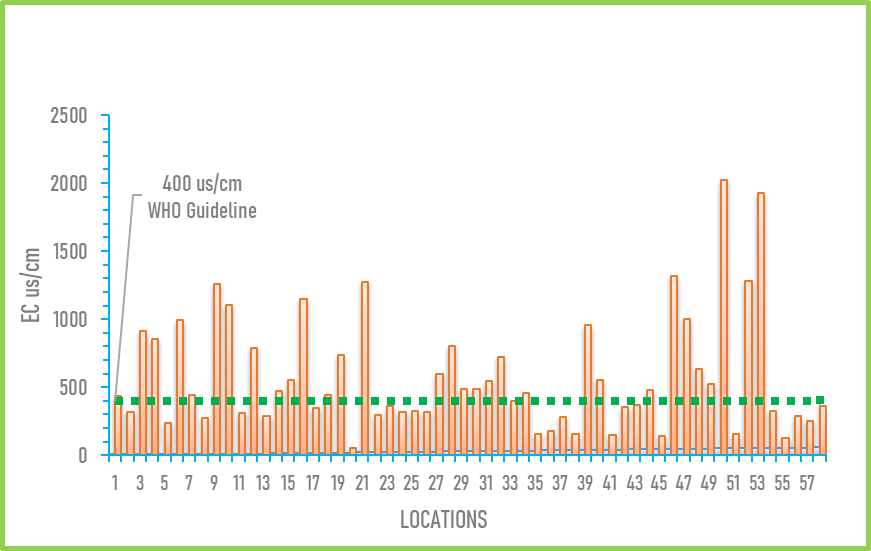
Result and Discussion: The analysis showed that all water samples complied with the WHO permissible pH range, while 19 of 58 samples (32.8%) exceeded the WHO limit for total dissolved solids (TDS). Temperature remained within acceptable limits at all sampling locations. Turbidity exceeded the WHO guideline (5 NTU) in 5 samples (8.6%), dissolved oxygen (DO) was below the recommended level in 10 samples (17.2%), and arsenic concentrations exceeded the permissible limit in 9 samples (15.5%). The Water Quality Index (WQI) classified 1 location (1.7%) as excellent, 26 (44.8%) as good, 24 (41.4%) as poor, and 3 (5.2%) as very poor. Similarly, the Synthetic Pollution Index (SPI) identified 25 locations (43.1%) as suitable, 1 (1.7%) as slightly contaminated, 27 (46.6%) as moderately contaminated, 2 (3.4%) as highly contaminated, and 3 (5.2%) as unsuitable for drinking. A strong positive agreement between the WQI and SPI models was observed, with a coefficient of determination (R²) of 0.78, indicating the reliability and consistency of both assessment approaches.
Concluding Remarks: This study has revealed a minor violation of WHO water quality standards. However, the required thresholds have been achieved at the most of the study locations.
References
E. Mutegoa, “Efficient techniques and practices for wastewater treatment: an update,” Discov. Water 2024 41, vol. 4, no. 1, pp. 69-, Sep. 2024, doi: 10.1007/S43832-024-00131-8.
H. Rasheed, “Drinking water quality in Pakistan: Current status and challenges,” Pakistan Counc. Res. water Resour. (PCRWR), Islam., vol. 141, 2021.
B. R. Scanlon et al., “Global water resources and the role of groundwater in a resilient water future,” Nat. Rev. Earth Environ. 2023 42, vol. 4, no. 2, pp. 87–101, Jan. 2023, doi: 10.1038/s43017-022-00378-6.
A. Shah, A. Arjunan, A. Baroutaji, and J. Zakharova, “A review of physicochemical and biological contaminants in drinking water and their impacts on human health,” Water Sci. Eng., vol. 16, no. 4, pp. 333–344, Dec. 2023, doi: 10.1016/J.WSE.2023.04.003.
“Water Crisis in Pakistan: Manifestation, Causes and the Way Forward,” https://pide.org.pk/.
M. S. Mehboob and Y. Kim, “Effect of climate and socioeconomic changes on future surface water availability from mountainous water sources in Pakistan’s Upper Indus Basin,” Sci. Total Environ., vol. 769, p. 144820, May 2021, doi: 10.1016/J.SCITOTENV.2020.144820.
K. S. Waseem Ishaque, “Water management and sustainable development in Pakistan: environmental and health impacts of water quality on achieving the UNSDGs by 2030,” Front. Water, vol. 6, 2024, doi: https://doi.org/10.3389/frwa.2024.1267164.
W. A. Jadoon, M. Zaheer, A. Tariq, R. U. Sajjad, and M. Varol, “Assessment of hydrochemical characteristics, health risks and quality of groundwater for drinking and irrigation purposes in a mountainous region of Pakistan,” Environ. Sci. Pollut. Res. 2024 3131, vol. 31, no. 31, pp. 43967–43986, Jun. 2024, doi: 10.1007/S11356-024-34046-7.
“Drinking-water.” Accessed: May 11, 2024. [Online]. Available: https://www.who.int/news-room/fact-sheets/detail/drinking-water
N. Abeer, S. A. Khan, S. Muhammad, A. Rasool, and I. Ahmad, “Health risk assessment and provenance of arsenic and heavy metal in drinking water in Islamabad, Pakistan,” Environ. Technol. Innov., vol. 20, p. 101171, Nov. 2020, doi: 10.1016/J.ETI.2020.101171.
M. F. Lanjwani et al., “Spatial distribution of hydrochemistry and characterization of groundwater of taluka Bakrani, Larkana, Sindh, Pakistan,” Arab. J. Geosci. 2022 155, vol. 15, no. 5, pp. 380-, Feb. 2022, doi: 10.1007/S12517-022-09609-Y.
K. Jomova, S. Y. Alomar, E. Nepovimova, K. Kuca, and M. Valko, “Heavy metals: toxicity and human health effects,” Arch. Toxicol., vol. 99, no. 1, pp. 153–209, Jan. 2025, doi: 10.1007/S00204-024-03903-2.
“Drinking Water Regulations and Contaminants | US EPA.” Accessed: Aug. 15, 2026. [Online]. Available: https://www.epa.gov/sdwa/drinking-water-regulations-and-contaminants
M. R. Shaibur, M. Howlader, I. Ahmmed, S. Sarwar, and A. Hussam, “Water quality index and health risk assessment for heavy metals in groundwater of Kashiani and Kotalipara upazila, Gopalganj, Bangladesh,” Appl. Water Sci. 2024 145, vol. 14, no. 5, pp. 106-, Apr. 2024, doi: 10.1007/S13201-024-02169-4.
“Widening & Improvement Of Priority Sections Of N-5 (487 KM)”, [Online]. Available: https://www.aiib.org/en/projects/details/2025/_download/Pakistan/9.-Draft-Resettlement-Action-Plan-RAP-for-Section-7-Rawalpindi-Hassanabdal.pdf
H. U. Qureshi, S. M. H. Shah, and F. Y. Teo, “Trend assessment of changing climate patterns over the major agro-climatic zones of Sindh and Punjab,” Front. Water, vol. 5, p. 1194540, Sep. 2023, doi: 10.3389/FRWA.2023.1194540/TEXT.
W. Xu, Y. Jin, and G. Zeng, “Introduction of heavy metals contamination in the water and soil: a review on source, toxicity and remediation methods,” Green Chem. Lett. Rev., vol. 17, no. 1, Dec. 2024, doi: 10.1080/17518253.2024.2404235.
“Guidelines for drinking-water quality: fourth edition incorporating the first, second and third addenda.” Accessed: Aug. 15, 2026. [Online]. Available: https://www.who.int/publications/i/item/9789240121225
A. Ali, H. A. Keerio, O. A. Abro, M. Noor, S. Panhwar, and R. B. Mahar, “A Study of Mathematical Models Used in Anaerobic Digestion of Organic Refuse,” VFAST Trans. Math., vol. 12, no. 1, pp. 150–163, Apr. 2024, doi: 10.21015/VTM.V12I1.1771.
Z. A. & M. B. Maria Latif, Nimra Nasir, Rab Nawaz, Iqra Nasim, Khawar Sultan, Muhammad Atif Irshad, Ali Irfan, Turki M. Dawoud, Youssouf Ali Younous, “Assessment of drinking water quality using Water Quality Index and synthetic pollution index in urban areas of mega city Lahore: a GIS-based approach,” Sci. Rep., vol. 14, p. 13416, 2024, doi: https://doi.org/10.1038/s41598-024-63296-1.
N. ur Rehman et al., “Assessment of water quality and health hazards using water quality index and human health risk evaluation in district Talagang Pakistan,” Sci. Reports 2025 151, vol. 15, no. 1, pp. 5191-, Feb. 2025, doi: 10.1038/s41598-025-89932-y.
A. Ali, H. A. Keerio, S. Panhwar, and M. Z. Ahad, “Experimental Investigation of Methane Generation in the Presence of Surface and Un-Surface Nanoparticles of Iron Oxide,” AgriEngineering, vol. 4, no. 1, pp. 134–140, Mar. 2022, doi: 10.3390/AGRIENGINEERING4010009/S1.
A. Ali, A. M. Alnadish, S. Panhwar, H. A. Keerio, A. Waheed, and R. B. Mahar, “Investigating the Impact of Organic Loading Rates and Magnetic Nanoparticles on the Performance and Stability of Continuous Stirred Tank Reactors,” Process. 2025, Vol. 13, Page 2126, vol. 13, no. 7, p. 2126, Jul. 2025, doi: 10.3390/PR13072126.
M. Gad et al., “Groundwater Quality and Health Risk Assessment Using Indexing Approaches, Multivariate Statistical Analysis, Artificial Neural Networks, and GIS Techniques in El Kharga Oasis, Egypt,” Water 2023, Vol. 15, Page 1216, vol. 15, no. 6, p. 1216, Mar. 2023, doi: 10.3390/W15061216.
“UNFPA Pakistan | Policy Brief- State of Pakistan Population Report 2025.” Accessed: Aug. 15, 2026. [Online]. Available: https://pakistan.unfpa.org/en/publications/policy-brief-state-pakistan-population-report-2entity25-0
“PAKISTAN: Staying the Course on Implementing Structural Reforms Critical to Turn Economic Stabilization into Sustained, Inclusive Growth, says World Bank.” Accessed: Aug. 15, 2026. [Online]. Available: https://www.worldbank.org/en/news/press-release/2025/04/23/pakistan-structural-reforms-needed-to-turn-economic-stabilization-into-sustained-inclusive-growth-says-world-bank
“Pakistan | Data.” Accessed: Aug. 15, 2026. [Online]. Available: https://data.worldbank.org/country/pakistan?utm_source=chatgpt.com
Shazia Perveen, Amar-Ul-Haque, “Drinking water quality monitoring, assessment and management in Pakistan: A review,” Heliyon, vol. 9, no. 3, p. e13872, 2023, doi: https://doi.org/10.1016/j.heliyon.2023.e13872.
“Population growth (annual %) - Pakistan | Data.” Accessed: Aug. 15, 2026. [Online]. Available: https://data.worldbank.org/indicator/SP.POP.GROW?locations=PK
Downloads
Published
How to Cite
Issue
Section
License
Copyright (c) 2026 50SEA

This work is licensed under a Creative Commons Attribution 4.0 International License.