Prediction and Proactive Congestion Mitigation in Software-Defined Networks Using a Hybrid Spatio-Temporal GCN–LSTM and Deep Reinforcement Learning Framework
DOI:
https://doi.org/10.33411/IJIST/1999Keywords:
Software-Defined Networking, Graph Convolutional Network, Long Short-Term Memory, Deep Reinforcement Learning, Traffic Prediction, Congestion ControlAbstract
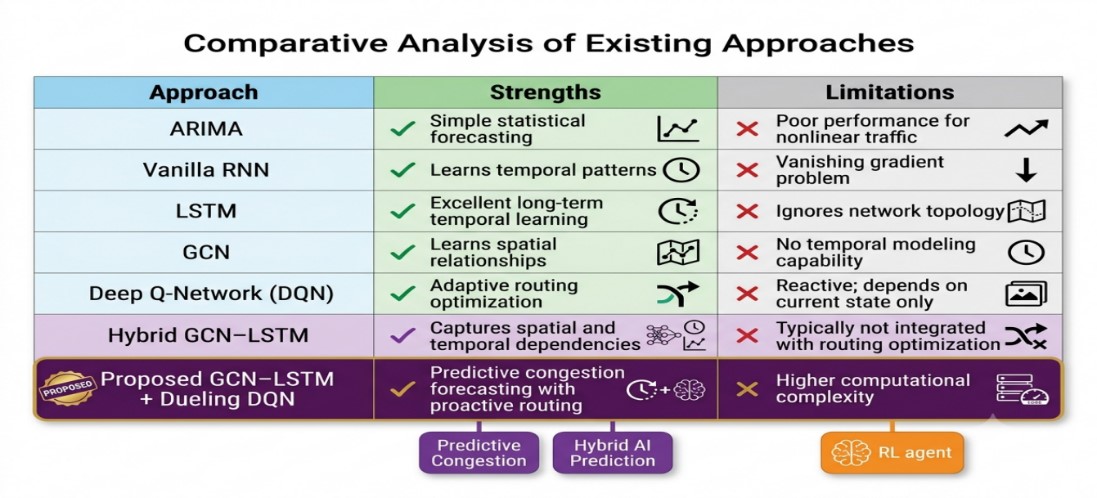
Software-Defined Networking (SDN) has emerged as a promising paradigm for centralized network management; however, conventional routing protocols remain predominantly reactive, responding only after congestion has already occurred. This reactive behavior increases end-to-end latency, packet loss, and inefficient bandwidth utilization, particularly under dynamic traffic conditions. This paper presents a hybrid Artificial Intelligence (AI)-driven framework that integrates a Spatio-Temporal Graph Convolutional Network with Long Short-Term Memory (GCN–LSTM) for traffic prediction and a Dueling Deep Q-Network (DQN) for proactive routing optimization. The proposed framework operates within an SDN architecture using the Ryu controller and OpenFlow 1.3 while network scenarios are emulated in Mininet. The GCN component captures spatial dependencies among network nodes, whereas the LSTM models temporal traffic evolution to forecast future congestion. These predictions guide the reinforcement learning agent to proactively update forwarding paths before congestion develops. Experimental evaluation demonstrates significant improvements over conventional routing approaches, including lower prediction error (MAPE 0.94%), reduced average latency (29.1 ms), zero packet loss during burst traffic, and an aggregate throughput of 8.1 Gbps. The proposed framework demonstrates the effectiveness of combining deep learning and reinforcement learning to enable intelligent, predictive, and adaptive traffic management in modern SDN environments. GCN–LSTM MAE of 1.05 Kbps at t+1 and 3.18 Kbps at t+5, RMSE 4.22 Kbps, MAPE 0.94%, average latency 29.1 ms, packet loss 0.00% in the reported burst-traffic experiment, throughput 8.1 Gbps, and Dueling-DQN convergence at approximately episode 350 versus approximately 700 for standard DQN. Calculated comparative improvements were also added.
References
“(PDF) An Innovative Machine Learning based end-to-end Data Security Framework in Emerging Cloud Computing Databases and Integrated Paradigms: Analysis on Taxonomy, challenges, and Opportunities.” Accessed: Aug. 21, 2026. [Online]. Available: https://www.researchgate.net/publication/388841743_An_Innovative_
Machine_Learning_based_end-to-end_Data_Security_Framework_in_Emerging_
Cloud_Computing_Databases_and_Integrated_Paradigms_Analysis_on_Taxonomy_challenges_and_Opportunities
“View of Predictive Analytics For AI-Assisted Patient No-Show Management And Clinic Revenue Optimization: A Simulation-Based Research.” Accessed: Aug. 21, 2026. [Online]. Available: https://migrationletters.com/index.php/ml/
article/view/12274/8089
A. Jamal, F. Tauseef, F. Naseer, and J. Ahmad, “Business Analytics for Healthcare Cost Optimization: A Data-Driven Study on Improving Financial Sustainability in Healthcare Systems,” Spectr. Eng. Sci., pp. 723–736, Dec. 2024, doi: 10.5281/zenodo.20488115.
A. Jamal, M. Mahmud, F. Tauseef, H. M. Sozib, S. Bin Shafi, and M. Tariquzzaman, “Explainable AI for Predicting Patient Readmission in Hospitals,” Proc. 9th Int. Conf. Inven. Comput. Technol. ICICT 2026, pp. 1961–1967, 2026, doi: 10.1109/ICICT68280.2026.11510989.
M. Faiyazuddin et al., “The Impact of Artificial Intelligence on Healthcare: A Comprehensive Review of Advancements in Diagnostics, Treatment, and Operational Efficiency,” Heal. Sci. Reports, vol. 8, no. 1, p. e70312, Jan. 2025, doi: 10.1002/HSR2.70312.
“AI-Driven Discovery of Novel Biomarkers for Early Cardiovascular Disease Detection,” AI-Driven Discov. Nov. Biomarkers Early Cardiovasc. Dis. Detect., 2026, doi: 10.66669/WT.V35IS2.287.
A. Jamal, F. Tauseef, F. Naseer, A. Akbar, M. Jabeen, and F. Nasim, “A Convolutional Neural Network Approach for Diabetic Retinopathy Detection from Retinal Images: A Critical Review of Deep Learning Techniques in Ophthalmic Diagnosis: https://doi.org/10.5281/zenodo.20587510,” Multidiscip. Surg. Res. Ann., vol. 3, no. 4, pp. 3100–3128, Dec. 2025, doi: 10.5281/ZENODO.20587510.
M. Barua, T. Kumar, K. Raj, and A. M. Roy, “Comparative Analysis of Deep Learning Models for Stock Price Prediction in the Indian Market,” Oct. 2024, doi: 10.20944/PREPRINTS202410.1497.V1.
“Constyn Platform Solutions | Sellers Dorsey.” Accessed: Aug. 21, 2026. [Online]. Available: https://www.sellersdorsey.com/tech-enabled-solutions/constyn-platform-solutions/?utm_source=google&utm_medium=cpc&utm_campaign=long-term-keywords&utm_id=constyn-adwords&utm_content=constyn-homepage&gad_source=1&gad_campaignid=23904725928&gbraid=0AAAAA9ljymxbmMFP6z6IUUdyWXAUPxM_6&gclid=CjwKCAjw7p_UBhBlEiwAhpIs71Ugvd621tz1fuxmaUhU5dyjJBdfU6yGz8Cz-jKkQA4DOcsKbbkDexoCJ8kQAvD_BwE
J. Chen, X. Wang, · Xuanheng Xu, J. Chen, X. Wang, and X. Xu, “GC-LSTM: Graph Convolution Embedded LSTM for Dynamic Link Prediction,” arXiv, pp. 1–12, Dec. 2018, Accessed: Aug. 21, 2026. [Online]. Available: https://arxiv.org/pdf/1812.04206
E. H. Bouzidi, A. Outtagarts, R. Langar, and R. Boutaba, “Deep Q-Network and Traffic Prediction based Routing Optimization in Software Defined Networks,” J. Netw. Comput. Appl., vol. 192, p. 103181, Oct. 2021, doi: 10.1016/J.JNCA.2021.103181.
Y. R. Chen, A. Rezapour, W. G. Tzeng, and S. C. Tsai, “RL-Routing: An SDN Routing Algorithm Based on Deep Reinforcement Learning,” IEEE Trans. Netw. Sci. Eng., vol. 7, no. 4, pp. 3185–3199, Oct. 2020, doi: 10.1109/TNSE.2020.3017751.
W. xi Liu, J. Cai, Q. C. Chen, and Y. Wang, “DRL-R: Deep reinforcement learning approach for intelligent routing in software-defined data-center networks,” J. Netw. Comput. Appl., vol. 177, p. 102865, Mar. 2021, doi: 10.1016/J.JNCA.2020.102865.
Y. Song, X. Qian, N. Zhang, W. Wang, and A. Xiong, “QoS Routing Optimization Based on Deep Reinforcement Learning in SDN,” Comput. Mater. Contin., vol. 79, no. 2, pp. 3007–3021, May 2024, doi: 10.32604/CMC.2024.051217.
M. Pióro, Á. Szentesi, J. Harmatos, A. Jüttner, P. Gajowniczek, and S. Kozdrowski, “On open shortest path first related network optimisation problems,” Perform. Eval., vol. 48, no. 1–4, pp. 201–223, May 2002, doi: 10.1016/S0166-5316(02)00036-6.
C. Hopps, “Analysis of an Equal-Cost Multi-Path Algorithm,” Nov. 2000, doi: 10.17487/RFC2992.
“View of Detecting Governance Risk In Generative AI Adoption: A Predictive Analysis Of Organizational Misalignment And AI Failure Signals.” Accessed: Aug. 21, 2026. [Online]. Available: https://www.metall-mater-eng.com/index.php/home/article/view/1965/1170
“(PDF) Predictive Analytics in Healthcare AI: Leveraging Machine Learning for Data Integrity and Medical Data Privacy.” Accessed: Aug. 21, 2026. [Online]. Available: https://www.researchgate.net/publication/389462361_Predictive_Analytics_in_Healthcare_AI_Leveraging_Machine_Learning_for_Data_Integrity_and_Medical_Data_Privacy
F. Nasim, M. A. Yousaf, S. Masood, A. Jaffar, and M. Rashid, “Data-Driven Probabilistic S for Batsman Performance Prediction in a Cricket Match,” Intell. Autom. Soft Comput., vol. 36, no. 3, pp. 2865–2877, 2023, doi: 10.32604/IASC.2023.034258.
W. Xia, Y. Wen, C. H. Foh, D. Niyato, and H. Xie, “A Survey on Software-Defined Networking,” IEEE Commun. Surv. Tutorials, vol. 17, no. 1, pp. 27–51, Jan. 2015, doi: 10.1109/COMST.2014.2330903.
A. Pramanik, S. Sultana, and M. S. Rahman, “Time Series Analysis and Forecasting of Monkeypox Disease Using ARIMA and SARIMA Model,” 2022 13th Int. Conf. Comput. Commun. Netw. Technol. ICCCNT 2022, 2022, doi: 10.1109/ICCCNT54827.2022.9984345.
A. Jamal, Z. Akbar, S. Akbar, S. Niaz, and F. Tauseef, “Predicting Human-GenAI Collaboration Effectiveness: A Machine Learning Investigation Of Skill Configurations, Trust, And Work Design,” Migr. Lett., vol. 19, no. S8, pp. 2303–2324, Dec. 2022, Accessed: Aug. 21, 2026. [Online]. Available: https://migrationletters.com/index.php/ml/article/view/12298
M. Usman Ghani, A. Ahmad, F. Nasim, J. Ahmad, and G. Mumtaz, “AI-Based Network Traffic Analysis for Threat Hunting,” J. Innov. Comput. Emerg. Technol., vol. 4, no. 2, Oct. 2024, doi: 10.56536/JICET.V4I2.158.
K. Patel, M. Shah, K. M. Qureshi, and M. R. N. Qureshi, “A systematic review of generative AI: importance of industry and startup-centered perspectives, agentic AI, ethical considerations & challenges, and future directions,” Artif. Intell. Rev. 2025 591, vol. 59, no. 1, pp. 7-, Nov. 2025, doi: 10.1007/S10462-025-11435-Z.
“3-Channel Motor Imagery Classification using Conventional Classifiers and Deep Learning Models | Journal of Computing & Biomedical Informatics.” Accessed: Aug. 21, 2026. [Online]. Available: https://jcbi.org/index.php/Main/article/view/560
F. Tauseef, A. Jamal, and F. Naseer, “Artificial Intelligence in Healthcare Systems Exploring the Transformational Role of AI Technologies in Healthcare Management and Clinical Decision Support,” Rev. J. Neurol. Med. Sci. Rev., vol. 1, no. 02, pp. 83–101, 2023, doi: 10.63075/26RFHC13.
P. D. S. Shakya and https://pcampus.academia.edu/SubarnaShakya, “An Efficient Security Framework for Data Migration in a Cloud Computing Environment,” J. Artif. Intell. Capsul. Networks, vol. 1, no. 1, pp. 45–53, Sep. 2019, doi: 10.36548/JAICN.2019.1.006.
K. Arulkumaran, M. P. Deisenroth, M. Brundage, and A. A. Bharath, “Deep reinforcement learning: A brief survey,” IEEE Signal Process. Mag., vol. 34, no. 6, pp. 26–38, Nov. 2017, doi: 10.1109/MSP.2017.2743240.
H. Dong, Z. Ding, and S. Zhang, “Deep reinforcement learning: Fundamentals, research and applications,” Deep Reinf. Learn. Fundam. Res. Appl., pp. 1–514, Jan. 2020, doi: 10.1007/978-981-15-4095-0.
Downloads
Published
How to Cite
Issue
Section
License
Copyright (c) 2026 50sea

This work is licensed under a Creative Commons Attribution 4.0 International License.