Smart Incentive Based EV Scheduling and Increasing Efficiency of Charging Stations
DOI:
https://doi.org/10.33411/IJIST/2005Keywords:
Electric Vehicle Charging, Connector Utilization, Charging Incentives, State of Charge, Charging InfrastructureAbstract
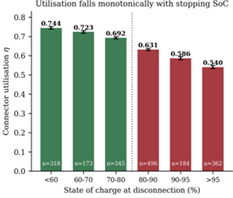
Direct-current fast-charging connectors are a scarce and expensive asset, and how long each vehicle occupies one determines how many vehicles a site can serve. This paper examines where that occupancy actually goes, using 1,876 sessions recorded over fifteen months at a two-connector fast-charging installation, corroborated against minute-level telemetry from the same site. Three quantitative findings emerge. First, delivery is limited at the connector in every session recorded: the median vehicle requests 191 kW against a median delivered maximum of 98 kW, leaving a median of 86 kW of demand unserved, which excludes vehicle-side limitation as an explanation for underutilization. Second, connector utilization averages 0.619 and falls monotonically with the state of charge at which the driver disconnects, from 0.688 for sessions ending below 60 percent to 0.526 for those ending above 95 percent, a relative reduction of 23.5 percent across six bands with no reversal and a session-level rank correlation of −0.462 (95 percent bootstrap interval −0.500 to −0.426); sessions ending below 80 percent average 0.679 against 0.541 for those ending above 90 percent, a difference of 0.138 (Welch t = 20.41, p < 10⁻⁷⁰, Cohen's d = 1.21). A Jonckheere–Terpstra test confirms the ordered decline (z = −20.92, p < 10⁻⁹⁶). Third, the rate of energy transfer degrades over the same range: throughput falls from 1.20 kWh per occupied minute below 60 per cent to 0.74 kWh above 95 per cent, and the minute-level telemetry gives a mean delivered power of 80.2 kW below the 80 per cent threshold against 37.7 kW above it, a reduction of 53.0 per cent. 55.5% of sessions of sessions continue past 80 per cent, and those final percentage points consume between 176 and 215 of the 1,029 connector-hours in the record, 17.1 to 20.9 per cent of all occupancy, to deliver a median of only 7.1 kWh each; the share is sensitive to where the threshold is placed, rising to 32.1 per cent at 70 per cent and falling to 5.7 per cent at 90 per cent. Minute-level data further establish that this occupancy is not idle time: power flows for 99 per cent of the connected period in every band, so the decline is attributable to the charging curve rather than to vehicles left connected after charging has finished. An incentive linked to the state of charge at disconnection rather than to time of day is outlined at the concept level. It is deliberately not evaluated: the record contains no intervention, so no driver response is estimated and no improvement in utilization is claimed. What the record establishes is the size of the target and the two site conditions under which pursuing it would be warranted. The site studied satisfies neither; its two connectors are occupied for 1,029 of 21,513 available connector-hours, a site occupancy of 4.8 percent, so the measurement is offered as a diagnostic that can be computed from records already held by an operator.
References
Z. Jin, H. Li, D. Chen, L. Yu, and H. Tu, “Accounting for BEV Users’ Risk Attitudes and Charging Inertia in En Route Charging Choice Behavior,” J. Adv. Transp., vol. 2024, no. 1, p. 9926334, Jan. 2024, doi: 10.1155/2024/9926334.
S. Gohlke and Z. Nochta, “Short-Term Utilization Forecasting of Electric Vehicle Charging Infrastructures,” World Electr. Veh. J. 2025, Vol. 16, Page 655, vol. 16, no. 12, p. 655, Nov. 2025, doi: 10.3390/WEVJ16120655.
M. Rashid, T. Elfouly, and N. Chen, “A Comprehensive Survey of Electric Vehicle Charging Demand Forecasting Techniques,” IEEE Open J. Veh. Technol., vol. 5, pp. 1348–1373, 2024, doi: 10.1109/OJVT.2024.3457499.
R. Wolbertus and R. Van den Hoed, “Electric Vehicle Fast Charging Needs in Cities and along Corridors,” World Electr. Veh. J. 2019, Vol. 10, Page 45, vol. 10, no. 2, p. 45, Jun. 2019, doi: 10.3390/WEVJ10020045.
C. Hecht, J. Figgener, and D. U. Sauer, “Analysis of electric vehicle charging station usage and profitability in Germany based on empirical data,” iScience, vol. 25, no. 12, p. 105634, Dec. 2022, doi: 10.1016/J.ISCI.2022.105634.
A. Rautiainen et al., “Anatomy of electric vehicle fast charging: Peak shaving through a battery energy storage—A case study from Oslo,” IET Electr. Syst. Transp., vol. 11, no. 1, pp. 69–80, Mar. 2021, doi: 10.1049/ELS2.12005.
M. Neaimeh, S. D. Salisbury, G. A. Hill, P. T. Blythe, D. R. Scoffield, and J. E. Francfort, “Analysing the usage and evidencing the importance of fast chargers for the adoption of battery electric vehicles,” Energy Policy, vol. 108, pp. 474–486, Sep. 2017, doi: 10.1016/J.ENPOL.2017.06.033.
J. R. Helmus, M. H. Lees, and R. van den Hoed, “A data driven typology of electric vehicle user types and charging sessions,” Transp. Res. Part C Emerg. Technol., vol. 115, p. 102637, Jun. 2020, doi: 10.1016/J.TRC.2020.102637.
S. Hardman et al., “A review of consumer preferences of and interactions with electric vehicle charging infrastructure,” Transp. Res. Part D Transp. Environ., vol. 62, pp. 508–523, Jul. 2018, doi: 10.1016/J.TRD.2018.04.002.
T. Gnann, S. Funke, N. Jakobsson, P. Plötz, F. Sprei, and A. Bennehag, “Fast charging infrastructure for electric vehicles: Today’s situation and future needs,” Transp. Res. Part D Transp. Environ., vol. 62, pp. 314–329, Jul. 2018, doi: 10.1016/J.TRD.2018.03.004.
R. Wolbertus, M. Kroesen, R. van den Hoed, and C. G. Chorus, “Policy effects on charging behaviour of electric vehicle owners and on purchase intentions of prospective owners: Natural and stated choice experiments,” Transp. Res. Part D Transp. Environ., vol. 62, pp. 283–297, Jul. 2018, doi: 10.1016/J.TRD.2018.03.012.
C. Hecht, J. Figgener, and D. U. Sauer, “Predicting Electric Vehicle Charging Station Availability Using Ensemble Machine Learning,” Energies 2021, Vol. 14, Page 7834, vol. 14, no. 23, p. 7834, Nov. 2021, doi: 10.3390/EN14237834.
D. Matkovic, I. Sudic, and T. Capuder, “Day-ahead and intra-day forecasting of electric vehicle charging station energy consumption,” 2023 8th Int. Conf. Smart Sustain. Technol. Split. 2023, 2023, doi: 10.23919/SPLITECH58164.2023.10193158.
E. Apostolaki-Iosifidou, P. Codani, and W. Kempton, “Measurement of power loss during electric vehicle charging and discharging,” Energy, vol. 127, pp. 730–742, May 2017, doi: 10.1016/J.ENERGY.2017.03.015.
I. Ullah, K. Liu, T. Yamamoto, M. Zahid, and A. Jamal, “Prediction of electric vehicle charging duration time using ensemble machine learning algorithm and Shapley additive explanations,” Int. J. Energy Res., vol. 46, no. 11, pp. 15211–15230, Sep. 2022, doi: 10.1002/ER.8219.
F. Alanazi, “Electric Vehicles: Benefits, Challenges, and Potential Solutions for Widespread Adaptation,” Appl. Sci. 2023, Vol. 13, Page 6016, vol. 13, no. 10, p. 6016, May 2023, doi: 10.3390/APP13106016.
Y. A. Khan et al., “Enhancing Smart Home Efficiency with Heuristic-Based Energy Optimization,” Comput. 2025, Vol. 14, Page 149, vol. 14, no. 4, p. 149, Apr. 2025, doi: 10.3390/COMPUTERS14040149.
C. Latinopoulos, A. Sivakumar, and J. W. Polak, “Response of electric vehicle drivers to dynamic pricing of parking and charging services: Risky choice in early reservations,” Transp. Res. Part C Emerg. Technol., vol. 80, pp. 175–189, Jul. 2017, doi: 10.1016/J.TRC.2017.04.008.
S. Limmer, “Dynamic Pricing for Electric Vehicle Charging—A Literature Review,” Energies 2019, Vol. 12, Page 3574, vol. 12, no. 18, p. 3574, Sep. 2019, doi: 10.3390/EN12183574.
Z. J. Lee, T. Li, and S. H. Low, “ACN-Data: Analysis and applications of an open EV charging dataset,” e-Energy 2019 - Proc. 10th ACM Int. Conf. Futur. Energy Syst., pp. 139–149, Jun. 2019, doi: 10.1145/3307772.3328313;.
O. I. Asensio, C. Z. Apablaza, M. C. Lawson, and S. E. Walsh, “A field experiment on workplace norms and electric vehicle charging etiquette,” J. Ind. Ecol., vol. 26, no. 1, pp. 183–196, Feb. 2022, doi: 10.1111/JIEC.13116;.
Z. Lu, Q. Zhang, Y. Yuan, and W. Tong, “Optimal Driving Range for Battery Electric Vehicles Based on Modeling Users’ Driving and Charging Behavior,” J. Adv. Transp., vol. 2020, no. 1, p. 8813137, Jan. 2020, doi: 10.1155/2020/8813137.
O. Frendo, N. Gaertner, and H. Stuckenschmidt, “Open Source Algorithm for Smart Charging of Electric Vehicle Fleets,” IEEE Trans. Ind. Informatics, vol. 17, no. 9, pp. 6014–6022, Sep. 2021, doi: 10.1109/TII.2020.3038144.
M. F. Voss, S. P. Haveman, and G. M. Bonnema, “In-Company Smart Charging: Development of a Simulation Model to Facilitate a Smart EV Charging System,” Energies 2021, Vol. 14, Page 6723, vol. 14, no. 20, p. 6723, Oct. 2021, doi: 10.3390/EN14206723.
K. V. Sastry, S. Holla, S. Tater, E. Gustafson, D. G. Taylor, and M. J. Leamy, “Design and Demonstration of a Smart Charging System for Plug-in Electric Vehicles,” 2023 IEEE Transp. Electrif. Conf. Expo, ITEC 2023, 2023, doi: 10.1109/ITEC55900.2023.10186905.
N. I. Nimalsiri, C. P. Mediwaththe, E. L. Ratnam, M. Shaw, D. B. Smith, and S. K. Halgamuge, “A Survey of Algorithms for Distributed Charging Control of Electric Vehicles in Smart Grid,” IEEE Trans. Intell. Transp. Syst., vol. 21, no. 11, pp. 4497–4515, Nov. 2020, doi: 10.1109/TITS.2019.2943620.
J. Y. Yong, V. K. Ramachandaramurthy, K. M. Tan, and N. Mithulananthan, “A review on the state-of-the-art technologies of electric vehicle, its impacts and prospects,” Renew. Sustain. Energy Rev., vol. 49, pp. 365–385, Sep. 2015, doi: 10.1016/J.RSER.2015.04.130.
A. Tomaszewska et al., “Lithium-ion battery fast charging: A review,” eTransportation, vol. 1, p. 100011, Aug. 2019, doi: 10.1016/J.ETRAN.2019.100011.
P. M. Attia et al., “Closed-loop optimization of fast-charging protocols for batteries with machine learning,” Nat. 2020 5787795, vol. 578, no. 7795, pp. 397–402, Feb. 2020, doi: 10.1038/s41586-020-1994-5.
Downloads
Published
How to Cite
Issue
Section
License
Copyright (c) 2026 50sea

This work is licensed under a Creative Commons Attribution 4.0 International License.