Maximum Value Attribute based Decision Tree and Random Forest for COVID-19 Prediction
DOI:
https://doi.org/10.33411/IJIST/1659Keywords:
COVID-19 Prediction, MVA, Symptoms, Rough Set TheoryAbstract
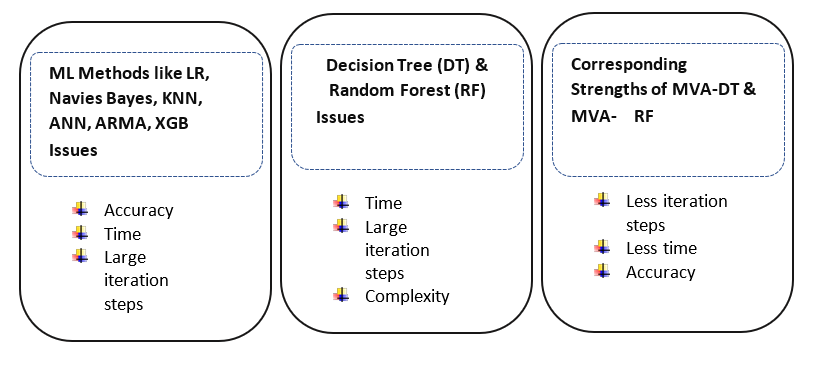
The Corona Virus Disease 2019 (COVID-19) is the most threatening disease of the present century that disturbed the whole world from an economic and life perspective. The increased number of positive COVID-19 patients put the health sector under stress to tackle the outbreak of this virus. In the current decade, the usage of Machine Learning (ML) in medical science has increased, particularly in the detection of Heart failure, Pneumonia, Dengue, Breast cancer, and Diabetes. Similarly, the COVID-19 symptoms can be utilized for an early prediction of COVID-19 to reduce the spread rate of infection in society. Several ML techniques detected the COVID-19 disease, and ensemble-based methods like Decision Tree and Random Forest perform well in terms of accuracy as compared to other standard classifiers. However, the execution time and iterations are the major areas of concern for these ensemble-based methods, as early and timely detection of COVID-19 can reduce its infection rate. In this study, the main focus is on the identification of fatal Coronavirus using ML techniques. For that purpose, Rough Set Theory (RST) based Maximum Value Attribute (MVA) is integrated with classical Decision Tree (DT) and Random Forest to efficiently predict COVID- 19 in terms of time and iterations. The proposed model can detect the result of COVID-19 as negative or positive on the eight basic relevant clinical symptoms. Accordingly, the performance of classical DT and RF classifiers is enhanced by integrating MVA. ML models are implemented to evaluate the model performance over clinical symptoms of 136294 COVID-19 patients. The information is extracted from the open-source GitHub website. Based on the symptoms of the COVID-19 data set, four ML models, DT, RF, Maximum Value Attribute-based Decision Tree (MVA-DT), and Maximum Value Attribute-based Random Forest (MVA-RF) were implemented in Jupyter Notebook via Python repository to forecast the result of COVID-19. Standard performance parameters of the classification process are considered to test model reliability against the prediction of COVID-19. From the time and iteration perspective, the proposed MVA-DT outperformed the other three models, and the MVA-RF technique predicted COVID-19 disease comparatively better, with 95.82% accuracy, 81.90% precision, 59.28% recall, and 68.77% F1 score.
References
D. P. Kavadi, R. Patan, M. Ramachandran, and A. H. Gandomi, “Partial derivative Nonlinear Global Pandemic Machine Learning prediction of COVID 19,” Chaos, Solitons & Fractals, vol. 139, p. 110056, Oct. 2020, doi: 10.1016/J.CHAOS.2020.110056.
A. Khakharia et al., “Outbreak Prediction of COVID-19 for Dense and Populated Countries Using Machine Learning,” Ann. Data Sci. 2020 81, vol. 8, no. 1, pp. 1–19, Oct. 2020, doi: 10.1007/S40745-020-00314-9.
A. A. Alrajhi et al., “Data-Driven Prediction for COVID-19 Severity in Hospitalized Patients,” Int. J. Environ. Res. Public Heal. 2022, Vol. 19, Page 2958, vol. 19, no. 5, p. 2958, Mar. 2022, doi: 10.3390/IJERPH19052958.
L. J. Muhammad, E. A. Algehyne, S. S. Usman, A. Ahmad, C. Chakraborty, and I. A. Mohammed, “Supervised Machine Learning Models for Prediction of COVID-19 Infection using Epidemiology Dataset,” SN Comput. Sci. 2020 21, vol. 2, no. 1, pp. 11-, Nov. 2020, doi: 10.1007/S42979-020-00394-7.
J. Uddin, R. Ghazali, M. M. Deris, U. Iqbal, and I. A. Shoukat, “A novel rough value set categorical clustering technique for supplier base management,” Comput. 2021 1039, vol. 103, no. 9, pp. 2061–2091, Apr. 2021, doi: 10.1007/S00607-021-00950-W.
Y. Zoabi, S. Deri-Rozov, and N. Shomron, “Machine learning-based prediction of COVID-19 diagnosis based on symptoms,” npj Digit. Med. 2021 41, vol. 4, no. 1, pp. 3-, Jan. 2021, doi: 10.1038/s41746-020-00372-6.
Y. Zoabi and N. Shomron, “COVID-19 diagnosis prediction by symptoms of tested individuals: a machine learning approach,” medRxiv, p. 2020.05.07.20093948, May 2020, doi: 10.1101/2020.05.07.20093948.
S. Subudhi et al., “Comparing machine learning algorithms for predicting ICU admission and mortality in COVID-19,” npj Digit. Med. 2021 41, vol. 4, no. 1, pp. 87-, May 2021, doi: 10.1038/s41746-021-00456-x.
N. Shakhovska, V. Yakovyna, V. Chopyak, N. Shakhovska, V. Yakovyna, and V. Chopyak, “A new hybrid ensemble machine-learning model for severity risk assessment and post-COVID prediction system,” Math. Biosci. Eng. 2022 66102, vol. 19, no. 6, pp. 6102–6123, 2022, doi: 10.3934/MBE.2022285.
D. K. Sharma, M. Subramanian, P. Malyadri, B. S. Reddy, M. Sharma, and M. Tahreem, “Classification of COVID-19 by using supervised optimized machine learning technique,” Mater. Today Proc., vol. 56, pp. 2058–2062, Jan. 2022, doi: 10.1016/J.MATPR.2021.11.388.
H. Coppock, A. Gaskell, P. Tzirakis, A. Baird, L. Jones, and B. Schuller, “End-to-end convolutional neural network enables COVID-19 detection from breath and cough audio: a pilot study,” BMJ Innov., vol. 7, no. 2, pp. 356–362, Apr. 2021, doi: 10.1136/BMJINNOV-2021-000668.
P. Patwa et al., “Can Self Reported Symptoms Predict Daily COVID-19 Cases?,” May 2021, Accessed: Dec. 09, 2025. [Online]. Available: https://arxiv.org/pdf/2105.08321
Z. Li et al., “Efficient management strategy of COVID-19 patients based on cluster analysis and clinical decision tree classification,” Sci. Reports 2021 111, vol. 11, no. 1, pp. 9626-, May 2021, doi: 10.1038/s41598-021-89187-3.
R. K. Mojjada, A. Yadav, A. V. Prabhu, and Y. Natarajan, “WITHDRAWN: Machine learning models for covid-19 future forecasting,” Mater. Today Proc., Dec. 2020, doi: 10.1016/J.MATPR.2020.10.962.
E. Fayyoumi, S. Idwan, and H. Aboshindi, “Machine Learning and Statistical Modelling for Prediction of Novel COVID-19 Patients Case Study: Jordan,” Int. J. Adv. Comput. Sci. Appl., vol. 11, no. 5, pp. 122–126, May 2020, doi: 10.14569/IJACSA.2020.0110518.
Y. Gao et al., “Machine learning based early warning system enables accurate mortality risk prediction for COVID-19,” Nat. Commun. 2020 111, vol. 11, no. 1, pp. 5033-, Oct. 2020, doi: 10.1038/s41467-020-18684-2.
A. H. M. Hassan, A. A. M. Qasem, W. F. M. Abdalla, and O. H. Elhassan, “Visualization & Prediction of COVID-19 Future Outbreak by Using Machine Learning,” Int. J. Inf. Technol. Comput. Sci., vol. 13, no. 3, pp. 16–32, Jun. 2021, doi: 10.5815/IJITCS.2021.03.02.
A. Alotaibi, M. Shiblee, and A. Alshahrani, “Prediction of Severity of COVID-19-Infected Patients Using Machine Learning Techniques,” Comput. 2021, Vol. 10, Page 31, vol. 10, no. 3, p. 31, Mar. 2021, doi: 10.3390/COMPUTERS10030031.
S. T. Ogunjo, I. A. Fuwape, and A. B. Rabiu, “Predicting COVID‐19 Cases From Atmospheric Parameters Using Machine Learning Approach,” GeoHealth, vol. 6, no. 4, p. e2021GH000509, Apr. 2022, doi: 10.1029/2021GH000509.
V. K. Gupta, A. Gupta, D. Kumar, and A. Sardana, “Prediction of COVID-19 confirmed, death, and cured cases in India using random forest model,” Big Data Min. Anal., vol. 4, no. 2, pp. 116–123, Jun. 2021, doi: 10.26599/BDMA.2020.9020016.
N. Rochmawati et al., “Covid Symptom Severity Using Decision Tree,” Proceeding - 2020 3rd Int. Conf. Vocat. Educ. Electr. Eng. Strength. Framew. Soc. 5.0 through Innov. Educ. Electr. Eng. Informatics Eng. ICVEE 2020, Oct. 2020, doi: 10.1109/ICVEE50212.2020.9243246.
M. H. Tayarani N., “Applications of artificial intelligence in battling against covid-19: A literature review,” Chaos, Solitons & Fractals, vol. 142, p. 110338, Jan. 2021, doi: 10.1016/j.chaos.2020.110338.
S. Roy and P. Ghosh, “Factors affecting COVID-19 infected and death rates inform lockdown-related policymaking,” PLoS One, vol. 15, no. 10, p. e0241165, Oct. 2020, doi: 10.1371/JOURNAL.PONE.0241165.
K. B. Prakash, “Analysis, Prediction and Evaluation of COVID-19 Datasets using Machine Learning Algorithms,” Int. J. Emerg. Trends Eng. Res., vol. 8, no. 5, pp. 2199–2204, May 2020, doi: 10.30534/IJETER/2020/117852020.
H. R. Niazkar and M. Niazkar, “Application of artificial neural networks to predict the COVID-19 outbreak,” Glob. Heal. Res. Policy 2020 51, vol. 5, no. 1, pp. 50-, Nov. 2020, doi: 10.1186/S41256-020-00175-Y.
X. Guan et al., “Clinical and inflammatory features based machine learning model for fatal risk prediction of hospitalized COVID-19 patients: results from a retrospective cohort study,” Ann. Med., vol. 53, no. 1, pp. 257–266, 2021, doi: 10.1080/07853890.2020.1868564;ISSUE:ISSUE:DOI.
D. Darwin, D. Christian, W. Chandra, and M. Nababan, “Comparison of Decision Tree and Linear Regression Algorithms in the Case of Spread Prediction of COVID-19 in Indonesia,” J. Comput. Networks, Archit. High Perform. Comput., vol. 4, no. 1, pp. 1–12, Jan. 2022, doi: 10.47709/CNAHPC.V4I1.1234.
M. S. Satu et al., “Short-Term Prediction of COVID-19 Cases Using Machine Learning Models,” Appl. Sci. 2021, Vol. 11, Page 4266, vol. 11, no. 9, p. 4266, May 2021, doi: 10.3390/APP11094266.
D. Chumachenko, I. Meniailov, K. Bazilevych, T. Chumachenko, and S. Yakovlev, “Investigation of Statistical Machine Learning Models for COVID-19 Epidemic Process Simulation: Random Forest, K-Nearest Neighbors, Gradient Boosting,” Comput. 2022, Vol. 10, Page 86, vol. 10, no. 6, p. 86, May 2022, doi: 10.3390/COMPUTATION10060086.
Downloads
Published
How to Cite
Issue
Section
License
Copyright (c) 2025 50sea

This work is licensed under a Creative Commons Attribution 4.0 International License.