Agentic AI for Autonomous Soil and Fertilization Management for Agriculture Sustainability
Keywords:
Multi-Agent Reinforcement learning, Rule-Based Control, Farmer Practice, Agentic AI, Soil health indexAbstract
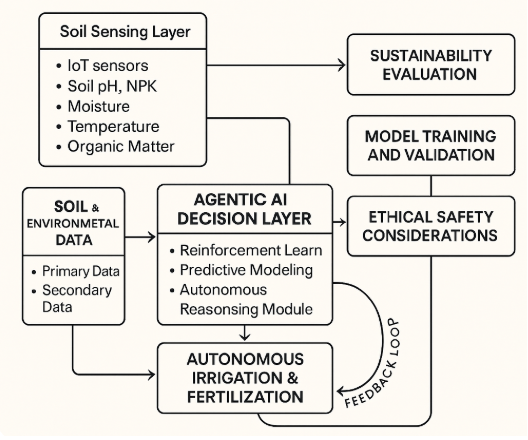
Soil fertility loss and excessive chemical fertilization are major environmental and economic issues in developing regions such as Punjab, Pakistan. This paper proposes an Agentic AI framework for autonomous soil and fertilization management that combines (i) IoT soil sensing and drone-based crop monitoring for real-time perception, (ii) predictive modelling for short-horizon nutrient and moisture forecasting, and (iii) multi-agent reinforcement learning (MARL) for adaptive decision-making. The system operates with operational autonomy, executing daily management decisions without routine human-in-the-loop control. Agronomic expert knowledge is incorporated only offline as safety constraints and initialization priors (e.g., allowable nutrient ranges and stress-avoidance rules) to bound the action space and prevent unsafe behavior, rather than to prescribe actions. Experiments were conducted across two seasons at two sites (Sheikhupura and Multan) under four treatments: Farmer Practice (FP), Rule-Based Control (RBC), Machine Learning Predict (ML-Predict), and the proposed Agentic AI. Results show that Agentic AI reduces nitrogen fertilizer use while maintaining/improving yield proxy and improving soil indicators (including residual nitrate reduction and improved Soil Health Index). We also analyze irrigation outcomes as a sustainability objective and show how water usage must be treated as a constrained or multi-objective term in the reward function to avoid over-irrigation. Overall, the framework supports scalable, data-driven soil management with bounded autonomy, preserving expert-defined agronomic safety.
References
A. K. Pati, “Agentic AI: A Comprehensive Survey of Technologies, Applications, and Societal Implications,” IEEE Access, vol. 13, pp. 151824–151837, 2025, doi: 10.1109/ACCESS.2025.3585609.
M. K. Ranjan Sapkota, Konstantinos I. Roumeliotis, “AI Agents vs. Agentic AI: A Conceptual Taxonomy, Applications and Challenges,” SuperIntelligence - Robot. - Saf. Alignment, vol. 2, no. 3, 2025, [Online]. Available: https://s-rsa.com/index.php/agi/article/view/15161
Q. Chen, L. Li, C. Chong, and X. Wang, “AI-enhanced soil management and smart farming,” Soil Use Manag., vol. 38, no. 1, pp. 7–13, Jan. 2022, doi: 10.1111/SUM.12771.
S. Saha and A. Bhardwaj, “A narrative review of artificial intelligence to optimize the use of fertilizers: A game changing opportunity,” Crop. Forage Turfgrass Manag., vol. 11, no. 1, p. e70027, Jun. 2025, doi: 10.1002/CFT2.70027;ISSUE:ISSUE:DOI.
A. Pamisetty, “Application of Agentic Artificial Intelligence in Autonomous Decision Making Across Food Supply Chains,” SSRN Electron. J., Dec. 2024, doi: 10.2139/SSRN.5231360.
H. Y. E. Liu, “Agents are all you need: Pioneering the use of agentic artificial intelligence to embrace large language models into dairy science,” J. Dairy Sci., vol. 108, no. 12, pp. 14038–14049, 2025, [Online]. Available: https://www.journalofdairyscience.org/article/S0022-0302(25)00727-1/fulltext
A. Mørch and R. Andersen, “Human-Centred AI in Education in the Age of Generative AI Tools,” IS-EUD Work., 2023.
Latief Ahmad, Firasath Nabi, “Agriculture 5.0 Artificial Intelligence, IoT and Machine Learning,” Routledge, 2021, [Online]. Available: https://www.routledge.com/Agriculture-50-Artificial-Intelligence-IoT-and-Machine-Learning/Ahmad-Nabi/p/book/9780367646080
V. S. Magomadov, “Deep learning and its role in smart agriculture,” J. Phys. Conf. Ser., 2019, doi: 10.1088/1742-6596/1399/4/044109.
K. P. Vishal Meshram, “Machine learning in agriculture domain: A state-of-art survey,” Artif. Intell. Life Sci., vol. 1, p. 100010, 2021, doi: https://doi.org/10.1016/j.ailsci.2021.100010.
A. Pamisetty, “Leveraging Agentic AI and Cloud Infrastructure for Predictive Logistics in National Food Supply Chains,” SSRN Electron. J., Dec. 2024, doi: 10.2139/SSRN.5262994.
V. Lakshmi and J. Corbett, “Using AI to Improve Sustainable Agricultural Practices: A Literature Review and Research Agenda,” Commun. Assoc. Inf. Syst., vol. 53, no. 1, pp. 96–137, Oct. 2023, doi: 10.17705/1CAIS.05305.
I. Ouhnine and I. Ouhnine, “The Future of Human Autonomy: Will Agentic Artificial Intelligence Augment or Replace Human Decision-Making,” https://services.igi-global.com/resolvedoi/resolve.aspx?doi=10.4018/979-8-3373-1737-3.ch003, pp. 79–107, Jan. 1AD, doi: 10.4018/979-8-3373-1737-3.CH003.
S. M. S. Muhammad Usman Tariq, “Edge-enabled smart agriculture framework: Integrating IoT, lightweight deep learning, and agentic AI for context-aware farming,” Results Eng., vol. 28, p. 107342, 2025, doi: https://doi.org/10.1016/j.rineng.2025.107342.
R. S. Maaz Gardezi, “Growing algorithmic governmentality: Interrogating the social construction of trust in precision agriculture,” J. Rural Stud., vol. 84, pp. 1–11, 2021, doi: https://doi.org/10.1016/j.jrurstud.2021.03.004.
B. C. Maher Alndiwee, “Reinventing Agriculture: AI and Blockchain in Farming Practices,” Signals Commun. Technol., pp. 213–229, 2025, [Online]. Available: https://link.springer.com/chapter/10.1007/978-3-031-88095-7_11
M. S. Basir et al., “Meta Ag 2.0: A Framework for AI-Infused Contextual Agricultural Recordkeeping,” 2025 ASABE Annu. Int. Meet., pp. 1-, 2025, doi: 10.13031/AIM.202500039.
A. M. M. Hayley Clatterbuck, Clinton Castro, “Risk Alignment in Agentic AI Systems,” arXiv:2410.01927, 2024, doi: https://doi.org/10.48550/arXiv.2410.01927.
Y. A. Shentsov, T. Y. Chernysheva, I. N. Glukhikh, and D. I. Glukhikh, “Development and Use of LLM-Agents to Automate Business Processes of a Smart Farm,” Lect. Notes Networks Syst., vol. 1422 LNNS, pp. 69–81, 2025, doi: 10.1007/978-3-031-94273-0_6.
A. Phadke, A. Hadimlioglu, T. Chu, and C. N. Sekharan, “Integrating Large Language Models for UAV Control in Simulated Environments: A Modular Interaction Approach,” Researchgate, Oct. 2024, Accessed: Dec. 22, 2025. [Online]. Available: http://arxiv.org/abs/2410.17602
L. Hughes et al., “AI Agents and Agentic Systems: A Multi-Expert Analysis,” J. Comput. Inf. Syst., vol. 65, no. 4, pp. 489–517, Jul. 2025, doi: 10.1080/08874417.2025.2483832;WGROUP:STRING:PUBLICATION.
R. Sapkota et al., “Multi-Modal LLMs in Agriculture: A Comprehensive Review,” Authorea Prepr., Sep. 2024, doi: 10.36227/TECHRXIV.172651082.24507804/V1.
A. M. N. Karishma Kumari, “AI-Driven Future Farming: Achieving Climate-Smart and Sustainable Agriculture,” AgriEngineering, vol. 7, no. 3, p. 89, 2025, doi: https://doi.org/10.3390/agriengineering7030089.
T. Tonmoy, M. S. I., Rabbi, R., Hassan, M. R., Naswan, R., & Shome, “AgriBuddy: An Agentic AI System for Bangladeshi Agriculture Using RAG and Vision Models,” BRAC Univ., 2025, [Online]. Available: https://www.researchgate.net/publication/392194862_AgriBuddy_An_AI-powered_Agent-based_System_for_Bangladeshi_Agriculture_Using_RAG_and_Vision_Models
J. G. W. Graham Hill, JingYuan Gong, Thulani Babeli, Moseli Mots’oehli, “LLMs and Agentic AI in Insurance Decision-Making: Opportunities and Challenges For Africa,” arXiv:2508.15110, 2025, [Online]. Available: https://arxiv.org/abs/2508.15110
J. A. Mohammad A. Obeidat, “Enhancing Agricultural Operations Through AI-Driven Agent Communication in Smart Farming Systems,” Ing. des Syst. d’Information, 2024, [Online]. Available: https://www.iieta.org/journals/isi/paper/10.18280/isi.290312
S. F. E. U. A. T. P. A. and R. Optimization, “Smart Farming: Enhancing Urban Agriculture Through Predictive Analytics and Resource Optimization,” IEEE Access, vol. 13, pp. 72375–72388, 2025, doi: 10.1109/ACCESS.2025.3530006.
S. S. S. Vaddhiparthy, G. R, R. N. Dasari, and S. Mandava, “Technical Report on KshemaGPT: A Multi-Agent LLM for Agriculture & Enterprise AI,” Authorea Prepr., Jul. 2025, doi: 10.36227/TECHRXIV.175372827.71128287/V1.
K. S. Laura Foster, “Smart farming and artificial intelligence in East Africa: Addressing indigeneity, plants, and gender,” Smart Agric. Technol., vol. 3, p. 100132, 2023, doi: https://doi.org/10.1016/j.atech.2022.100132.
K. K. and B. D. D. B. Acharya, “Agentic AI: Autonomous Intelligence for Complex Goals—A Comprehensive Survey,” IEEE Access, vol. 13, pp. 18912–18936, 2025, doi: 10.1109/ACCESS.2025.3532853.
Downloads
Published
How to Cite
Issue
Section
License
Copyright (c) 2025 50sea

This work is licensed under a Creative Commons Attribution 4.0 International License.