Service Sphere: Citizen Service and Complaint Management System
DOI:
https://doi.org/10.33411/IJIST/1709Keywords:
Artificial Intelligence, Automation, Complaint Management System, Human–AI Collaboration, Large Language Models, MERN Stack, Multilingual System, Natural Language Processing, Public Service DeliveryAbstract
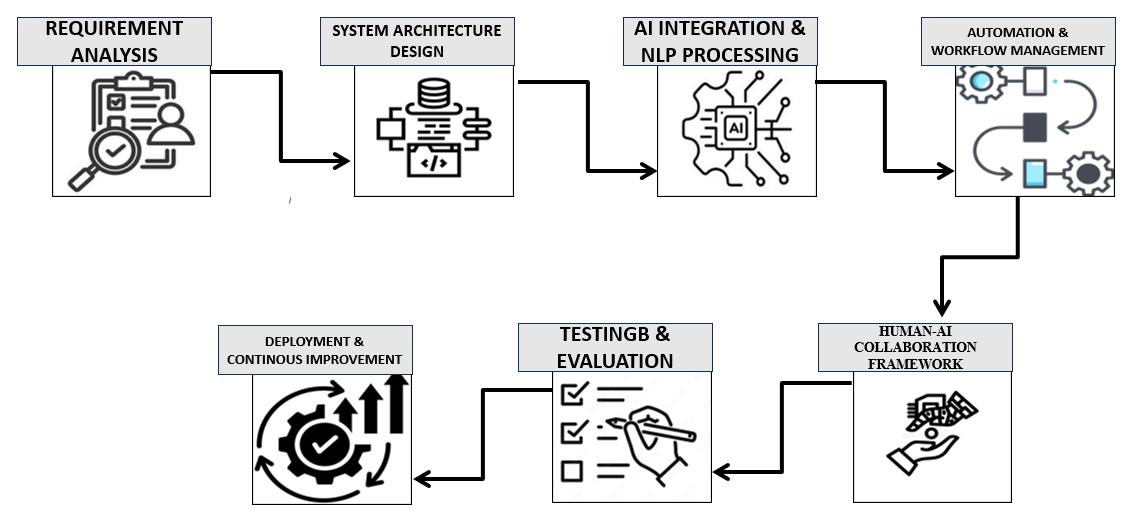
Globally, particularly in developing countries, registering and tracking citizen complaints remains a significant challenge due to complex government procedures, slow response times, and limited follow-up mechanisms. To address this issue, this study proposes an integrated citizen service and complaint management system that enables users to draft, submit, and monitor complaints through a unified platform. The system leverages fine-tuned large language models (LLMs), including GPT and LLaMA, along with a custom backend that manages routing, microservices, and business logic. The AI models automatically classify complaints and forward them to the appropriate government departments. The platform supports both English and Urdu languages, reducing manual processing and improving accessibility. Experimental results demonstrate that the system achieves 92% classification accuracy, reduces average response time by 40%, and automates 68% of complaint cases. These findings indicate that the proposed system can significantly enhance efficiency, transparency, and citizen satisfaction in public service complaint management.
References
Hila Mehr, “Artificial Intelligence for Citizen Services and Government,” Harvard Ash Cent. Technol. Democr. Fellow, 2017, [Online]. Available: https://ash.harvard.edu/wp-content/uploads/2024/02/artificial_intelligence_for_citizen_services.pdf
G. M. Colin van Noordt, “Artificial intelligence for the public sector: results of landscaping the use of AI in government across the European Union,” Gov. Inf. Q., vol. 39, no. 3, p. 101714, 2022, [Online]. Available: http://sciencedirect.com/science/article/abs/pii/S0740624X22000478
H. M. S. S. Javairia Shafiq, “Use of ICTs and Artificial Intelligence to Overcome Judicial Trial Delays in Pakistani Courts,” Pakistan Lang. Humanit. Rev., vol. 6, no. 2, 2022, [Online]. Available: https://ojs.plhr.org.pk/journal/article/view/131
A. D. Samuel-Okon and O. Abejide, “Bridging the Digital Divide: Exploring the Role of Artificial Intelligence and Automation in Enhancing Connectivity in Developing Nations,” SSRN Electron. J., May 2024, doi: 10.2139/SSRN.4839447.
“Research on Artificial Intelligence For Citizen Services and Government.” Accessed: Feb. 10, 2026. [Online]. Available: https://www.researchgate.net/publication/357033081_Research_On_Artificial_Intelligence_For_Citizen_Services_And_Government
P. Wadkar, A. Raorane, S. Bushra, and shreyas shedge, “AI-Driven Complaint Management System,” SSRN Electron. J., May 2021, doi: 10.2139/ssrn.3866078.
Asad Khattak, Waqas Tariq Paracha, Muhammad Zubair Asghar, “Fine-Grained Sentiment Analysis for Measuring Customer Satisfaction Using an Extended Set of Fuzzy Linguistic Hedges,” Int. J. Comput. Intell. Syst., vol. 13, pp. 744–756, 2020, [Online]. Available: https://link.springer.com/article/10.2991/ijcis.d.200513.001
Z. Y. Xudong Zhang, “Community Governance Based on Sentiment Analysis: Towards Sustainable Management and Development,” Sustainability, vol. 15, no. 3, p. 2684, 2023, [Online]. Available: https://www.mdpi.com/2071-1050/15/3/2684
Basit Afzal, Dr. Muhammad Imran Khan, “AI Adaptability and Customer Satisfaction in Telecom Complaint Handling: The Mediating Role of Customer Psychographics and Perceived Usefulness,” Soc. Sci. Rev. Arch., vol. 3, no. 3, pp. 1278–1291, 2025, [Online]. Available: https://www.researchgate.net/publication/394834111_AI_
Adaptability_and_Customer_Satisfaction_in_Telecom_Complaint_Handling_The_Mediating_Role_of_Customer_Psychographics_and_Perceived_Usefulness
Ana Marta Goucha de Carvalho, “Government Augmented Intelligence the Use of AI to Improve Citizen Relationship Management,” Nov. Inf. Manag. Sch. Inst. Super. Estatística e Gestão Informação, 2022.
Naomi Aoki, “An experimental study of public trust in AI chatbots in the public sector,” Gov. Inf. Q., vol. 37, no. 4, p. 101490, 2020, [Online]. Available: https://www.sciencedirect.com/science/article/abs/pii/S0740624X1930406X
D. I. N. Tayyaba Jadoon, “Leveraging Artificial Intelligence for Social Governance in Pakistan: Toward an Ethical and Policy-Oriented Framework,” Acad. Int. J. Soc. Sci., vol. 4, no. 3, 2025, [Online]. Available: https://academia.edu.pk/index.php/Journals/article/view/541?articlesBySimilarityPage=1
Downloads
Published
How to Cite
Issue
Section
License
Copyright (c) 2025 50sea

This work is licensed under a Creative Commons Attribution 4.0 International License.