A Hierarchical Ensemble Deep Learning Framework for Angiographic Blood Vessel Segmentation and Coronary Artery Disease Classification
Keywords:
Coronary Angiography, Blood Vessel Segmentation, Coronary Artery Disease, Ensemble Deep Learning, Feature Fusion, Computer-Aided DiagnosisAbstract
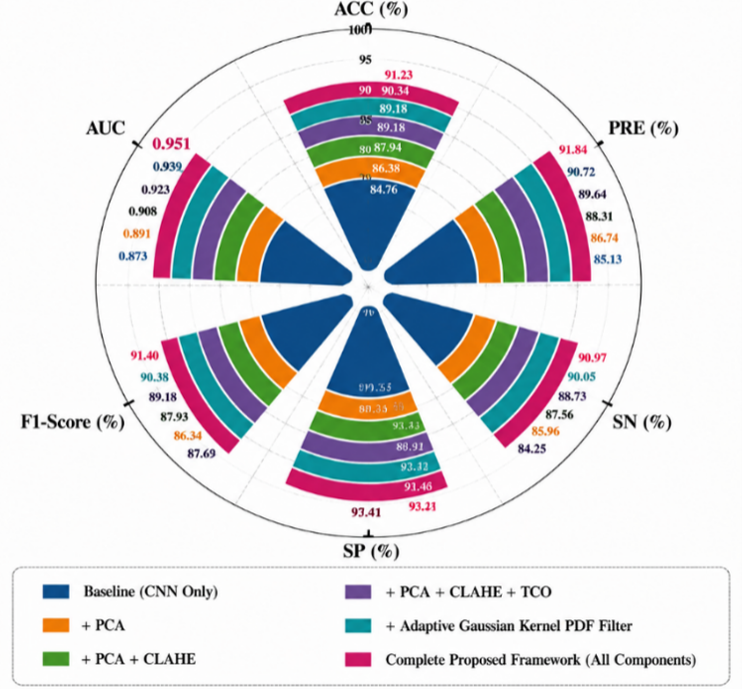
Artificial Intelligence (AI) and deep learning have revolutionized medical image analysis by enabling accurate, efficient, and automated disease diagnosis across diverse healthcare applications. In cardiovascular medicine, these technologies have significantly improved the analysis of coronary angiographic images, supporting early detection and clinical decision-making for coronary artery disease (CAD). However, accurate angiographic blood vessel segmentation and disease classification remain challenging due to low image contrast, brightness inhomogeneity, imaging noise, and the limited feature representation capability of single deep learning models. To address these challenges, this paper proposes a hierarchical ensemble-based deep learning framework for angiographic blood vessel segmentation and coronary artery disease classification. First, Principal Component Analysis (PCA), Contrast Limited Adaptive Histogram Equalization (CLAHE), and the Toggle Contrast Operator (TCO) are employed to enhance angiographic image quality. Secondly, an adaptive Gaussian kernel probability density function (PDF)-based matched filtering technique, followed by entropy-based thresholding, length filtering, and masking, is applied for accurate coronary vessel segmentation. Thirdly, complementary deep features are extracted using EfficientNet-B0, VGG-16, and ResNet-152 and integrated through an ensemble feature fusion strategy. Finally, the fused features are classified using a Softmax classifier. Experimental results demonstrate that the proposed framework achieves an accuracy of 91.23%, precision of 91.84%, sensitivity of 90.97%, specificity of 93.41%, F1-score of 91.40%, MCC of 0.825, Cohen's Kappa of 0.823, and an AUC of 0.951. Comparative evaluation against conventional machine learning and state-of-the-art deep learning models demonstrates that the proposed framework provides superior classification performance, robustness, and diagnostic reliability, "making it a promising computer-aided clinical decision support tool" l for coronary artery disease diagnosis.
References
M. Alzamel, I. Uddin, S. Khan, N. Dilshad, and N. Ahmad, “Deep learning-based identification of N6-methyladenine sites via hybrid feature fusion and SHAP-driven feature selection,” Sci. Reports 2026 161, vol. 16, no. 1, pp. 22385-, May 2026, doi: 10.1038/s41598-026-50667-z.
S. Khan, I. Uddin, F. K. Alarfaj, and N. Almusallam, “A novel computational framework for tumor-specific T cell antigen identification using a deep neural network,” J. Comput. Mol. Des. 2026 401, vol. 40, no. 1, pp. 150-, Jun. 2026, doi: 10.1007/S10822-026-00861-Y.
S. Khan, I. Uddin, S. Noor, S. A. AlQahtani, and N. Ahmad, “N6-methyladenine identification using deep learning and discriminative feature integration,” BMC Med. Genomics 2025 181, vol. 18, no. 1, pp. 58-, Mar. 2025, doi: 10.1186/S12920-025-02131-6.
M. Sanz et al., “Periodontitis and cardiovascular diseases: Consensus report,” J. Clin. Periodontol., vol. 47, no. 3, pp. 268–288, Mar. 2020, doi: 10.1111/JCPE.13189.
I. Uddin et al., “Deep-m6Am: a deep learning model for identifying N6, 2′-O-Dimethyladenosine (m6Am) sites using hybrid features,” AIMS Bioeng. 2025 1145, vol. 12, no. 1, pp. 145–161, 2025, doi: 10.3934/BIOENG.2025006.
Masroor Shah, Fazal Malik, Muhammad Suliman, Noor Rahman, Irfan Ullah, Sana Ullah, Romaan Khan, & Salman Alam, “Dark Data in Accident Prediction: Using AdaBoost and Random Forest for Improved Accuracy,” J. Comput. Biomed. Informatics, vol. 7, no. 2, 2024, [Online]. Available: https://jcbi.org/index.php/Main/article/view/531
S. Upadhyay, A. K. Sagar, and N. R. Roy, “Benchmarking Ensemble Learning Approaches for Coronary Artery Disease Classification,” Int. J. Comput. Intell. Syst. 2026 191, vol. 19, no. 1, pp. 78-, Jan. 2026, doi: 10.1007/S44196-025-01147-1.
A. Al Gahtani and H. El-Sayed, “Building a Novel Ensemble Learning – Based Prediction Framework for Diagnosis of Coronary Heart Disease,” Int. J. Intell. Syst. Appl. Eng., vol. 10, no. 3, pp. 265–273, Oct. 2022, Accessed: Aug. 07, 2026. [Online]. Available: https://ijisae.org/index.php/IJISAE/article/view/2164
I. Uddin, S. Noor, Y. A. Ali, S. Khan, and M. Al-Razgan, “A hybrid deep learning framework for accurate N6,2′-O-Dimethyladenosine site prediction,” Biophys. Chem., vol. 335, p. 107639, Aug. 2026, doi: 10.1016/J.BPC.2026.107639.
“Explainable AI-Driven Clinical Decision Support System for Cardiovascular Disease Prediction Using Hybrid Models | International Journal of Innovations in Science & Technology.” Accessed: Aug. 07, 2026. [Online]. Available: https://journal.50sea.com/index.php/IJIST/article/view/1962
N. V. Chinnasamy, A. V. Kavyasree, C. Sanjay, C. P. Krishna, and D. Gnaneswar, “Hybrid Ensemble Deep Learning Framework with Feature Optimization and Explainable AI for Coronary Artery Disease Detection,” Proc., pp. 1195–1202, Jan. 2026, doi: 10.1109/ICPCSN68523.2026.11543974.
A. Ur Rahman, N. Iqbal, I. Uddin, and S. A. C. Bukhari, “Multifaceted Fusion of Glove and Additive Attention Models for Scalable Fake News Detection,” Proc. - 2025 IEEE Int. Conf. Futur. Mach. Learn. Data Sci. FMLDS 2025, pp. 363–368, 2025, doi: 10.1109/FMLDS67896.2025.00069.
I. Syed Ahmad Chan Bukhar., Nadeem Iqbal., Uddin., “Discriminative Sequence Features for DNA-Binding Protein Detection Using ML and DL Techniques,” reseach gate., pp. 461–421, doi: 10.1109/FMLDS67896.2025.0007.
A. Ghasemieh, A. Lloyed, P. Bahrami, P. Vajar, and R. Kashef, “A novel machine learning model with Stacking Ensemble Learner for predicting emergency readmission of heart-disease patients,” Decis. Anal. J., vol. 7, p. 100242, Jun. 2023, doi: 10.1016/J.DAJOUR.2023.100242.
M. Yousefzadeh et al., “Coronary Artery Segmentation and Vessel-Type Classification in X-Ray Angiography,” Jan. 2026, Accessed: Aug. 07, 2026. [Online]. Available: https://arxiv.org/pdf/2601.17429
R. R. Sarra, A. M. Dinar, and M. A. Mohammed, “Enhanced accuracy for heart disease prediction using artificial neural network,” Indones. J. Electr. Eng. Comput. Sci., vol. 29, no. 1, pp. 375–383, Jan. 2023, doi: 10.11591/IJEECS.V29.I1.PP375-383.
A. Ashfaq, A. Imran, I. Ullah, A. Alzahrani, K. M. A. Alheeti, and A. Yasin, “Multi-model Ensemble Based Approach for Heart Disease Diagnosis,” 2022 Int. Conf. Recent Adv. Electr. Eng. Comput. Sci. RAEE CS 2022, 2022, doi: 10.1109/RAEECS56511.2022.9954490.
T. M. A. M. Sharean and G. Johncy, “Deep learning models on Heart Disease Estimation - A review,” J. Artif. Intell. Capsul. Networks, vol. 4, no. 2, pp. 122–130, Jul. 2022, doi: 10.36548/JAICN.2022.2.004.
T. Aswani, J. M. Gummadi, and G. Sharada, “CardioEnsemNet: An Optimized Ensemble Learning Framework for Accurate Coronary Artery Disease Prediction Across Multiple Datasets,” Int. J. Comput. Intell. Syst. 2026, Jun. 2026, doi: 10.1007/S44196-026-01451-4.
P. A. Patel and T. V Nakrani, “A Feature-Optimized Hybrid Supervised Ensemble Learning Framework for Early Heart Attack Prediction Using Artificial Intelligence and Machine Learning,” Int. J. Comput. Inf. Syst. Ind. Manag. Appl., vol. 18, no. 10s, pp. 792–807, Jul. 2026, doi: 10.70917/IJCISIM-2026-3650.
M. C. Devi and M. Ramaswami, “Efficient Hybrid Deep Learning Network Model for Segmentation and Classification of Heart Angiographic Images,” Nano Biomed. Eng., vol. 17, no. 3, pp. 426–441, Sep. 2025, doi: 10.26599/NBE.2024.9290063.
G. N. Ahmad, H. Fatima, Shafiullah, A. Salah Saidi, and Imdadullah, “Efficient Medical Diagnosis of Human Heart Diseases Using Machine Learning Techniques with and Without GridSearchCV,” IEEE Access, vol. 10, pp. 80151–80173, 2022, doi: 10.1109/ACCESS.2022.3165792.
B. Zhao, J. Peng, C. Chen, Y. Fan, K. Zhang, and Y. Zhang, “Deep Learning-Based Segmentation and Localization in CT Angiography for Coronary Heart Disease Diagnosis,” IEEE Access, vol. 13, pp. 57615–57628, 2025, doi: 10.1109/ACCESS.2025.3555991.
F. Shariaty et al., “Deep vessel segmentation with U-Net and texture representation of image (TRI) features provides a foundation for improved objective and automated analysis of coronary artery disease from angiography,” Comput. Methods Programs Biomed., vol. 272, Dec. 2025, doi: 10.1016/j.cmpb.2025.109072.
T. R. Ramesh, U. K. Lilhore, M. Poongodi, S. Simaiya, A. Kaur, and M. Hamdi, “Predictive Analysis of Heart Diseases with Machine Learning Approaches,” Malaysian J. Comput. Sci., vol. 2022, no. Special Issue 1, pp. 132–148, Mar. 2022, doi: 10.22452/MJCS.SP2022NO1.10.
C. Pan, A. Poddar, R. Mukherjee, and A. K. Ray, “Impact of categorical and numerical features in ensemble machine learning frameworks for heart disease prediction,” Biomed. Signal Process. Control, vol. 76, p. 103666, Jul. 2022, doi: 10.1016/J.BSPC.2022.103666.
D. K. Maharana, P. Das, and R. K. Rout, “Automated segmentation of blood vessels in retinal images based on entropy weighted thresholding,” Comput. Methods Biomech. Biomed. Eng. Imaging Vis., vol. 11, no. 3, pp. 542–553, May 2023, doi: 10.1080/21681163.2022.2083982.
S. Yang et al., “Deep learning segmentation of major vessels in X-ray coronary angiography,” Sci. Reports 2019 91, vol. 9, no. 1, pp. 16897-, Nov. 2019, doi: 10.1038/s41598-019-53254-7.
K. Iyer et al., “AngioNet: a convolutional neural network for vessel segmentation in X-ray angiography,” Sci. Reports 2021 111, vol. 11, no. 1, pp. 18066-, Sep. 2021, doi: 10.1038/s41598-021-97355-8.
Z. Jiang, C. Ou, Y. Qian, R. Rehan, and A. Yong, “Coronary vessel segmentation using multiresolution and multiscale deep learning,” Informatics Med. Unlocked, vol. 24, p. 100602, Jan. 2021, doi: 10.1016/J.IMU.2021.100602.
M. A. Gil-Rios et al., “Automatic Feature Selection for Stenosis Detection in X-ray Coronary Angiograms,” Math. 2021, Vol. 9, Page 2471, vol. 9, no. 19, p. 2471, Oct. 2021, doi: 10.3390/MATH9192471.
I. Uddin, S. Khan, Y. A. Ali, N. Dilshad, N. Ahmad, and M. Al-Razgan, “Hybrid Deep Learning Framework for Accurate RNA m6Am Site Prediction,” 2025, doi: 10.2139/SSRN.5704553.
I. H. A. S. K. Majdi Khalid., Uddin., “A hybrid residue based sequential encoding mechanism with XGBoost improved ensemble model for identifying 5-hydroxymethylcytosine modifications,” Res. gate., vol. 14, no. 1.
S. Khan et al., “Sequence based model using deep neural network and hybrid features for identification of 5-hydroxymethylcytosine modification,” Sci. Reports 2024 141, vol. 14, no. 1, pp. 9116-, Apr. 2024, doi: 10.1038/s41598-024-59777-y.
S.-I. L. Scott Lundberg, “A Unified Approach to Interpreting Model Predictions,” arXiv:1705.07874, 2017, [Online]. Available: https://arxiv.org/abs/1705.07874
V. Chelak, O. Hornostal, Y. Chelak, and S. Gavrylenko, “Advanced Methods for Classification Quality Assessment Leveraging ROC Analysis And Multidimensional Confusion Matrix,” Adv. Inf. Syst., vol. 9, no. 1, pp. 24–34, Feb. 2025, doi: 10.20998/2522-9052.2025.1.03.
N. Ramadanov et al., “Artificial intelligence-guided distal radius fracture detection on plain radiographs in comparison with human raters,” J. Orthop. Surg. Res., vol. 20, no. 1, Dec. 2025, doi: 10.1186/S13018-025-05888-9.
C. Li et al., “Diagnostic Performance of Fractional Flow Reserve Derived From Coronary CT Angiography: The ACCURATE-CT Study,” JACC Cardiovasc. Interv., vol. 17, no. 17, pp. 1980–1992, Sep. 2024, doi: 10.1016/j.jcin.2024.06.027.
C. Cong, Y. Kato, H. D. De Vasconcellos, M. R. Ostovaneh, J. A. C. Lima, and B. Ambale-Venkatesh, “Deep learning-based end-to-end automated stenosis classification and localization on catheter coronary angiography,” Front. Cardiovasc. Med., vol. 10, Feb. 2023, doi: 10.3389/FCVM.2023.944135/PDF.
R. Avram et al., “CathAI: fully automated coronary angiography interpretation and stenosis estimation,” npj Digit. Med. 2023 61, vol. 6, no. 1, pp. 142-, Aug. 2023, doi: 10.1038/s41746-023-00880-1.
É. Labrecque Langlais et al., “Evaluation of stenoses using AI video models applied to coronary angiography,” npj Digit. Med. 2024 71, vol. 7, no. 1, pp. 138-, May 2024, doi: 10.1038/s41746-024-01134-4.
F. Arefinia, M. Aria, R. Rabiei, A. Hosseini, A. Ghaemian, and A. Roshanpoor, “Non-invasive fractional flow reserve estimation using deep learning on intermediate left anterior descending coronary artery lesion angiography images,” Sci. Reports 2024 141, vol. 14, no. 1, pp. 1818-, Jan. 2024, doi: 10.1038/s41598-024-52360-5.
L. Yu et al., “Coronary stenosis assessment: AI-based CT quantification, visual analysis of invasive angiography, and quantitative coronary angiography,” Insights Imaging, vol. 17, no. 1, p. 134, Dec. 2026, doi: 10.1186/S13244-026-02308-2.
A. R. Ihdayhid et al., “Coronary Artery Stenosis and High-Risk Plaque Assessed With an Unsupervised Fully Automated Deep Learning Technique,” JACC Adv., vol. 3, no. 9, Sep. 2024, doi: 10.1016/j.jacadv.2024.100861.
Downloads
Published
How to Cite
Issue
Section
License
Copyright (c) 2026 50SEA

This work is licensed under a Creative Commons Attribution 4.0 International License.