Dynamic Behavior of a Magnetized Multi-Component Hybrid Nanofluid on an Oblique Elongating Interface Affected by Extraction and Permeable Media Interactions
DOI:
https://doi.org/10.33411/IJIST/1657Keywords:
Nanofluid, Nanoparticles, Magnetized, Permeable MediaAbstract
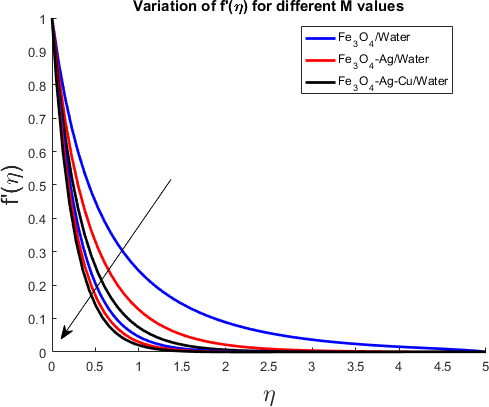
The current study explores the mechanism of heat transfer in non-Newtonian Maxwell tri-component nanofluid flow past an inclined stretching sheet embedded in a permeable medium. The electrically conducting nanofluid is considered under the impact of the Lorentz force. The nanoparticles of three types: Silver, Copper, and Ferric oxide, are considered and mixed with the water taken as a base fluid. The proposed phenomenon in the form of differential equations is solved numerically for the numerical outcomes. These results reflect that the Maxwell fluid parameter has an increasing impact on the velocity of the fluid and a decreasing effect on the temperature. The increasing magnetic force effects highlight the increasing trend in temperature of the fluid and the decreasing impact on the velocity of the fluid. The increasing number of nanoparticles has an increasing thermal effect on the fluid. Similarly, the skin friction and rate of heat transfer are dependent functions of pertinent parameters. The differential equations are solved using the exact solver bvp4c.
References
S. U. S. Choi, “Nanofluids: A new field of scientific research and innovative applications,” Heat Transf. Eng., vol. 29, no. 5, pp. 429–431, May 2008, doi: 10.1080/01457630701850778;CTYPE:STRING:JOURNAL.
“New polypyrrole-multiwall carbon nanotubes hybrid materials.” Accessed: Dec. 09, 2025. [Online]. Available: https://www.researchgate.net/publication/266224651_New_polypyrrole-multiwall_carbon_nanotubes_hybrid_materials
S. U. S. Choi, S. Li, and J. A. Eastman, “Measuring thermal conductivity of fluids containing oxide nanoparticles,” J. Heat Transfer, vol. 121, no. 2, pp. 280–289, 1999, doi: 10.1115/1.2825978.
S. K. Das, N. Putra, P. Thiesen, and W. Roetzel, “Temperature Dependence of Thermal Conductivity Enhancement for Nanofluids,” J. Heat Transfer, vol. 125, no. 4, pp. 567–574, Aug. 2003, doi: 10.1115/1.1571080.
Y. Xuan and W. Roetzel, “Conceptions for heat transfer correlation of nanofluids,” Int. J. Heat Mass Transf., vol. 43, no. 19, pp. 3701–3707, Oct. 2000, doi: 10.1016/S0017-9310(99)00369-5.
L. Godson, B. Raja, D. Mohan Lal, and S. Wongwises, “Enhancement of heat transfer using nanofluids—An overview,” Renew. Sustain. Energy Rev., vol. 14, no. 2, pp. 629–641, Feb. 2010, doi: 10.1016/J.RSER.2009.10.004.
R. Dharmalingam, K. K. Sivagnanaprabhu, B. Senthil Kumar, and R. Thirumalai, “Nano Materials and Nanofluids: An Innovative Technology Study for New Paradigms for Technology Enhancement,” Procedia Eng., vol. 97, pp. 1434–1441, Jan. 2014, doi: 10.1016/J.PROENG.2014.12.425.
“Enhancing thermal conductivity of fluids with nanoparticles.” Accessed: Dec. 09, 2025. [Online]. Available: https://www.researchgate.net/publication/236353373_Enhancing_thermal_conductivity_of_fluids_with_nanoparticles
M. Nuim Labib, M. J. Nine, H. Afrianto, H. Chung, and H. Jeong, “Numerical investigation on effect of base fluids and hybrid nanofluid in forced convective heat transfer,” Int. J. Therm. Sci., vol. 71, pp. 163–171, Sep. 2013, doi: 10.1016/J.IJTHERMALSCI.2013.04.003.
U. Khan, S. Ahmad, A. Hayyat, I. Khan, K. S. Nisar, and D. Baleanu, “On the Cattaneo–Christov Heat Flux Model and OHAM Analysis for Three Different Types of Nanofluids,” Appl. Sci. 2020, Vol. 10, Page 886, vol. 10, no. 3, p. 886, Jan. 2020, doi: 10.3390/APP10030886.
D. Lu, M. Ramzan, M. Mohammad, F. Howari, and J. D. Chung, “A Thin Film Flow of Nanofluid Comprising Carbon Nanotubes Influenced by Cattaneo-Christov Heat Flux and Entropy Generation,” Coatings 2019, Vol. 9, Page 296, vol. 9, no. 5, p. 296, May 2019, doi: 10.3390/COATINGS9050296.
M. Abdul Basit, M. Imran, S. A. Khan, A. Alhushaybari, R. Sadat, and M. R. Ali, “Partial differential equations modeling of bio-convective sutterby nanofluid flow through paraboloid surface,” Sci. Reports 2023 131, vol. 13, no. 1, pp. 6152-, Apr. 2023, doi: 10.1038/s41598-023-32902-z.
T. Oreyeni, A. Oladimeji Akindele, A. Martins Obalalu, S. Olakunle Salawu, and K. Ramesh, “Thermal performance of radiative magnetohydrodynamic Oldroyd-B hybrid nanofluid with Cattaneo–Christov heat flux model: Solar-powered ship application,” Numer. Heat Transf. Part A Appl., vol. 85, no. 12, pp. 1954–1972, 2024, doi: 10.1080/10407782.2023.2213837.
A. Asghar et al., “Magnetized mixed convection hybrid nanofluid with effect of heat generation/absorption and velocity slip condition,” Heliyon, vol. 9, no. 2, Feb. 2023, doi: 10.1016/j.heliyon.2023.e13189.
O. K. Koriko, N. A. Shah, S. Saleem, J. D. Chung, A. J. Omowaye, and T. Oreyeni, “Exploration of bioconvection flow of MHD thixotropic nanofluid past a vertical surface coexisting with both nanoparticles and gyrotactic microorganisms,” Sci. Reports 2021 111, vol. 11, no. 1, pp. 16627-, Aug. 2021, doi: 10.1038/s41598-021-96185-y.
I. Waini, A. Ishak, and I. Pop, “Hybrid Nanofluid Flow Past a Permeable Moving Thin Needle,” Math. 2020, Vol. 8, Page 612, vol. 8, no. 4, p. 612, Apr. 2020, doi: 10.3390/MATH8040612.
M. A. Qureshi, “Thermal capability and entropy optimization for Prandtl-Eyring hybrid nanofluid flow in solar aircraft implementation,” Alexandria Eng. J., vol. 61, no. 7, pp. 5295–5307, Jul. 2022, doi: 10.1016/J.AEJ.2021.10.051.
A. M. Obalalu et al., “Computational study of Cattaneo–Christov heat flux on cylindrical surfaces using CNT hybrid nanofluids: A solar-powered ship implementation,” Case Stud. Therm. Eng., vol. 45, p. 102959, May 2023, doi: 10.1016/J.CSITE.2023.102959.
Z. Xie, J. Jiao, and K. Yang, “Theoretical and experimental study on the fluid-structure-acoustic coupling dynamics of a new water lubricated bearing,” Tribol. Int., vol. 177, p. 107982, Jan. 2023, doi: 10.1016/J.TRIBOINT.2022.107982.
T. Hayat, Z. Abbas, and I. Pop, “Mixed convection in the stagnation point flow adjacent to a vertical surface in a viscoelastic fluid,” Int. J. Heat Mass Transf., vol. 51, no. 11–12, pp. 3200–3206, Jun. 2008, doi: 10.1016/J.IJHEATMASSTRANSFER.2007.05.032.
N. Balci, B. Thomases, M. Renardy, and C. R. Doering, “Symmetric factorization of the conformation tensor in viscoelastic fluid models,” J. Nonnewton. Fluid Mech., vol. 166, no. 11, pp. 546–553, Jun. 2011, doi: 10.1016/J.JNNFM.2011.02.008.
T. Hayat and A. Alsaedi, “On Thermal Radiation and Joule Heating Effects in MHD Flow of an Oldroyd-B Fluid with Thermophoresis,” Arab. J. Sci. Eng. 2011 366, vol. 36, no. 6, pp. 1113–1124, Aug. 2011, doi: 10.1007/S13369-011-0066-4.
T. Hayat, M. I. Khan, M. Farooq, A. Alsaedi, and T. Yasmeen, “Impact of Marangoni convection in the flow of carbon–water nanofluid with thermal radiation,” Int. J. Heat Mass Transf., vol. 106, pp. 810–815, Mar. 2017, doi: 10.1016/J.IJHEATMASSTRANSFER.2016.08.115.
A. Ishak, Y. Y. Lok, and I. Pop, “Stagnation-point flow over a shrinking sheet in a micropolar fluid,” Chem. Eng. Commun., vol. 197, no. 11, pp. 1417–1427, Nov. 2010, doi: 10.1080/00986441003626169;CTYPE:STRING:JOURNAL.
R. Ali, M. I. Asjad, A. Aldalbahi, M. Rahimi-Gorji, and M. Rahaman, “Convective flow of a Maxwell hybrid nanofluid due to pressure gradient in a channel,” J. Therm. Anal. Calorim. 2020 1432, vol. 143, no. 2, pp. 1319–1329, Oct. 2020, doi: 10.1007/S10973-020-10304-X.
Downloads
Published
How to Cite
Issue
Section
License
Copyright (c) 2025 50sea

This work is licensed under a Creative Commons Attribution 4.0 International License.