Design and Fabrication of Novel Air Conditioning System in CNG Fitted Vehicles
Keywords:
Traditional Air Conditioning, Novel Air Conditioning, Compressed Natural Gas (CNG), Joule-Thomson effect, Fuel ConsumptionAbstract
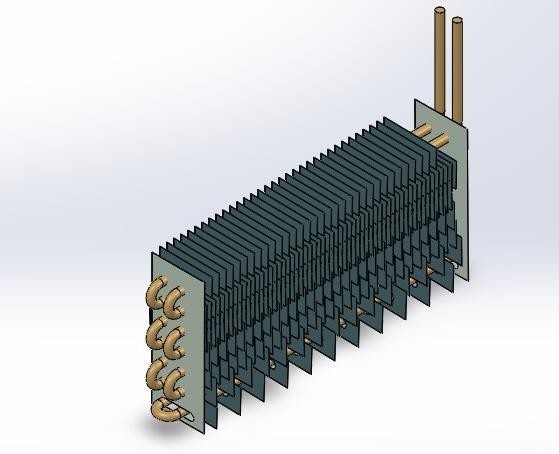
This paper presents a novel air conditioning system for Compressed Natural Gas (CNG)-fitted vehicles that overcomes the high fuel consumption of conventional belt-driven compressors. The system utilizes the Joule–Thomson effect of CNG expansion to generate cooling, captured through a heat exchanger and circulated via a blower, without adding engine load. CNG consumption was measured by recording the initial and final tank pressures and calculating the consumed gas mass based on tank volume and CNG density. Emissions were measured using a gas flow analyzer, with sensors placed in the vehicle’s silencer. Tests were conducted under identical conditions for both the conventional and the proposed air conditioning systems. The main objective of this project was to get a fuel-free air conditioning system in CNG-fitted vehicles. Experimental results show a significant cabin temperature drop to 11°C (284.15K) in 14 minutes (readings were noted by using digital multi meter having temperature sensor), improved fuel economy up to 25% as compared to conventional air conditioning system, and reduced emissions of CO₂ about 55% and CO about 30% (emissions reading were noted by using kane-458s gas flow analyzer). Car Consumption has been calculated by an indirect gravimetric (pressure-density-based) method used to estimate CNG fuel consumption. The findings confirm that the system is a technically feasible, low-cost, and sustainable alternative to conventional AC units for CNG vehicles, especially in hot climates.
References
S. Vashisht and D. Rakshit, “Recent advances and sustainable solutions in automobile air conditioning systems,” J. Clean. Prod., vol. 329, p. 129754, 2021, [Online]. Available: https://www.sciencedirect.com/science/article/abs/pii/S0959652621039305
Rui Hu, Xinyi Chen, “Exhaust emissions and energy conversion of hybrid and conventional CNG buses,” Transp. Res. Part D Transp. Environ., vol. 134, p. 1044055, 2024, [Online]. Available: https://www.sciencedirect.com/science/article/abs/pii/S1361920924003626
G. A. Daria Sachelarie, “Air Conditioning Systems in Vehicles: Approaches and Challenges,” Sustainability, vol. 17, no. 12, p. 5257, 2025, doi: https://doi.org/10.3390/su17125257.
A. N. Sina Nabati Shoghl, “Thermodynamic analysis and process optimization of a natural gas liquid recovery unit based on the Joule – Thomson process,” J. Nat. Gas Sci. Eng., vol. 96, p. 104265, 2021, doi: https://doi.org/10.1016/j.jngse.2021.104265.
N. Zhang and Y. Dai, “Performance evaluation of alternative refrigerants for R134a in automotive air conditioning system,” Asia-Pacific J. Chem. Eng., vol. 17, no. 1, Jan. 2022, doi: 10.1002/APJ.2732.
S. A. R. Han-Seop Song, “Innovative Pathways for Sustainable Automotive Air Conditioning Systems: A Comprehensive Review,” ResearchGate, 2025, doi: 10.20944/preprints202502.0728.v1.
“- IEA.” Accessed: Jan. 08, 2026. [Online]. Available: https://www.iea.org/data-and-statistics/data-product/natural-gas-information, Licence: Terms of Use for Non-CC Material
X. Yang et al., “Measurement report: Insight into greenhouse gas emission characteristics of light-duty vehicles in China in the context of technological innovation,” Atmos. Chem. Phys., vol. 25, no. 14, pp. 7669–7682, Jul. 2025, doi: 10.5194/ACP-25-7669-2025.
Marek Ja´skiewiczja´skiewicz, Zbigniew Matuszak, “Experimental Investigation of Performance and Emissions for a Hybrid Electric Vehicle Operating on Gasoline, CNG, and Dual Fuel over the WLTC,” Appl. Sci, vol. 15, no. 23, p. 12541, 2025, [Online]. Available: https://www.mdpi.com/2076-3417/15/23/12541
T. S. Roberto Gioria, “Regulated and unregulated emissions from Euro VI Diesel and CNG heavy-duty vehicles,” Transp. Res. Part D Transp. Environ., vol. 134, p. 104349, 2024, doi: https://doi.org/10.1016/j.trd.2024.104349.
J. N. Johannes Fichtner, “Simultaneous Reductions in NOx Emissions, Combustion Instability, and Efficiency Loss in a Lean-Burn CHP Engine via Hydrogen-Enriched Natural Gas,” Energies, vol. 18, no. 16, p. 4339, 2025, doi: https://doi.org/10.3390/en18164339.
M. K. Fatih Özcan, “Dynamic Modeling of a Compressed Natural Gas Refueling Station and Multi-Objective Optimization via Gray Relational Analysis Method,” Appl. Sci., vol. 15, no. 9, p. 4908, 2025, doi: https://doi.org/10.3390/app15094908.
Paolo Blecich, Laszlo Garbai, “Analysis of Thermodynamic Processes in Thermal Energy Storage Vessels,” Thermo, vol. 6, no. 1, p. 5, 2026, [Online]. Available: https://www.mdpi.com/2673-7264/6/1/5
S. A. Pradeep Vishnuram, “A critical review on alternative fuels for road transportation: Pollution mitigation, environment and economic perspective,” Energy Strateg. Rev., vol. 61, p. 101894, 2025, [Online]. Available: https://www.sciencedirect.com/science/article/pii/S2211467X25002573
Beatrice Pulvirenti, Giacomo Puccetti, “Dynamic Energy Consumption Modeling for HVAC Systems in Electric Vehicles,” Appl. Sci., vol. 15, no. 7, p. 3514, 20251, [Online]. Available: https://www.mdpi.com/2076-3417/15/7/3514
N. G. Mohamed Hofny, “The Impact of Alternative Fuels on the Performance and Emissions of Petrol Engines: A Review,” J. Adv. Res. Fluid Mech. Therm. Sci., 2024, [Online]. Available: https://semarakilmu.com.my/journals/index.php/fluid_mechanics_thermal_sciences/article/view/9600
Yousaf Ali, Ahsan Younus, “Compressed Natural Gas (CNG) as a fuel and the associated risks: A quantitative analysis in the scenario of a developing country,” J. Saf. Sci. Resil., vol. 5, no. 3, pp. 306–316, 2024, [Online]. Available: https://www.sciencedirect.com/science/article/pii/S2666449624000380
S. H. Medhat Elkelawy, M.M. Bassuoni, Hagar Alm ElDin Mohamad, “Effect of Dual-fuelled CNG and Gasoline on Spark Ignition engine performance and Emissions behaviors at different loads,” J. Eng. Res., 2024, doi: 10.70259/ENGJER.2024.861810.
Y. Liang, “A Review of the Effect of Compressed Natural Gas (CNG) on Combustion and Emission Performance of Internal Combustion Engines,” Trends Renew. Energy, vol. 8, no. 2, pp. 119–129, 2022, doi: 10.17737/tre.2022.8.2.00144.
V. S. Dmitry Stadnik, “Study on Stability of Gas Pressure Regulator with a Built-In Silencer,” Energies, vol. 16, no. 1, p. 372, 2023, [Online]. Available: https://www.mdpi.com/1996-1073/16/1/372
Bi Yu Chen, Qi Liu, “Evaluation of energy-environmental-economic benefits of CNG taxi policy using multi-task deep-learning-based microscopic models and big trajectory data,” Travel Behav. Soc., vol. 34, p. 100680, 2024, [Online]. Available: https://www.sciencedirect.com/science/article/abs/pii/S2214367X2300131X
Downloads
Published
How to Cite
Issue
Section
License
Copyright (c) 2025 50sea

This work is licensed under a Creative Commons Attribution 4.0 International License.