Water Quality Evaluation using Agentic AI
DOI:
https://doi.org/10.33411/IJIST/1895Keywords:
Water Quality, Agentic AI, Explainability, SHAP, LIMEAbstract
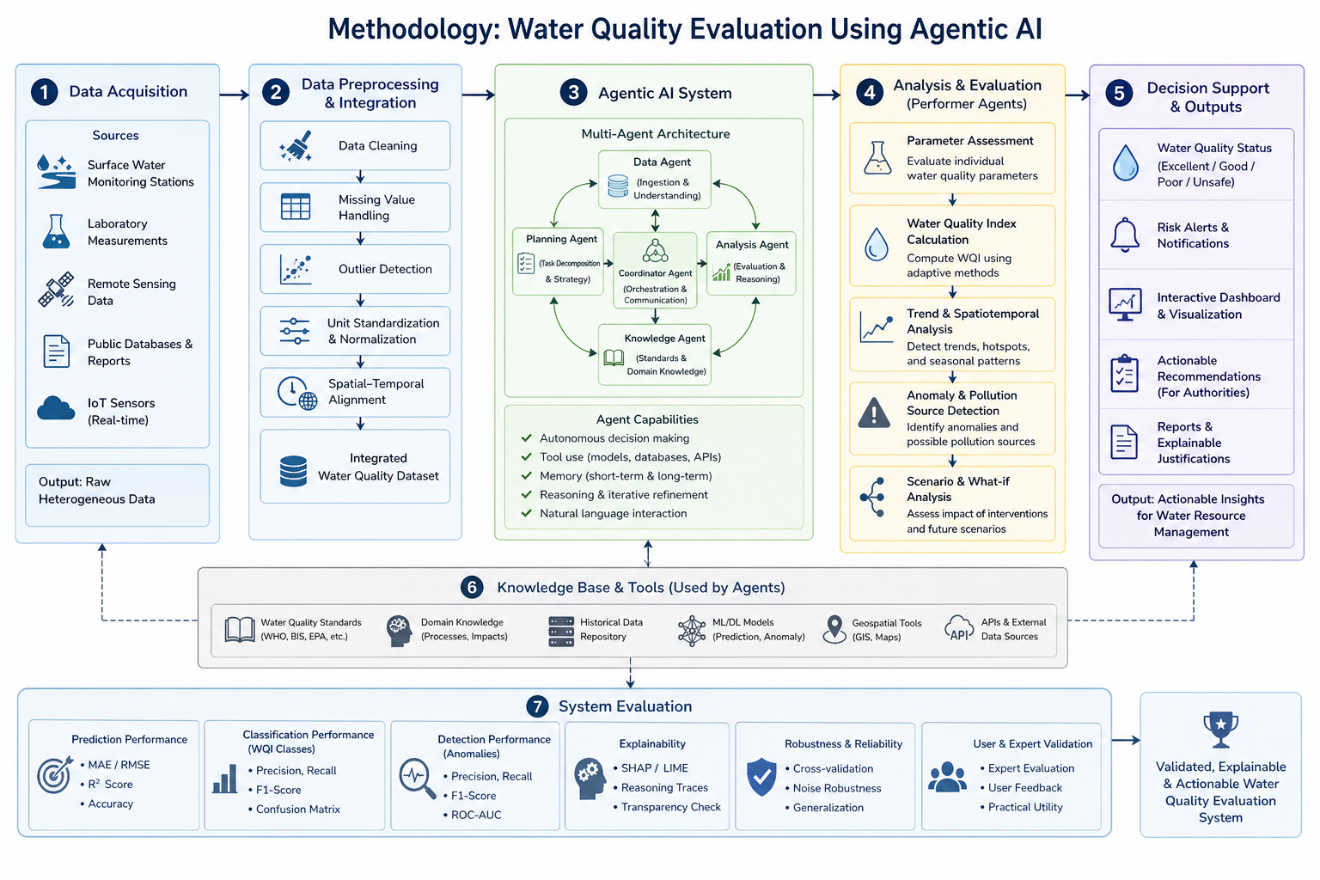
Water is the basic necessity of mankind and evaluation of water quality is highly significant for both environmental sustainability and public health. Traditional approaches applied for water quality analysis lack adaptability and interpretability and are unable to provide real-time assessments and informed decisions. In this paper, a unique framework has been presented to perform water quality analysis based on Agentic AI. The proposed approach combines Rule-Based WQI Calculations and Machine Learning methods, with multi-agent systems. The proposed system is composed of specialized agents, which include data agents, planning agents, analysis agents, knowledge agents, and coordination agents all working together to create a more intelligent and reliable system. The proposed framework was evaluated using a dataset containing 5,200 water quality samples collected from multiple monitoring locations, consisting of physicochemical parameters such as dissolved oxygen, turbidity, pH, temperature, and total dissolved solids (TDS). A stratified 80:20 train-test split along with 10-fold cross-validation was employed to ensure robustness and generalization of the model. Statistical analysis demonstrated that the proposed framework significantly outperformed traditional WQI and stand-alone machine learning models with an average improvement of 13.4% in classification accuracy and 11.2% in F1-score (p < 0.05).The experimental findings indicate high levels of accuracy (91%), and precision (0.89), and recall (0.88) compared with other current WQI-based or traditional stand-alone machine learning models (ROC AUC = 0.92), thus demonstrating the superiority of the proposed model over existing approaches. High classification accuracy and reliability has been achieved by utilizing domain knowledge from the knowledge agent, along with adaptive learning from the analysis agent. In addition, according to feature importance analysis, dissolved oxygen and turbidity have been identified as the two most important characteristics for the assessment of water quality. Finally, proposed framework has the provision of explainability through SHAP/LIME methods that not only makes it user-friendly but also makes it suitable for real-world environments while giving significant importance to transparency.
References
Stephen Mounce, Richard Mounce, “AI-Augmented Water Quality Event Response: The Role of Generative Models for Decision Support,” Water, vol. 17, no. 22, p. 3260, 2025, doi: https://doi.org/10.3390/w17223260.
Mengyuan Zhu, Jiawei Wang, “A review of the application of machine learning in water quality evaluation,” Eco-Environment Heal., vol. 1, no. 2, pp. 107–116, 2022, doi: https://doi.org/10.1016/j.eehl.2022.06.001.
D. V. V. Prasad et al., “Analysis and prediction of water quality using deep learning and auto deep learning techniques,” Sci. Total Environ., vol. 821, May 2022, doi: 10.1016/J.SCITOTENV.2022.153311.
Enas E. Hussein, Abdessamed Derdour, “Groundwater Quality Assessment and Irrigation Water Quality Index Prediction Using Machine Learning Algorithms,” Water, vol. 16, no. 2, p. 264, 2024, doi: https://doi.org/10.3390/w16020264.
Jian Wang, Guangtao Fu, “EPANET-Agentic: A multi-agent system for natural language-controlled simulations of water distribution networks,” Water Res., vol. 293, p. 125433, 2026, doi: https://doi.org/10.1016/j.watres.2026.125433.
“Integrating Conversational AI Agents for Enhanced Water Quality Analytics: Development of a Novel Data Expert System | Request PDF.” Accessed: May 20, 2026. [Online]. Available: https://www.researchgate.net/publication/381093006_Integrating_Conversational_AI_Agents_for_Enhanced_Water_Quality_Analytics_Development_of_a_Novel_Data_Expert_System
W. Zhi, A. P. Appling, H. E. Golden, J. Podgorski, and L. Li, “Deep learning for water quality,” Nat. Water 2024 23, vol. 2, no. 3, pp. 228–241, Mar. 2024, doi: 10.1038/s44221-024-00202-z.
Vasileios Alevizos, Zongliang Yue, “Multi-Agentic Water Health Surveillance,” Water, vol. 17, no. 17, p. 2653, 2025, doi: https://doi.org/10.3390/w17172653.
Tymoteusz Miller, Irmina Durlik, “Integrating Artificial Intelligence Agents with the Internet of Things for Enhanced Environmental Monitoring: Applications in Water Quality and Climate Data,” Electronics, vol. 14, no. 4, p. 696, 2025, doi: https://doi.org/10.3390/electronics14040696.
Rishi Rana, Anshul Kalia, “Artificial Intelligence for Surface Water Quality Evaluation, Monitoring and Assessment,” Water, vol. 15, no. 22, p. 3919, 2023, doi: https://doi.org/10.3390/w15223919.
Kyle T. Peterson, Vasit Sagan, “Deep learning-based water quality estimation and anomaly detection using Landsat-8/Sentinel-2 virtual constellation and cloud computing,” GIScience Remote Sens., vol. 57, no. 4, 2020, [Online]. Available: https://www.tandfonline.com/doi/full/10.1080/15481603.2020.1738061
Rodica Mihaela Frincu, “Artificial intelligence in water quality monitoring: A review of water quality assessment applications,” Water Qual. Res. J., vol. 60, no. 1, pp. 164–176, 2025, doi: https://doi.org/10.2166/wqrj.2024.049.
Ajay Bandi, Bhavani Kongari, “The Rise of Agentic AI: A Review of Definitions, Frameworks, Architectures, Applications, Evaluation Metrics, and Challenges,” Futur. Internet, vol. 17, no. 9, p. 404, 2025, doi: https://doi.org/10.3390/fi17090404.
S. Khullar and N. Singh, “Water quality assessment of a river using deep learning Bi-LSTM methodology: forecasting and validation,” Environ. Sci. Pollut. Res. 2021 299, vol. 29, no. 9, pp. 12875–12889, May 2021, doi: 10.1007/S11356-021-13875-W.
Mohammad Ehteram, Ali Najah Ahmed, “An advanced deep learning model for predicting water quality index,” Ecol. Indic., vol. 160, p. 111806, 2024, doi: https://doi.org/10.1016/j.ecolind.2024.111806.
Archana Solanki, Himanshu Agrawal, “Predictive Analysis of Water Quality Parameters using Deep Learning,” Int. J. Comput. Appl., vol. 125, no. 9, pp. 29–34, 2015, doi: 10.5120/ijca2015905874.
Ali Najah Ahmed, Faridah Binti Othman, “Machine learning methods for better water quality prediction,” J. Hydrol., 2019, doi: 10.1016/j.jhydrol.2019.124084.
A. Bhardwaj et al., “Smart IoT and Machine Learning-based Framework for Water Quality Assessment and Device Component Monitoring,” Environ. Sci. Pollut. Res. 2022 2930, vol. 29, no. 30, pp. 46018–46036, Feb. 2022, doi: 10.1007/S11356-022-19014-3.
Tiyasha, T. M. Tung, and Z. M. Yaseen, “Deep Learning for Prediction of Water Quality Index Classification: Tropical Catchment Environmental Assessment,” Nat. Resour. Res. 2021 306, vol. 30, no. 6, pp. 4235–4254, Aug. 2021, doi: 10.1007/S11053-021-09922-5.
Edoardo Borgomeo, Luke A. Holmes, “Diving into AI? Exploring the Potential for AI to Tackle Complex Water Quality Challenges,” Environ. Sci. Technol., vol. 16, no. 14, 2026, [Online]. Available: https://pubs.acs.org/doi/10.1021/acs.est.5c15991
H. Ghosh, M. A. Tusher, I. S. Rahat, S. Khasim, and S. N. Mohanty, “Water Quality Assessment Through Predictive Machine Learning,” Lect. Notes Networks Syst., vol. 699 LNNS, pp. 77–88, 2023, doi: 10.1007/978-981-99-3177-4_6/SAVE-RESEARCH.
S. Chopade, H. P. Gupta, R. Mishra, A. Oswal, P. Kumari, and T. Dutta, “A Sensors-Based River Water Quality Assessment System Using Deep Neural Network,” IEEE Internet Things J., vol. 9, no. 16, pp. 14375–14384, Aug. 2022, doi: 10.1109/JIOT.2021.3078892.
Randika K. Makumbura, Lakindu Mampitiya, “Advancing water quality assessment and prediction using machine learning models, coupled with explainable artificial intelligence (XAI) techniques like shapley additive explanations (SHAP) for interpreting the black-box nature,” Results Eng., vol. 23, p. 102831, 2024, [Online]. Available: https://www.sciencedirect.com/science/article/pii/S2590123024010867
Varsha Lakshmikantha, Anjitha Hiriyannagowda, “IoT based smart water quality monitoring system,” Glob. Transitions Proc., vol. 2, no. 2, pp. 181–186, 2021, doi: https://doi.org/10.1016/j.gltp.2021.08.062.
Abhilash M. Nair, “Integration of Internet of Things with artificial intelligence and biological wastewater treatment plants,” Digit. Biol. Wastewater Treat. Plants, pp. 119–142, 2026, doi: https://doi.org/10.1016/B978-0-443-31424-7.00002-2.
P. Sharma, A. Sharma, and P. Ahluwalia, “Future Trends: AI Driven Innovation in Environmental Science,” Microplastic Monit. Using Artif. Intell., pp. 267–291, Jan. 2026, doi: 10.1002/9781394450114.CH13.
“(PDF) AI-Based Early Warning Systems for Industrial Stormwater Exceedances: A Data-Driven Approach to Regulatory Compliance and Environmental Protection.” Accessed: May 20, 2026. [Online]. Available: https://www.researchgate.net/publication/404266432_AI-Based_Early_Warning_Systems_for_Industrial_Stormwater_Exceedances_A_Data-Driven_Approach_to_Regulatory_Compliance_and_Environmental_Protection
Jerome G. Gacu, Cris Edward F. Monjardin, “Artificial Intelligence (AI) in Surface Water Management: A Comprehensive Review of Methods, Applications, and Challenges,” Water, vol. 17, no. 11, p. 1707, 2025, doi: https://doi.org/10.3390/w17111707.
Downloads
Published
How to Cite
Issue
Section
License
Copyright (c) 2026 50sea

This work is licensed under a Creative Commons Attribution 4.0 International License.