Digital Cardiology: ECG-Based Arrhythmia Detection Using 3D Convolutional Neural Networks
Keywords:
ECG, 3D-CNN, Arrhythmia Detection, Deep Learning, Cardiac SignalsAbstract
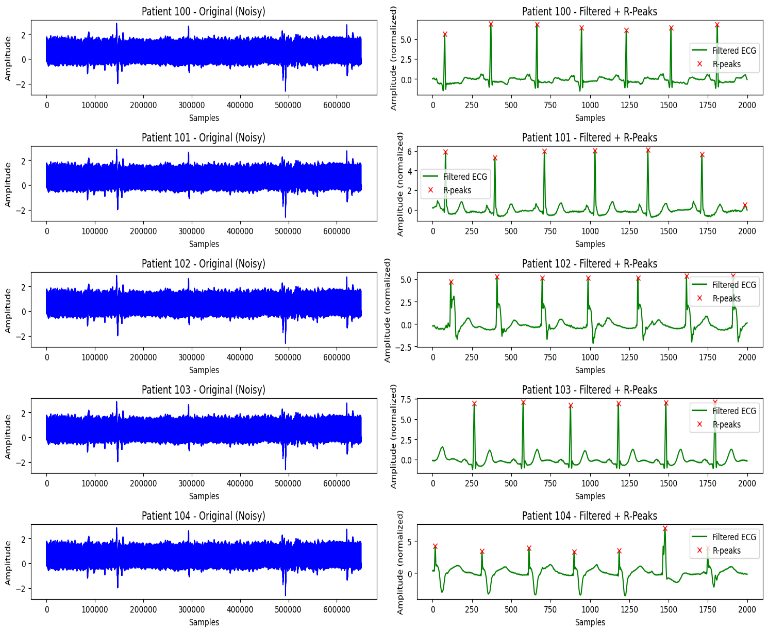
Cardiovascular diseases prove to be a prominent cause of worldwide deaths, and arrhythmias specifically remain a serious threat owing to their unexpected and painless characteristics. This paper presents an ECG-based arrhythmia detection system using a three-dimensional convolutional neural network, or 3D-CNN, architecture. The ECG signals obtained from the MIT/BIH Arrhythmia Database undergo preprocessing techniques like band-pass filtering, R-peak detection by the Pan and Tompkins algorithm, heartbeat segmentation, and volume representation of the heartbeat. The data is divided into training, validation, and testing sets, where 80% of the data is utilized for training and validation, and the remaining 20% for testing independently. The efficiency of the system is tested by accuracy, precision, recall, and F1-score. The proposed system records a validation accuracy of 98.52% and a test accuracy of 98.74%, which is superior to the previously used accuracy of the same database by the 1D CNN and 2D CNN architectures.
References
T. B. S. & A. L. P. R. Antônio H. Ribeiro, Manoel Horta Ribeiro, Gabriela M. M. Paixão, Derick M. Oliveira, Paulo R. Gomes, Jéssica A. Canazart, Milton P. S. Ferreira, Carl R. Andersson, Peter W. Macfarlane, Wagner Meira Jr., “Automatic diagnosis of the 12-lead ECG using a deep neural network,” Nat. Commun., 2020, doi: https://doi.org/10.1038/s41467-020-15432-4.
J. S. L. Donghyeon Kim, Kyoung Ryul Lee, Dong Seok Lim, Kwang Hyun Lee, “A novel hybrid CNN-transformer model for arrhythmia detection without R-peak identification using stockwell transform,” Sci. Reports Vol., vol. 15, 2025, [Online]. Available: https://www.nature.com/articles/s41598-025-92582-9
T. M. Patrick Wagner, “Explaining deep learning for ECG analysis: Building blocks for auditing and knowledge discovery,” Comput. Biol. Med., 2024, [Online]. Available: https://pubmed.ncbi.nlm.nih.gov/38749322/
X. Y. Fahad Khan, “ECG classification using 1-D convolutional deep residual neural network,” PLoS One, 2023, [Online]. Available: https://journals.plos.org/plosone/article?id=10.1371/journal.pone.0284791
Aymane Edder, Fatima Ezzahraa Ben-Bouazza, “Self Attention-Driven ECG Denoising: A Transformer-Based Approach for Robust Cardiac Signal Enhancement,” Signals, vol. 6, no. 2, p. 26, 2025, [Online]. Available: https://www.mdpi.com/2624-6120/6/2/26
Yaqoob Ansari, Omar Mourad, “Deep learning for ECG Arrhythmia detection and classification: an overview of progress for period 2017–2023,” Front. Physiol., 2023, [Online]. Available: https://www.frontiersin.org/journals/physiology/articles/10.3389/fphys.2023.1246746/full
M. L. Xin Zhang, “MSFT: A multi-scale feature-based transformer model for arrhythmia classification,” Biomed. Signal Process. Control, vol. 100, p. 106968, 2025, [Online]. Available: https://www.sciencedirect.com/science/article/abs/pii/S1746809424010267
Y. W. Zhuozheng Wang, “Multi-branch GAT-GRU-transformer for explainable EEG-based finger motor imagery classification,” Front. Hum. Neurosci., vol. 19, 2025, [Online]. Available: https://www.frontiersin.org/journals/human-neuroscience/articles/10.3389/fnhum.2025.1599960/full
J. L. Myeonghun Lee, “ECG-GraphNet: Advanced arrhythmia classification based on graph convolutional networks,” Hear. Rhythm O2, vol. 6, no. 8, pp. 1199–1211, 2025, [Online]. Available: https://www.sciencedirect.com/science/article/pii/S266650182500162X
K. Tzevelekakis, Z. Stefanidi, and G. Margetis, “Real-Time Stress Level Feedback from Raw Ecg Signals for Personalised, Context-Aware Applications Using Lightweight Convolutional Neural Network Architectures,” Sensors 2021, Vol. 21, Page 7802, vol. 21, no. 23, p. 7802, Nov. 2021, doi: 10.3390/S21237802.
H. Z. T. Chen, Y. Sun, “Hybrid CNN–Transformer architecture for real-time ECG arrhythmia detection,” IEEE Sens. J., vol. 24, no. 3, pp. 4121–4132, 2024.
S. P. R. Banerjee, A. Mitra, “Explainable AI-enabled ECG arrhythmia detection using Grad-CAM,” IEEE Access, vol. 12, 2024.
S. R. Yuwei Wang, “Hybrid CNN-LSTM model for ECG-based arrhythmia detection in internet of medical things,” Discov. Internet Things, vol. 6, no. 7, 2026, [Online]. Available: https://link.springer.com/article/10.1007/s43926-025-00131-7
C. L. Jianqiang Hu, “A novel multimodal self-supervised framework for ECG arrhythmia classification,” Comput Biol Med, 2025, [Online]. Available: https://pubmed.ncbi.nlm.nih.gov/41056617/
B. C. Challagundla, “Advanced Neural Network Architecture for Enhanced Multi-Lead ECG Arrhythmia Detection through Optimized Feature Extraction,” arXiv:2404.15347, 2024, [Online]. Available: https://arxiv.org/abs/2404.15347
T. O. F. Conrad, Kuba Weimann, “Transfer learning for ECG classification,” Sci. Rep., 2021, [Online]. Available: https://www.nature.com/articles/s41598-021-84374-8
H. M. H. Daniel Mauricio Jimenez Gutierrez, “Application of federated learning techniques for arrhythmia classification using 12-lead ECG signals,” arXiv:2208.10993v3, 2024, [Online]. Available: https://arxiv.org/html/2208.10993v3
B. S. Vaishnavi, P. Nayak, R. Janapati, V. Trivedi, J. S. Naga Jyothi, and P. Jugge, “Ensemble Deep Learning Framework for Robust Arrhythmia Detection,” 2025 Third Int. Conf. Ind. 4.0 Technol., pp. 1–7, Sep. 2025, doi:10.1109/I4TECH64670.2025.11277843.
M. A. M. Shadhon Chandra Mohonta, “Electrocardiogram based arrhythmia classification using wavelet transform with deep learning model,” Sens. Bio-Sensing Res., vol. 37, p. 100502, 2022, [Online]. Available: https://www.sciencedirect.com/science/article/pii/S2214180422000319
S. H. A. Hassan, M. Amin, “Hybrid CNN with explainable AI for ECG arrhythmia diagnosis,” IEEE Access, vol. 12, pp. 21456–21468, 2024.
A. O. M. Mohammed Guhdar, “Advanced deep learning framework for ECG arrhythmia classification using 1D-CNN with attention mechanism,” Knowledge-Based Syst., vol. 315, p. 113301, 2025, [Online]. Available: https://www.sciencedirect.com/science/article/abs/pii/S095070512500348X
S. Kiranyaz, T. Ince, and M. Gabbouj, “Real-Time Patient-Specific ECG Classification by 1-D Convolutional Neural Networks,” IEEE Trans. Biomed. Eng., vol. 63, no. 3, pp. 664–675, Mar. 2016, doi: 10.1109/TBME.2015.2468589.
M. Dhilsath Fathima, S. Sithsabesan, K. Jayanthi, and S. U. Dhanyaa, “ACAC: Automatic Cardiac Arrhythmia Classification Based on 1D-Deep Resnet,” Proc. InC4 2024 - 2024 IEEE Int. Conf. Contemp. Comput. Commun., 2024, doi:10.1109/INC460750.2024.10649362.
A. I. Sunnia Ikram, “Transformer-based ECG classification for early detection of cardiac arrhythmias,” Front. Med., vol. 12, p. 1600855, 2025, [Online]. Available: https://pmc.ncbi.nlm.nih.gov/articles/PMC12411431/
Downloads
Published
How to Cite
Issue
Section
License
Copyright (c) 2025 50sea

This work is licensed under a Creative Commons Attribution 4.0 International License.