A Case-Based Evaluation of Quantum-Resistant Data Indexing Techniques for Blockchain Databases
DOI:
https://doi.org/10.33411/IJIST/1836Keywords:
Blockchain-Based Databases, Cryptographic Data Structures, Data Indexing Strategies, Post-Quantum Cryptography, Quantum-Resilient StorageAbstract
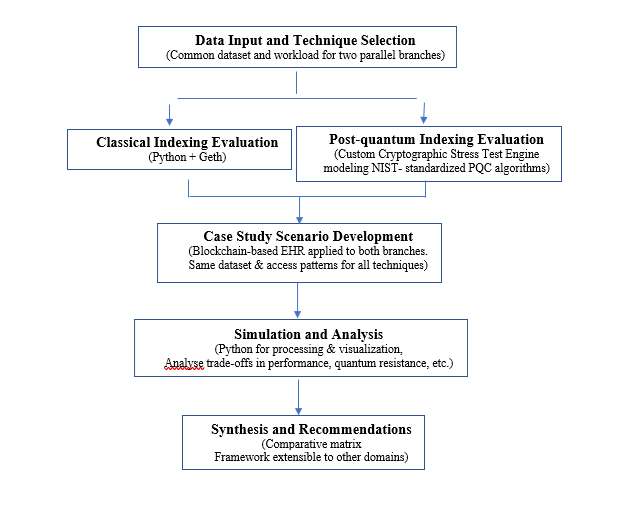
Blockchain architectures make extensive use of authenticated indexing structures, such as the Merkle Tree, for integrity and efficient retrieval of the data. However, the advent of quantum computing, in particular, through the use of Shor's and Grover's algorithms, poses a threat to classical cryptographic primitives (RSA, ECDSA, and SHA-256) on which these systems rely. While Post-Quantum Cryptography (PQC) is a solution, its integration introduces significant computational and storage overheads in terms of computation and storage, which remain underexplored in practical database environments. This research has a case study-based assessment of quantum-resistant indexing techniques in a simulated healthcare environment. This research compares a classical baseline using a private Go-Ethereum network against a custom Cryptographic Stress Test Engine modeling NIST-standardized PQC algorithms: Dilithium3 (Lattice-based), XMSS (Stateful Hash-based), and SPHINCS+ (Stateless Hash-based). Experiments were performed on a dataset of 10,000 Electronic Health Records (EHR) using resource-limited hardware to simulate a deployment in a developing infrastructure. Empirical findings show a crucial "storage explosion" in designs that are resistant to quantum computing. The classical ledger was 1.2 MB in size, the Dilithium3 increases storage by approximately 50× (1.2 MB to 62.8 MB) and SPHINCS+ by 270x (up to 325.9 MB). In terms of indexing latency, Dilithium3 was a nice middle ground option (13.10s), while SPHINCS+ exhibits higher computational cost (25.63s). The study concludes that stateless hash-based schemes are suitable for long-term archival security applications (e.g., degree verification) and lattice-based structures are more suitable for high-throughput systems, such as in real-time healthcare monitoring and national digital currencies.
References
M. A. Mansoor, M. Ali, A. Mateen, M. Kaleem, and S. Nazir, “Blockchain Technology for Land Registry Management in Developing Countries,” 2023 2nd Int. Conf. Emerg. Trends Electr. Control. Telecommun. Eng. ETECTE 2023 - Proc., 2023, doi: 10.1109/ETECTE59617.2023.10396736.
Sabreen Ahmadjee, Carlos Mera-Gómez, “A Study on Blockchain Architecture Design Decisions and Their Security Attacks and Threats,” ACM Trans. Softw. Eng. Methodol., vol. 31, no. 2, pp. 1–45, 2022, [Online]. Available: https://dl.acm.org/doi/10.1145/3502740
Shi Dong, Khushnood Abbas, “Blockchain technology and application: an overview,” PeerJ Comput. Sci., vol. 9, 2023, [Online]. Available: https://www.researchgate.net/publication/376051976_Blockchain_technology_and_application_an_overview
G. M.Faruk Ahmed, Imran Hasan, “Enhancing e-KYC Security and Privacy: Harnessing Quantum Computing and Blockchain in Web 3.0,” Distrib. Ledger Technol., vol. 3, no. 4, pp. 1–23, 2024, [Online]. Available: https://dl.acm.org/doi/full/10.1145/3686166
Tiago M. Fernandez-Carames, Paula Fraga-Lamas, “Towards Post-Quantum Blockchain: A Review on Blockchain Cryptography Resistant to Quantum Computing Attacks,” IEEE Access, vol. 8, 2020, [Online]. Available: https://ieeexplore.ieee.org/document/8967098
Shuyun Shi, Debiao He, “Applications of blockchain in ensuring the security and privacy of electronic health record systems: A survey,” Comput. Secur., 2020, [Online]. Available: https://pubmed.ncbi.nlm.nih.gov/32834254/
D. Commey, S. G. Hounsinou, and G. V. Crosby, “Post-Quantum Secure Blockchain-Based Federated Learning Framework for Healthcare Analytics,” IEEE Netw. Lett., vol. 7, no. 2, pp. 126–129, 2025, doi: 10.1109/LNET.2025.3563434.
Pooja Dhiman, Santosh Kumar Henge, “Blockchain Merkle-Tree Ethereum Approach in Enterprise Multitenant Cloud Environment,” Comput. Mater. Contin., vol. 74, no. 2, pp. 3297–3313, 2022, doi: https://doi.org/10.32604/cmc.2023.030558.
H. Liu, X. Luo, H. Liu, and X. Xia, “Merkle Tree: A Fundamental Component of Blockchains,” 2021 Int. Conf. Electron. Inf. Eng. Comput. Sci. EIECS 2021, pp. 556–561, Sep. 2021, doi: 10.1109/EIECS53707.2021.9588047.
Ralph C. Merkle, “A Certified Digital Signature,” Adv. Cryptol. — CRYPTO’ 89 Proc., 2001, [Online]. Available: https://link.springer.com/chapter/10.1007/0-387-34805-0_21
Rongjie Zhou, Huaqun Guo, “Investigating Post-Quantum Cryptography to Secure Transmitted Data via Mobile Communication,” Electronics, vol. 15, no. 6, p. 1257, 2026, doi: https://doi.org/10.3390/electronics15061275.
S. Mishra, O. Agarwal, and S. K. Patel, “Quantum Decryption using Shor’s Algorithm,” 2024 IEEE Pune Sect. Int. Conf. PuneCon 2024, 2024, doi: 10.1109/PuneCon63413.2024.10895777.
S. K. Shandilya, C. Ganguli, A. Kumar, I. Izonin and M. Gregus, “Post-Quantum Cryptography and Nature-Inspired Cyber Defense: Strategic Readiness and Adaptive Techniques for Next-Gen Threat Response,” IEEE Access, vol. 14, pp. 27418–27434, 2026, doi: 10.1109/ACCESS.2026.3663832.
L. K. Grover, “A fast quantum mechanical algorithm for database search,” Proc. Annu. ACM Symp. Theory Comput., 1996, [Online]. Available: https://dl.acm.org/doi/10.1145/237814.237866
Richard Preston, “Applying Grover’s Algorithm to Hash Functions: A Software Perspective,” arXiv:2202.10982, 2022, [Online]. Available: https://arxiv.org/abs/2202.10982
Daniel J. Bernstein, Daira Hopwood, Andreas Hülsing, Tanja Lange, Ruben Niederhagen, “SPHINCS: Practical Stateless Hash-Based Signatures,” Adv. Cryptol. -- EUROCRYPT 2015, 2015, [Online]. Available: https://link.springer.com/chapter/10.1007/978-3-662-46800-5_15
J. Di, T. Xie, S. Fan, W. Jia, and S. Fu, “An Anti-Quantum Signature Scheme over Ideal Lattice in Blockchain,” Proc. - 2020 Int. Symp. Comput. Eng. Intell. Commun. ISCEIC 2020, pp. 218–226, Aug. 2020, doi: 10.1109/ISCEIC51027.2020.00054.
M. Ma, X. Ji, and J. Cai, “A Configurable XMSS Post-Quantum Hardware Implementation with SM3 and SHA-256,” 2024 4th Int. Conf. Commun. Technol. Inf. Technol. ICCTIT 2024, pp. 220–225, 2024, doi: 10.1109/ICCTIT64404.2024.10928459.
“Status Report on the First Round of the Additional Digital Signature Schemes for the NIST Post-Quantum Cryptography Standardization Process | NIST.” Accessed: Mar. 31, 2026. [Online]. Available: https://www.nist.gov/publications/status-report-first-round-additional-digital-signature-schemes-nist-post-quantum
S. Abbas, A. Sultana, and G. Kaddoum, “Quantum-Safe Blockchain in Hyperledger Fabric,” IEEE Netw. Lett., vol. 7, no. 1, pp. 61–65, 2025, doi: 10.1109/LNET.2024.3522966.
G. J. W. Kathrine, P. Krittikka, I. Johnraja, S. Kirubakaran, S. Salaja, and K. Arunkumar, “Enhancing Smart Grid Security with XMSS-Based Blockchain Technology,” 1st Int. Conf. Emerg. Res. Comput. Sci. ICERCS 2023 - Proc., 2023, doi: 10.1109/ICERCS57948.2023.10433959.
Jonathan Lopez-Valdivieso, Rene Cumplido, “Design and Implementation of Hardware-Software Architecture Based on Hashes for SPHINCS+,” ACM Trans. Reconfigurable Technol. Syst., vol. 17, no. 4, 2024, [Online]. Available: https://dl.acm.org/doi/10.1145/3653459
Liqun Chen, Changyu Dong, “Sphinx-in-the-Head: Group Signatures from Symmetric Primitives,” Cryptol. ePrint Arch., 2024, [Online]. Available: https://eprint.iacr.org/2024/649
L. Mu, M. Lv, S. Wang, and H. Cao, “A Hybrid Index-Based Block Construction and Retrieval Algorithm for Efficient Data Retrieval on Blockchain,” 2024 4th Int. Conf. Comput. Sci. Blockchain, CCSB 2024, pp. 487–491, 2024, doi: 10.1109/CCSB63463.2024.10735653.
Lily Chen, Stephen Jordan, Yi-Kai Liu, Dustin Moody, Rene Peralta, Ray Perlner, Daniel Smith-Tone, “Report on Post-Quantum Cryptography,” Natl. Inst. Stand. Technol., 2016, [Online]. Available: https://nvlpubs.nist.gov/nistpubs/ir/2016/nist.ir.8105.pdf
Divesh Aggarwal, Gavin K. Brennen, Troy Lee, Miklos Santha, Marco Tomamichel, “Quantum attacks on Bitcoin, and how to protect against them,” arXiv:1710.10377, 2017, [Online]. Available: https://arxiv.org/abs/1710.10377
R. Roman, R. Arjona, J. Arcenegui, and I. Baturone, “Hardware Security for eXtended Merkle Signature Scheme Using SRAM-based PUFs and TRNGs,” Proc. Int. Conf. Microelectron. ICM, vol. 2020-December, Dec. 2020, doi: 10.1109/ICM50269.2020.9331821.
“A Performance Comparison of Post-Quantum Algorithms in Blockchain.” Accessed: Mar. 31, 2026. [Online]. Available: https://www.researchgate.net/publication/367589436_A_Performance_Comparison_of_Post-Quantum_Algorithms_in_Blockchain
“(PDF) Developing Hybrid Cryptographic Primitives for Quantum- Resistant Blockchain Technologies.” Accessed: Mar. 31, 2026. [Online]. Available: https://www.researchgate.net/publication/392082360_Developing_Hybrid_Cryptographic_Primitives_for_Quantum-_Resistant_Blockchain_Technologies
M. Ranjani, S. Pandey, A. Gattani, A. Choudhary, M. Gupta, and G. K. Sandhia, “Quantum Attacks on Blockchain and Mitigation Strategies,” Proc. 8th Int. Conf. Trends Electron. Informatics, ICOEI 2025, pp. 679–685, 2025, doi: 10.1109/ICOEI65986.2025.11013287.
S. K. L. P. V. Abha Naik, Esra Yeniaras, Gerhard Hellstern, Grishma Prasad, “From Portfolio Optimization to Quantum Blockchain and Security: A Systematic Review of Quantum Computing in Finance,” arXiv:2307.01155, 2023, [Online]. Available: https://arxiv.org/abs/2307.01155
W. Yang, X. Dai, J. Xiao and H. Jin, “LDV: A Lightweight DAG-Based Blockchain for Vehicular Social Networks,” IEEE Trans. Veh. Technol., vol. 69, no. 6, 2020, doi: 10.1109/TVT.2020.2963906.
Longbo Han, Gengran Hu, “A Novel Lattice-Based Blockchain Infrastructure and Its Application on Trusted Data Management,” IEEE Trans. Netw. Sci. Eng., vol. 12, no. 4, 2025, [Online]. Available: https://ieeexplore.ieee.org/document/10922084
Downloads
Published
How to Cite
Issue
Section
License
Copyright (c) 2026 50sea

This work is licensed under a Creative Commons Attribution 4.0 International License.